QUESTION IMAGE
Question
question 4
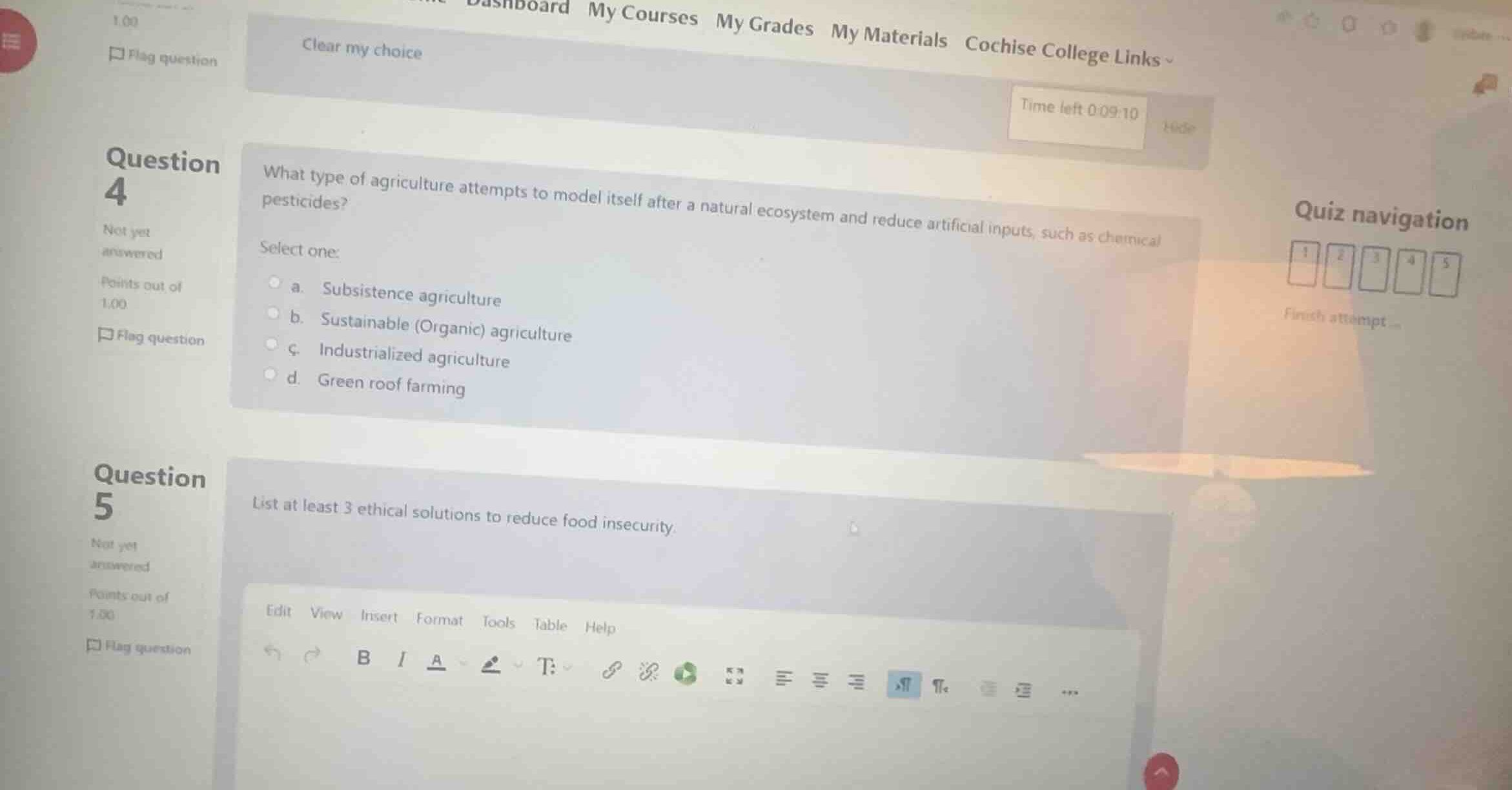
what type of agriculture attempts to model itself after a natural ecosystem and reduce artificial inputs, such as chemical pesticides?
select one:
a. subsistence agriculture
b. sustainable (organic) agriculture
c. industrialized agriculture
d. green roof farming
question 5
list at least 3 ethical solutions to reduce food insecurity.
Analyze Question 4
This question asks for the type of agriculture that models itself after natural ecosystems and reduces artificial inputs like chemical pesticides.
- Subsistence agriculture focuses on growing enough food to feed oneself and one's family, with little or no surplus for trade.
- Sustainable (Organic) agriculture emphasizes ecological balance, mimicking natural systems, and minimizing synthetic inputs like chemical fertilizers and pesticides.
- Industrialized agriculture relies heavily on large-scale monoculture, synthetic fertilizers, and chemical pesticides.
- Green roof farming is a specific urban agricultural practice of growing food on building roofs, not a broad agricultural system modeled after natural ecosystems.
Therefore, the correct choice is b. Sustainable (Organic) agriculture.
Analyze Question 5
This question asks for at least 3 ethical solutions to reduce food insecurity. Food insecurity is a complex socio-environmental challenge. Ethical solutions should focus on equity, human rights, sustainability, and reducing waste.
- Reducing Food Waste and Improving Distribution: Ensuring that surplus food from retailers, restaurants, and farms is redirected to communities in need rather than ending up in landfills.
- Supporting Local and Sustainable Farming: Empowering small-scale local farmers through fair wages, resources, and sustainable practices to build resilient local food systems.
- Implementing Social Safety Nets and Policy Reforms: Expanding programs like food assistance, community kitchens, and school meal initiatives, while addressing systemic poverty to ensure food is treated as a basic human right.

Snap & solve any problem in the app
Get step-by-step solutions on Sovi AI
Photo-based solutions with guided steps
Explore more problems and detailed explanations
Question 4
- a. Subsistence agriculture
- b. Sustainable (Organic) agriculture (Correct answer)
- c. Industrialized agriculture
- d. Green roof farming
Question 5
- Reduce Food Waste and Improve Redistribution: Establish efficient networks to redirect surplus food from supermarkets, farms, and restaurants to food banks and community kitchens, ensuring edible food does not go to waste.
- Support Small-Scale and Local Sustainable Agriculture: Invest in local community gardens, urban farming, and smallholder farmers by providing fair wages, resources, and training in ecological farming methods to enhance local food sovereignty.
- Strengthen Social Safety Nets and Policy Reforms: Expand public food assistance programs, school lunch initiatives, and living wage policies to address the root economic causes of hunger and ensure equitable access to nutritious food.