QUESTION IMAGE
Question
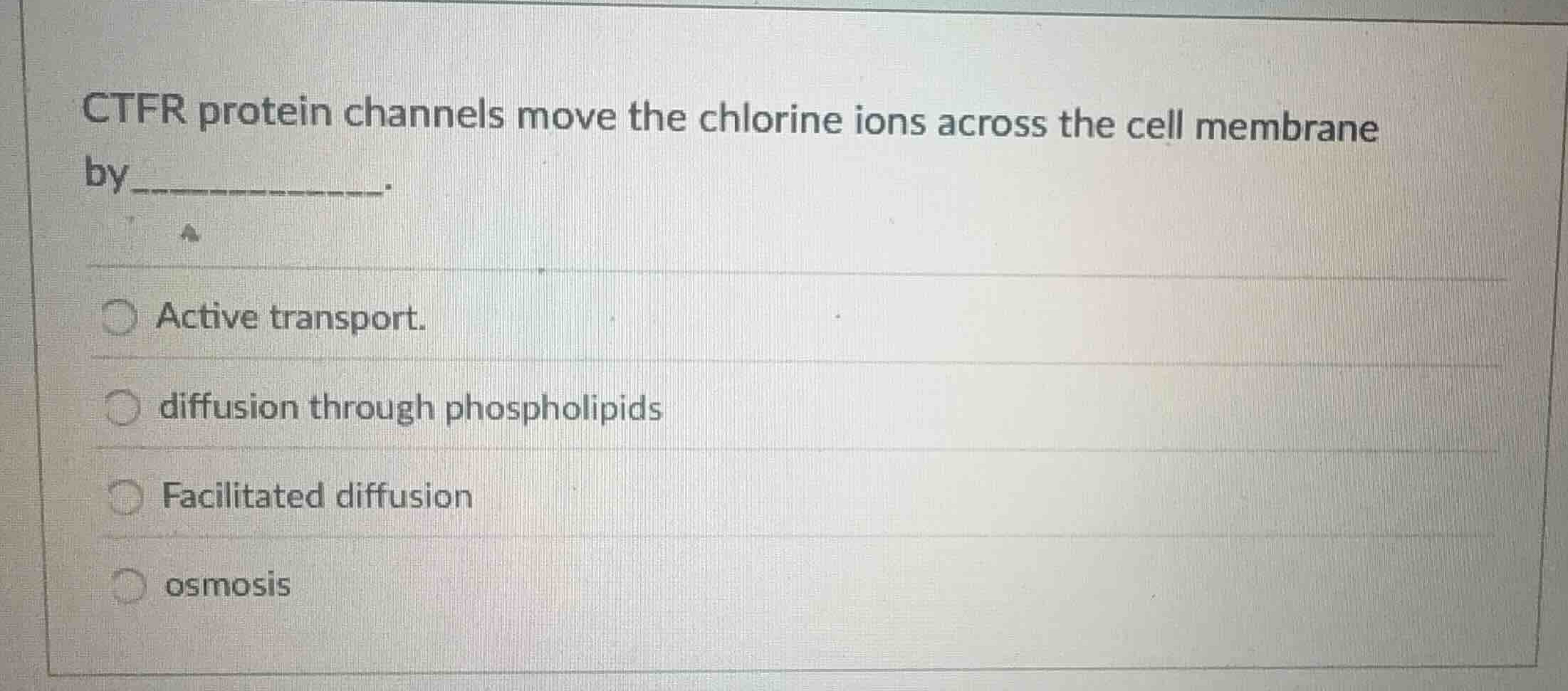
ctfr protein channels move the chlorine ions across the cell membrane by ______.
- active transport.
- diffusion through phospholipids
- facilitated diffusion
- osmosis
🆕 New Concept Discovered: Membrane Transport Mechanisms
Moving molecules across membranes using helper proteins.
Step 1: Analyze the nature of the solute
Chlorine ions (\(\text{Cl}^-\)) are charged particles. Because they carry a charge, they are highly polar and cannot pass directly through the hydrophobic lipid bilayer (phospholipids) of the cell membrane on their own.
Step 2: Identify the transport helper
The question states that CTFR protein channels are used to move these ions. When a membrane protein assists in moving a substance down its concentration gradient without using cellular energy (ATP), the process is a form of passive transport.
Step 3: Match with the correct transport mechanism
- Active transport requires energy (ATP) to pump substances against their gradient. While the CFTR protein is an ABC transporter family member that binds ATP to open its gate, it functions physically as an ion channel allowing chloride ions to flow down their electrochemical gradient.
- Diffusion through phospholipids (simple diffusion) only works for small, nonpolar molecules.
- Facilitated diffusion is the passive movement of molecules or ions across a membrane via specific transmembrane integral proteins (like channels or carriers).
- Osmosis is specifically the diffusion of water molecules.
Since a channel protein is facilitating the movement of the ions down their gradient, this process is classified as Facilitated diffusion.

Snap & solve any problem in the app
Get step-by-step solutions on Sovi AI
Photo-based solutions with guided steps
Explore more problems and detailed explanations
Facilitated diffusion