QUESTION IMAGE
Question
question 4
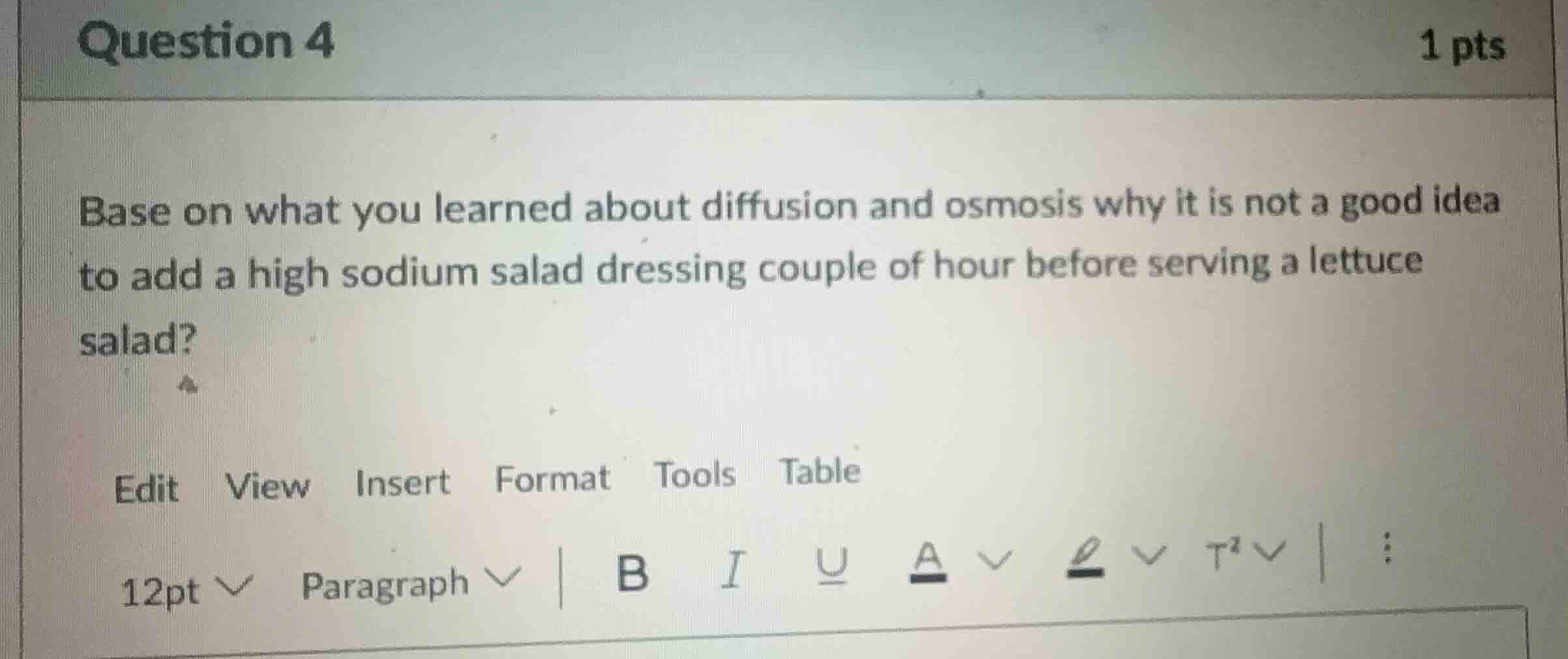
base on what you learned about diffusion and osmosis why it is not a good idea to add a high sodium salad dressing couple of hour before serving a lettuce salad?
🆕 New Concept Discovered: Osmosis and Tonicity
Water moves to balance solute concentrations.
Step 1: Identify the environment created by the dressing
A high-sodium salad dressing contains a high concentration of dissolved salt (solutes). When you pour this dressing over lettuce leaves, it creates a hypertonic environment outside the lettuce cells. This means the concentration of solutes is much higher outside the cells than it is inside the cells.
Step 2: Determine the direction of water movement (Osmosis)
Osmosis is the movement of water molecules across a semipermeable membrane (like the plant cell membrane) from an area of lower solute concentration (inside the lettuce cells) to an area of higher solute concentration (outside in the dressing).
Because the dressing is hypertonic, water will naturally leave the lettuce cells and move into the dressing to try to balance the concentrations.
Step 3: Analyze the effect on the lettuce
As water exits the lettuce cells, the cells lose their internal water pressure (turgor pressure) that keeps them rigid and crisp. This loss of water causes the plant cells to shrink and collapse (plasmolysis), resulting in a soggy, wilted, and limp salad.

Snap & solve any problem in the app
Get step-by-step solutions on Sovi AI
Photo-based solutions with guided steps
Explore more problems and detailed explanations
Adding a high-sodium salad dressing hours before serving is a bad idea because it creates a hypertonic environment outside the lettuce cells. Through the process of osmosis, water moves out of the lettuce cells (where solute concentration is lower) and into the dressing (where solute concentration is higher). This loss of water decreases the cells' turgor pressure, causing the lettuce to wilt, lose its crispness, and become soggy.