QUESTION IMAGE
Question
question 9 of 10
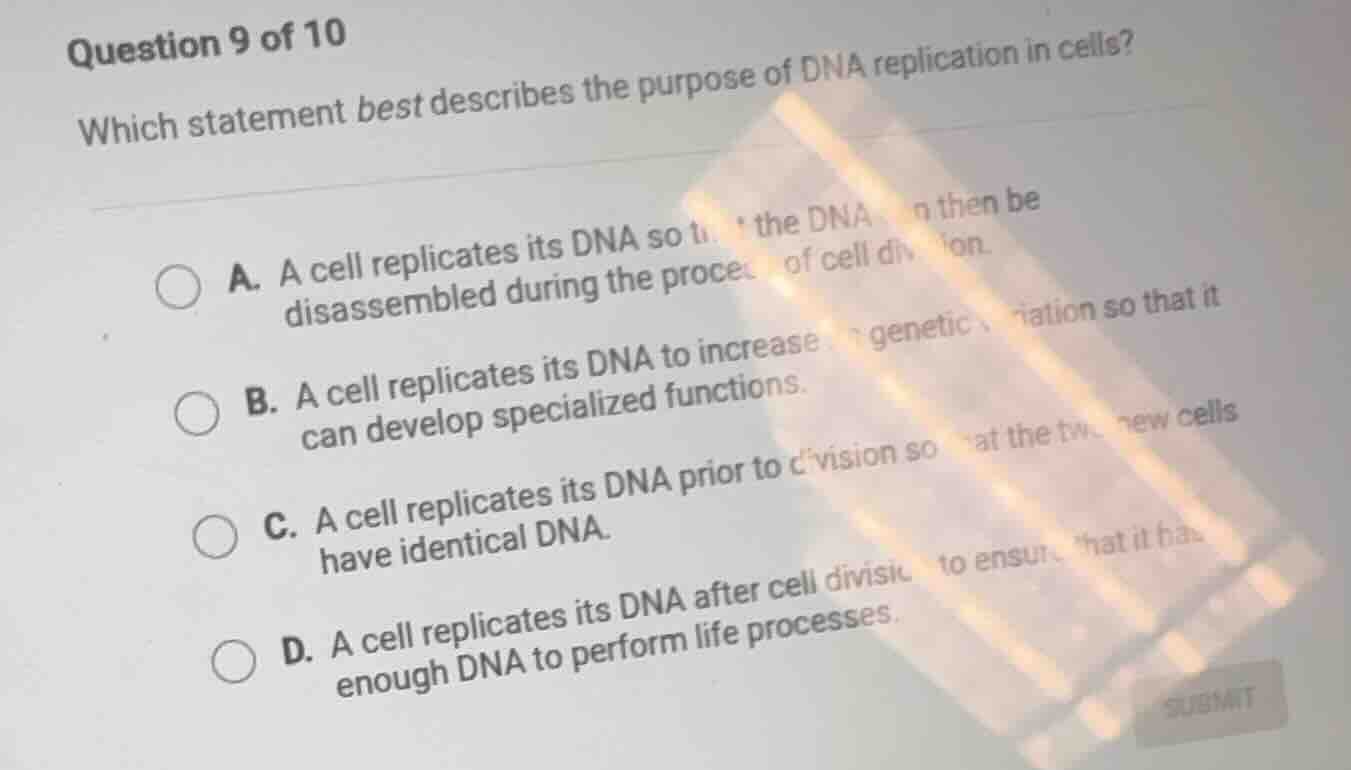
which statement best describes the purpose of dna replication in cells?
a. a cell replicates its dna so that the dna can then be disassembled during the process of cell division.
b. a cell replicates its dna to increase genetic variation so that it can develop specialized functions.
c. a cell replicates its dna prior to division so that the two new cells have identical dna.
d. a cell replicates its dna after cell division to ensure that it has enough dna to perform life processes.
Analyze the question
The question asks for the statement that best describes the purpose of DNA replication in cells.
Evaluate Option A
Option A suggests DNA is replicated so it can be disassembled during cell division. This is incorrect because DNA is preserved and distributed, not disassembled.
Evaluate Option B
Option B states replication increases genetic variation for specialization. This is incorrect; DNA replication is highly accurate to copy genetic material exactly, while variation comes from other processes.
Evaluate Option C
Option C states a cell replicates its DNA prior to division so that the two new cells have identical DNA. This aligns with the core purpose of Cellular Division, ensuring genetic continuity.
Evaluate Option D
Option D suggests replication occurs after cell division. This is incorrect because replication must occur before division (during S phase of interphase) so each daughter cell receives a copy.

Snap & solve any problem in the app
Get step-by-step solutions on Sovi AI
Photo-based solutions with guided steps
Explore more problems and detailed explanations
- (A) A cell replicates its DNA so that the DNA can then be disassembled during the process of cell division.
- (B) A cell replicates its DNA to increase genetic variation so that it can develop specialized functions.
- (C) A cell replicates its DNA prior to division so that the two new cells have identical DNA. (Correct answer)
- (D) A cell replicates its DNA after cell division to ensure that it has enough DNA to perform life processes.