QUESTION IMAGE
Question
question 9 of 10
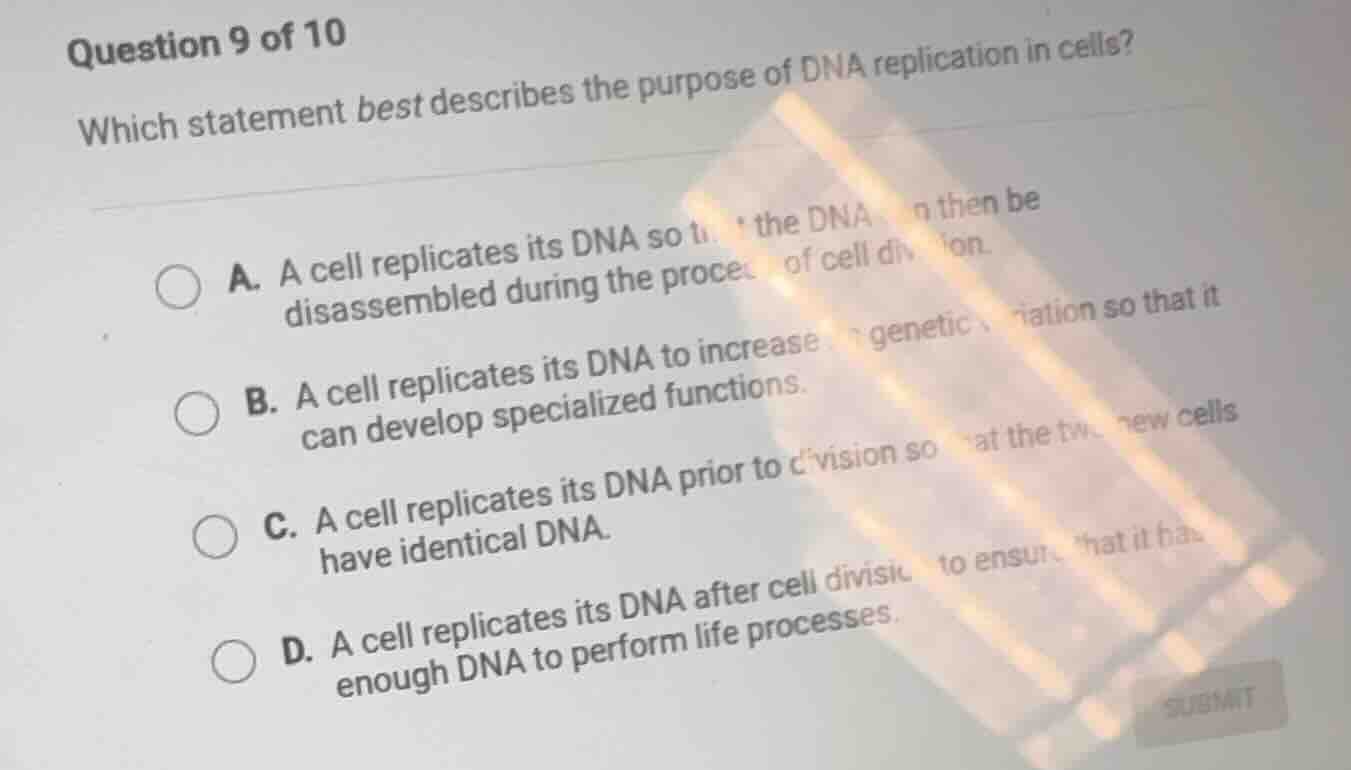
which statement best describes the purpose of dna replication in cells?
a. a cell replicates its dna so that the dna can then be disassembled during the process of cell division.
b. a cell replicates its dna to increase genetic variation so that it can develop specialized functions.
c. a cell replicates its dna prior to division so that the two new cells have identical dna.
d. a cell replicates its dna after cell division to ensure that it has enough dna to perform life processes.
<pre_analysis>
{
"quality": "clear",
"question_count": 1,
"skills_matched": [
"direct_cot",
"multiple_choice_formatter",
"explain_then_answer",
"tutor"
],
"needs_drawing": false,
"concepts_used": [
"Cellular Division"
],
"new_concepts": [
"DNA Replication Purpose"
],
"current_concepts": [
"Cellular Division",
"DNA Replication Purpose"
]
}
</pre_analysis>
<reasoning>
Analyze the question
The question asks for the statement that best describes the purpose of DNA replication in cells.
Evaluate Option A
Option A suggests DNA is replicated so it can be disassembled during cell division. This is incorrect because DNA is preserved and distributed, not disassembled.
Evaluate Option B
Option B states replication increases genetic variation for specialization. This is incorrect; DNA replication is highly accurate to copy genetic material exactly, while variation comes from other processes.
Evaluate Option C
Option C states a cell replicates its DNA prior to division so that the two new cells have identical DNA. This aligns with the core purpose of Cellular Division, ensuring genetic continuity.
Evaluate Option D
Option D suggests replication occurs after cell division. This is incorrect because replication must occur before division (during S phase of interphase) so each daughter cell receives a copy.
</reasoning>
<answer>
<mcq-option>(A) A cell replicates its DNA so that the DNA can then be disassembled during the process of cell division.</mcq-option>
<mcq-option>(B) A cell replicates its DNA to increase genetic variation so that it can develop specialized functions.</mcq-option>
<mcq-correct>(C) A cell replicates its DNA prior to division so that the two new cells have identical DNA.</mcq-correct>
<mcq-option>(D) A cell replicates its DNA after cell division to ensure that it has enough DNA to perform life processes.</mcq-option>
</answer>
<post_analysis>
{
"subject": "Natural Science",
"question_type": "Multiple Choice",
"knowledge_point": [
"Natural Science",
"Biology",
"DNA Replication Purpose"
]
}
</post_analysis>
Snap & solve any problem in the app
Get step-by-step solutions on Sovi AI
Photo-based solutions with guided steps
Explore more problems and detailed explanations
<pre_analysis>
{
"quality": "clear",
"question_count": 1,
"skills_matched": [
"direct_cot",
"multiple_choice_formatter",
"explain_then_answer",
"tutor"
],
"needs_drawing": false,
"concepts_used": [
"Cellular Division"
],
"new_concepts": [
"DNA Replication Purpose"
],
"current_concepts": [
"Cellular Division",
"DNA Replication Purpose"
]
}
</pre_analysis>
<reasoning>
Analyze the question
The question asks for the statement that best describes the purpose of DNA replication in cells.
Evaluate Option A
Option A suggests DNA is replicated so it can be disassembled during cell division. This is incorrect because DNA is preserved and distributed, not disassembled.
Evaluate Option B
Option B states replication increases genetic variation for specialization. This is incorrect; DNA replication is highly accurate to copy genetic material exactly, while variation comes from other processes.
Evaluate Option C
Option C states a cell replicates its DNA prior to division so that the two new cells have identical DNA. This aligns with the core purpose of Cellular Division, ensuring genetic continuity.
Evaluate Option D
Option D suggests replication occurs after cell division. This is incorrect because replication must occur before division (during S phase of interphase) so each daughter cell receives a copy.
</reasoning>
<answer>
<mcq-option>(A) A cell replicates its DNA so that the DNA can then be disassembled during the process of cell division.</mcq-option>
<mcq-option>(B) A cell replicates its DNA to increase genetic variation so that it can develop specialized functions.</mcq-option>
<mcq-correct>(C) A cell replicates its DNA prior to division so that the two new cells have identical DNA.</mcq-correct>
<mcq-option>(D) A cell replicates its DNA after cell division to ensure that it has enough DNA to perform life processes.</mcq-option>
</answer>
<post_analysis>
{
"subject": "Natural Science",
"question_type": "Multiple Choice",
"knowledge_point": [
"Natural Science",
"Biology",
"DNA Replication Purpose"
]
}
</post_analysis>