QUESTION IMAGE
Question
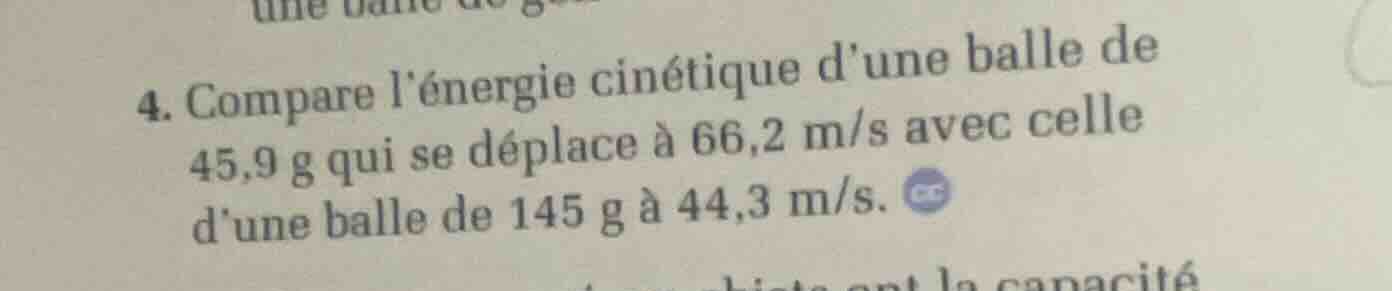
- compare lénergie cinétique dune balle de 45,9 g qui se déplace à 66,2 m/s avec celle dune balle de 145 g à 44,3 m/s.
Identify given values
We extract the mass and velocity for both objects:
- Ball 1: \(m_1 = 45.9\text{ g}\), \(v_1 = 66.2\text{ m/s}\)
- Ball 2: \(m_2 = 145\text{ g}\), \(v_2 = 44.3\text{ m/s}\)
Convert units to SI
Using Scientific Notation to convert grams to kilograms:
- \(m_1 = 45.9 \times 10^{-3}\text{ kg} = 0.0459\text{ kg}\)
- \(m_2 = 145 \times 10^{-3}\text{ kg} = 0.145\text{ kg}\)
Calculate kinetic energy of Ball 1
Using the kinetic energy formula \(E_k = \frac{1}{2}mv^2\):
Calculate kinetic energy of Ball 2
Using the kinetic energy formula \(E_k = \frac{1}{2}mv^2\):
Compare the kinetic energies
We find the ratio of the two kinetic energies:
The kinetic energy of the second ball is approximately \(1.41\) times that of the first ball.

Snap & solve any problem in the app
Get step-by-step solutions on Sovi AI
Photo-based solutions with guided steps
Explore more problems and detailed explanations
L'énergie cinétique de la première balle (\(45,9\text{ g}\) à \(66,2\text{ m/s}\)) est d'environ \(100,6\text{ J}\).
L'énergie cinétique de la deuxième balle (\(145\text{ g}\) à \(44,3\text{ m/s}\)) est d'environ \(142,3\text{ J}\).
La deuxième balle a une énergie cinétique environ \(1,41\) fois plus grande que la première.