QUESTION IMAGE
Question
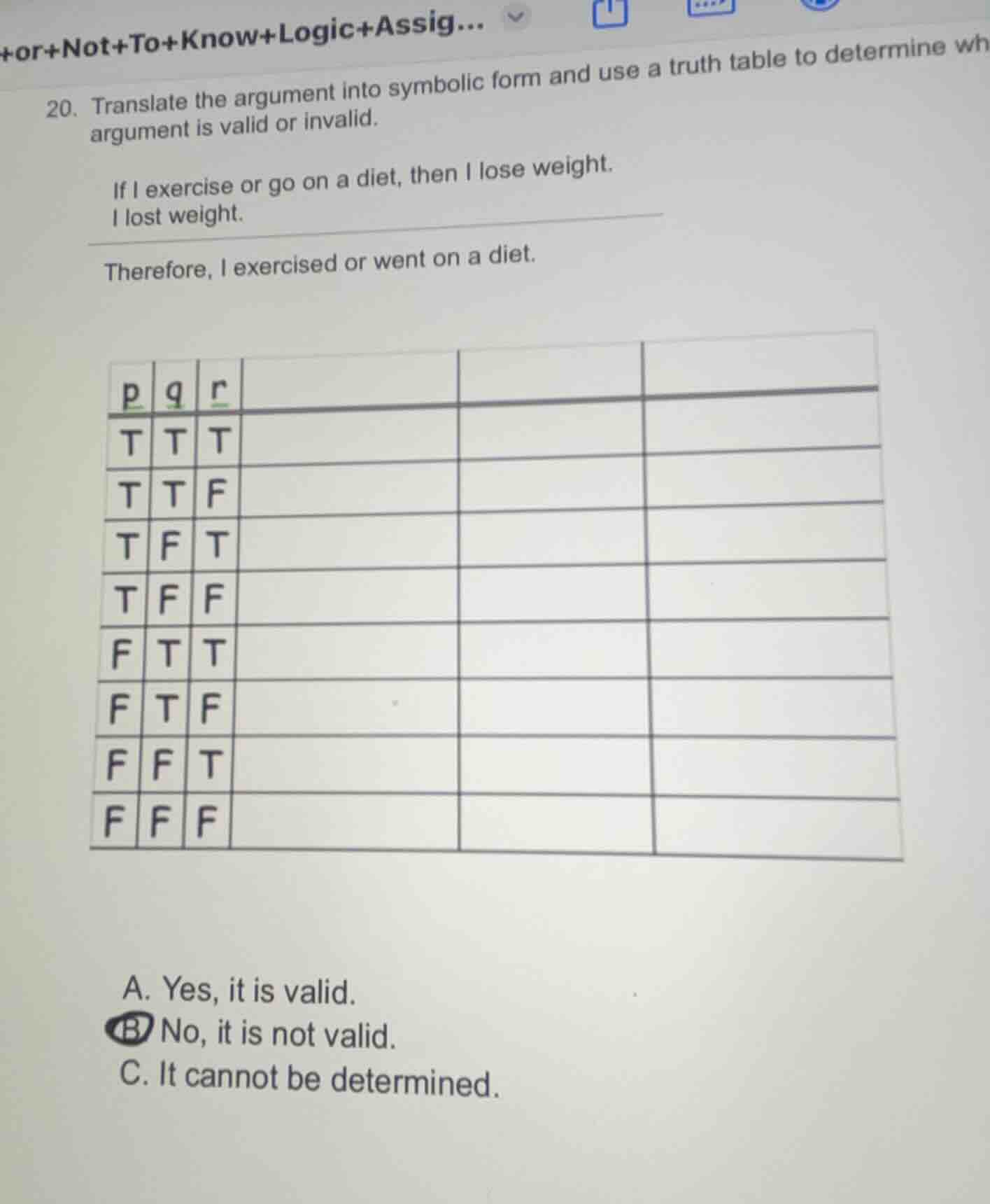
- translate the argument into symbolic form and use a truth table to determine whether the argument is valid or invalid.
if i exercise or go on a diet, then i lose weight.
i lost weight.
therefore, i exercised or went on a diet.
\
a. yes, it is valid.
b. no, it is not valid.
c. it cannot be determined.
<pre_analysis>
{
"quality": "clear",
"question_count": 1,
"skills_matched": [
"step_cot",
"multiple_choice_formatter",
"explain_then_answer",
"tutor",
"mastery_adaptive_brevity"
],
"needs_drawing": false,
"concepts_used": [
"Mathematical Logic",
"Truth Tables"
],
"new_concepts": [
"Argument Validity",
"Symbolic Translation"
],
"current_concepts": [
"Mathematical Logic",
"Truth Tables",
"Argument Validity",
"Symbolic Translation"
]
}
</pre_analysis>
<reasoning>
Define simple statements
Using the Mathematical Logic knowledge point
Let:
- \(p\): I exercise.
- \(q\): I go on a diet.
- \(r\): I lose weight.
Translate the argument
Using the Mathematical Logic knowledge point
- Premise 1: If I exercise or go on a diet, then I lose weight.
\[(p \lor q)
ightarrow r\]
- Premise 2: I lost weight.
\[r\]
- Conclusion: Therefore, I exercised or went on a diet.
\[p \lor q\]
Construct the truth table
Using the Truth Tables knowledge point
\[
\]
Evaluate argument validity
Using the Truth Tables knowledge point
- Critical rows where both premises \((p \lor q)
ightarrow r\) and \(r\) are True:
- Row 1: \(p=T, q=T, r=T\). Conclusion \(p \lor q = T\) (Valid).
- Row 3: \(p=T, q=F, r=T\). Conclusion \(p \lor q = T\) (Valid).
- Row 5: \(p=F, q=T, r=T\). Conclusion \(p \lor q = T\) (Valid).
- Row 7: \(p=F, q=F, r=T\). Conclusion \(p \lor q = F\) (Invalid).
- Since the conclusion is False in Row 7 while all premises are True, the argument is invalid.
</reasoning>
<answer>
<mcq-option>(A) Yes, it is valid.</mcq-option>
<mcq-correct>(B) No, it is not valid.</mcq-correct>
<mcq-option>(C) It cannot be determined.</mcq-option>
</answer>
<post_analysis>
{
"subject": "Mathematics",
"question_type": "Multiple Choice",
"knowledge_point": [
"Mathematics",
"Algebra",
"Mathematical Logic"
]
}
</post_analysis>
Snap & solve any problem in the app
Get step-by-step solutions on Sovi AI
Photo-based solutions with guided steps
Explore more problems and detailed explanations
<pre_analysis>
{
"quality": "clear",
"question_count": 1,
"skills_matched": [
"step_cot",
"multiple_choice_formatter",
"explain_then_answer",
"tutor",
"mastery_adaptive_brevity"
],
"needs_drawing": false,
"concepts_used": [
"Mathematical Logic",
"Truth Tables"
],
"new_concepts": [
"Argument Validity",
"Symbolic Translation"
],
"current_concepts": [
"Mathematical Logic",
"Truth Tables",
"Argument Validity",
"Symbolic Translation"
]
}
</pre_analysis>
<reasoning>
Define simple statements
Using the Mathematical Logic knowledge point
Let:
- \(p\): I exercise.
- \(q\): I go on a diet.
- \(r\): I lose weight.
Translate the argument
Using the Mathematical Logic knowledge point
- Premise 1: If I exercise or go on a diet, then I lose weight.
\[(p \lor q)
ightarrow r\]
- Premise 2: I lost weight.
\[r\]
- Conclusion: Therefore, I exercised or went on a diet.
\[p \lor q\]
Construct the truth table
Using the Truth Tables knowledge point
\[
\]
Evaluate argument validity
Using the Truth Tables knowledge point
- Critical rows where both premises \((p \lor q)
ightarrow r\) and \(r\) are True:
- Row 1: \(p=T, q=T, r=T\). Conclusion \(p \lor q = T\) (Valid).
- Row 3: \(p=T, q=F, r=T\). Conclusion \(p \lor q = T\) (Valid).
- Row 5: \(p=F, q=T, r=T\). Conclusion \(p \lor q = T\) (Valid).
- Row 7: \(p=F, q=F, r=T\). Conclusion \(p \lor q = F\) (Invalid).
- Since the conclusion is False in Row 7 while all premises are True, the argument is invalid.
</reasoning>
<answer>
<mcq-option>(A) Yes, it is valid.</mcq-option>
<mcq-correct>(B) No, it is not valid.</mcq-correct>
<mcq-option>(C) It cannot be determined.</mcq-option>
</answer>
<post_analysis>
{
"subject": "Mathematics",
"question_type": "Multiple Choice",
"knowledge_point": [
"Mathematics",
"Algebra",
"Mathematical Logic"
]
}
</post_analysis>