QUESTION IMAGE
Question
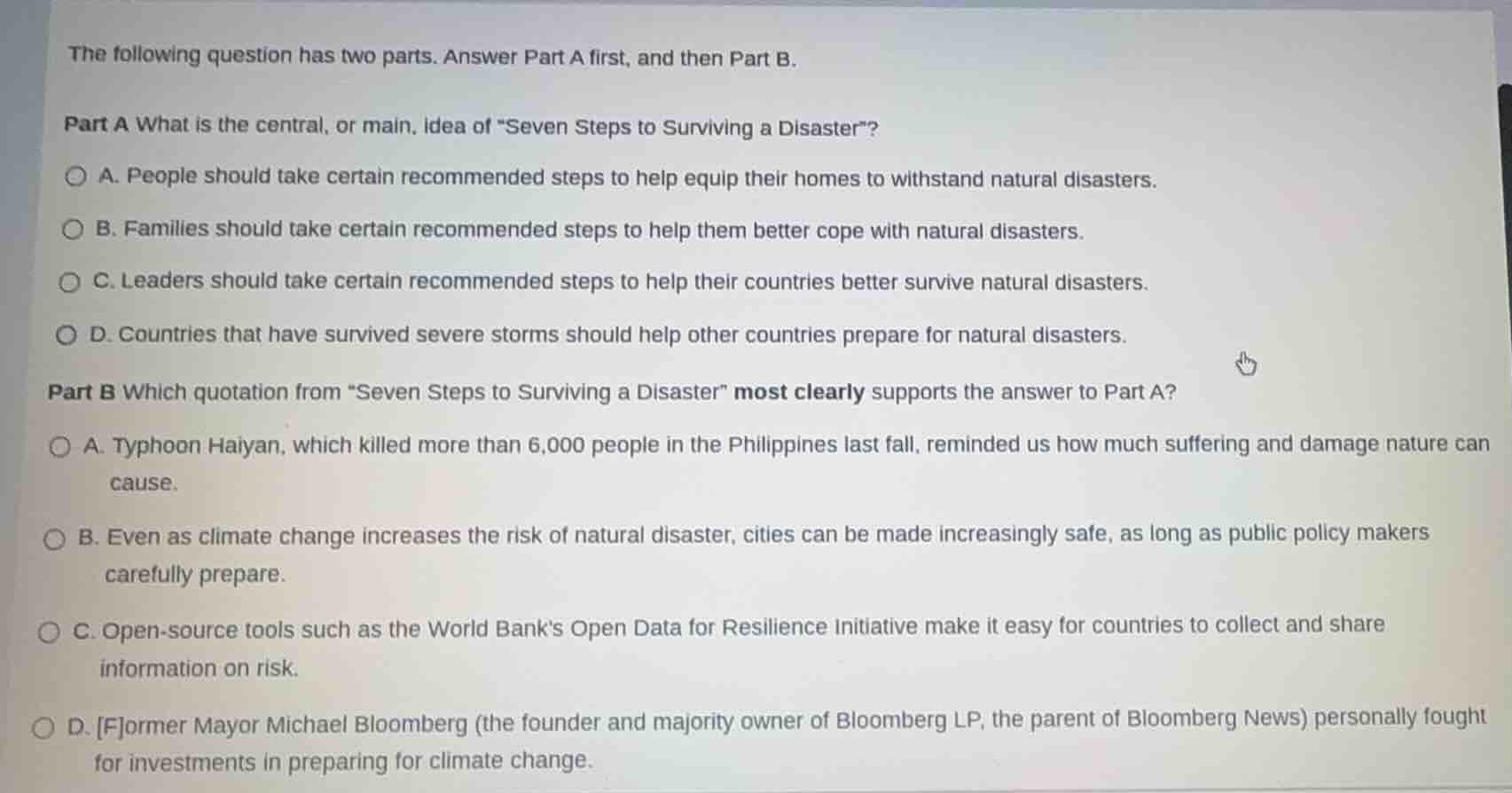
the following question has two parts. answer part a first, and then part b.
part a what is the central, or main, idea of \seven steps to surviving a disaster\?
a. people should take certain recommended steps to help equip their homes to withstand natural disasters.
b. families should take certain recommended steps to help them better cope with natural disasters.
c. leaders should take certain recommended steps to help their countries better survive natural disasters.
d. countries that have survived severe storms should help other countries prepare for natural disasters.
part b which quotation from \seven steps to surviving a disaster\ most clearly supports the answer to part a?
a. typhoon haiyan, which killed more than 6,000 people in the philippines last fall, reminded us how much suffering and damage nature can cause.
b. even as climate change increases the risk of natural disaster, cities can be made increasingly safe, as long as public policy makers carefully prepare.
c. open-source tools such as the world banks open data for resilience initiative make it easy for countries to collect and share information on risk.
d. former mayor michael bloomberg (the founder and majority owner of bloomberg lp, the parent of bloomberg news) personally fought for investments in preparing for climate change.
Analyze Part A
To find the central idea of "Seven Steps to Surviving a Disaster," we look at the scope of the options. The text focuses on how cities, governments, and policy makers can prepare for and mitigate the risks of natural disasters.
- Option A focuses on individual homes, which is too narrow.
- Option B focuses on families, which is also too narrow.
- Option C focuses on leaders taking steps to help their countries survive, which aligns with the broader public policy and national/municipal preparation themes.
- Option D suggests countries helping other countries, which is not the central focus.
Therefore, the central idea is best captured by Option C. This utilizes Reading Comprehension to identify the main scope of the text.
Analyze Part B
We need to find the quotation that directly supports the idea that leaders/policy makers should take steps to help their countries survive.
- Option A merely describes the damage of Typhoon Haiyan.
- Option B states: "Even as climate change increases the risk of natural disaster, cities can be made increasingly safe, as long as public policy makers carefully prepare." This directly links the safety of cities (countries/societies) to the preparation steps taken by public policy makers (leaders).
- Option C discusses open-source tools for sharing information.
- Option D mentions Michael Bloomberg's personal actions.
Option B provides the strongest Textual Evidence supporting the role of leaders in Disaster Preparedness to ensure safety.

Snap & solve any problem in the app
Get step-by-step solutions on Sovi AI
Photo-based solutions with guided steps
Explore more problems and detailed explanations
Question 1
- A. People should take certain recommended steps to help equip their homes to withstand natural disasters.
- B. Families should take certain recommended steps to help them better cope with natural disasters.
- C. Leaders should take certain recommended steps to help their countries better survive natural disasters. (Correct answer)
- D. Countries that have survived severe storms should help other countries prepare for natural disasters.
Question 2
- A. Typhoon Haiyan, which killed more than 6,000 people in the Philippines last fall, reminded us how much suffering and damage nature can cause.
- B. Even as climate change increases the risk of natural disaster, cities can be made increasingly safe, as long as public policy makers carefully prepare. (Correct answer)
- C. Open-source tools such as the World Bank's Open Data for Resilience Initiative make it easy for countries to collect and share information on risk.
- D. [F]ormer Mayor Michael Bloomberg (the founder and majority owner of Bloomberg LP, the parent of Bloomberg News) personally fought for investments in preparing for climate change.