Sovi.AI - AI Math Tutor

Scan to solve math questions

QUESTION IMAGE

solve the problem. use what you learned from the example. leo knows tha…
10,815 Learners found this answer helpful

Question

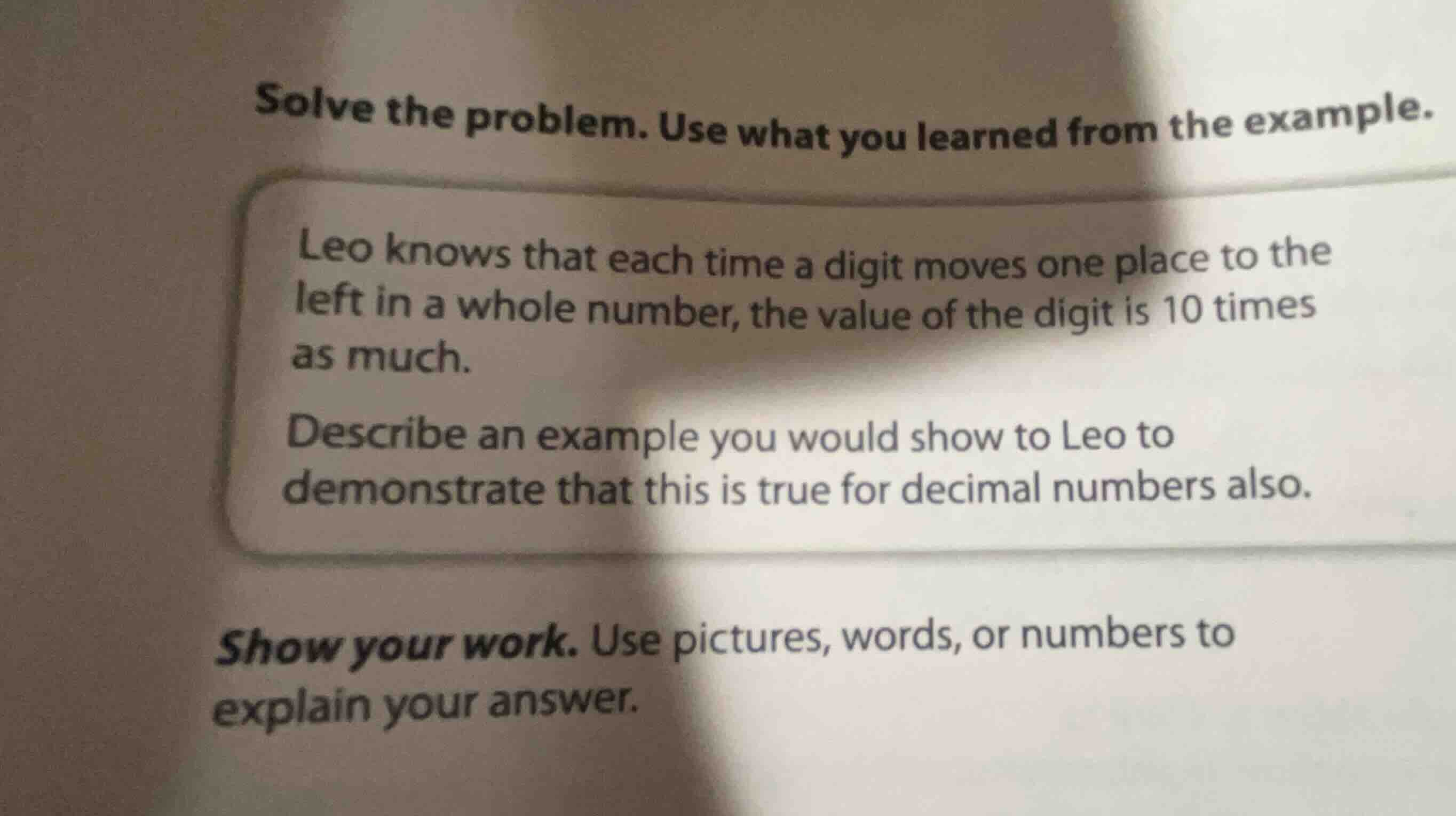
solve the problem. use what you learned from the example.

leo knows that each time a digit moves one place to the left in a whole number, the value of the digit is 10 times as much.

describe an example you would show to leo to demonstrate that this is true for decimal numbers also.

show your work. use pictures, words, or numbers to explain your answer.

Explanation:

Response

<pre_analysis>
{
"quality": "clear",
"question_count": 1,
"skills_matched": [
"step_cot",
"explain_then_answer",
"tutor"
],
"needs_drawing": false,
"concepts_used": [
"Decimal Place Value"
],
"new_concepts": [
"Decimal Place Value Relationships"
],
"current_concepts": [
"Decimal Place Value",
"Decimal Place Value Relationships"
]
}
</pre_analysis>

<reasoning>

Identify the mathematical concept

We use Decimal Place Value to analyze digit movement.

Choose a decimal example

Consider the digit \(5\) in the tenths and hundredths places.
\[
0.5 \quad \text{and} \quad 0.05
\]

Compare the values

We divide the larger value by the smaller value.
\[
\frac{0.5}{0.05} = 10
\]

Formulate the explanation

Moving \(5\) one place left multiplies its value by \(10\).
\[
0.05 \times 10 = 0.5
\]
</reasoning>

<answer>
An example to show Leo is comparing the numbers \(0.05\) and \(0.5\).

In the number \(0.05\), the digit \(5\) is in the hundredths place, so its value is five-hundredths:
\[0.05\]

In the number \(0.5\), the digit \(5\) has moved one place to the left into the tenths place, so its value is five-tenths:
\[0.5\]

Since five-tenths is ten times as much as five-hundredths, this demonstrates the rule:
\[0.05 \times 10 = 0.5\]
</answer>

<post_analysis>
{
"subject": "Mathematics",
"question_type": "Free Response",
"knowledge_point": [
"Mathematics",
"Algebra",
"Decimal Place Value"
]
}
</post_analysis>

Answer:

<pre_analysis>
{
"quality": "clear",
"question_count": 1,
"skills_matched": [
"step_cot",
"explain_then_answer",
"tutor"
],
"needs_drawing": false,
"concepts_used": [
"Decimal Place Value"
],
"new_concepts": [
"Decimal Place Value Relationships"
],
"current_concepts": [
"Decimal Place Value",
"Decimal Place Value Relationships"
]
}
</pre_analysis>

<reasoning>

Identify the mathematical concept

We use Decimal Place Value to analyze digit movement.

Choose a decimal example

Consider the digit \(5\) in the tenths and hundredths places.
\[
0.5 \quad \text{and} \quad 0.05
\]

Compare the values

We divide the larger value by the smaller value.
\[
\frac{0.5}{0.05} = 10
\]

Formulate the explanation

Moving \(5\) one place left multiplies its value by \(10\).
\[
0.05 \times 10 = 0.5
\]
</reasoning>

<answer>
An example to show Leo is comparing the numbers \(0.05\) and \(0.5\).

In the number \(0.05\), the digit \(5\) is in the hundredths place, so its value is five-hundredths:
\[0.05\]

In the number \(0.5\), the digit \(5\) has moved one place to the left into the tenths place, so its value is five-tenths:
\[0.5\]

Since five-tenths is ten times as much as five-hundredths, this demonstrates the rule:
\[0.05 \times 10 = 0.5\]
</answer>

<post_analysis>
{
"subject": "Mathematics",
"question_type": "Free Response",
"knowledge_point": [
"Mathematics",
"Algebra",
"Decimal Place Value"
]
}
</post_analysis>