QUESTION IMAGE
Question
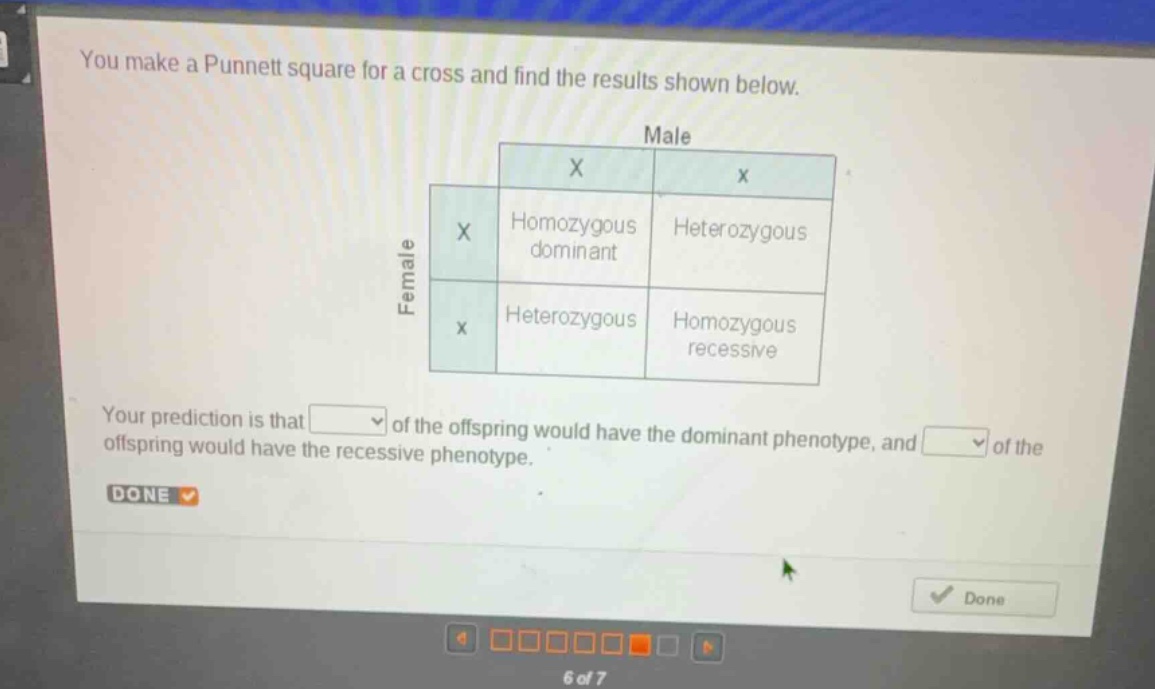
you make a punnett square for a cross and find the results shown below.
your prediction is that dropdown of the offspring would have the dominant phenotype, and dropdown of the offspring would have the recessive phenotype.
Analyze the Punnett square genotypes
Using the Punnett Square knowledge point, we examine the four possible offspring genotypes resulting from the cross:
- Top-left: Homozygous dominant (\(XX\))
- Top-right: Heterozygous (\(Xx\))
- Bottom-left: Heterozygous (\(Xx\))
- Bottom-right: Homozygous recessive (\(xx\))
Determine the dominant phenotype fraction
Dominant phenotypes are expressed by homozygous dominant (\(XX\)) and heterozygous (\(Xx\)) individuals.
- Number of dominant offspring: \(1 \text{ (homozygous dominant)} + 2 \text{ (heterozygous)} = 3\)
- Total offspring: \(4\)
- Fraction with dominant phenotype: \(\frac{3}{4}\) (or \(75\%\))
Determine the recessive phenotype fraction
Recessive phenotypes are expressed only by homozygous recessive (\(xx\)) individuals.
- Number of recessive offspring: \(1 \text{ (homozygous recessive)}\)
- Total offspring: \(4\)
- Fraction with recessive phenotype: \(\frac{1}{4}\) (or \(25\%\))

Snap & solve any problem in the app
Get step-by-step solutions on Sovi AI
Photo-based solutions with guided steps
Explore more problems and detailed explanations
You make a Punnett square for a cross and find the results shown below.
Your prediction is that <blank>\(3/4\)</blank> of the offspring would have the dominant phenotype, and <blank>\(1/4\)</blank> of the offspring would have the recessive phenotype.