QUESTION IMAGE
Question
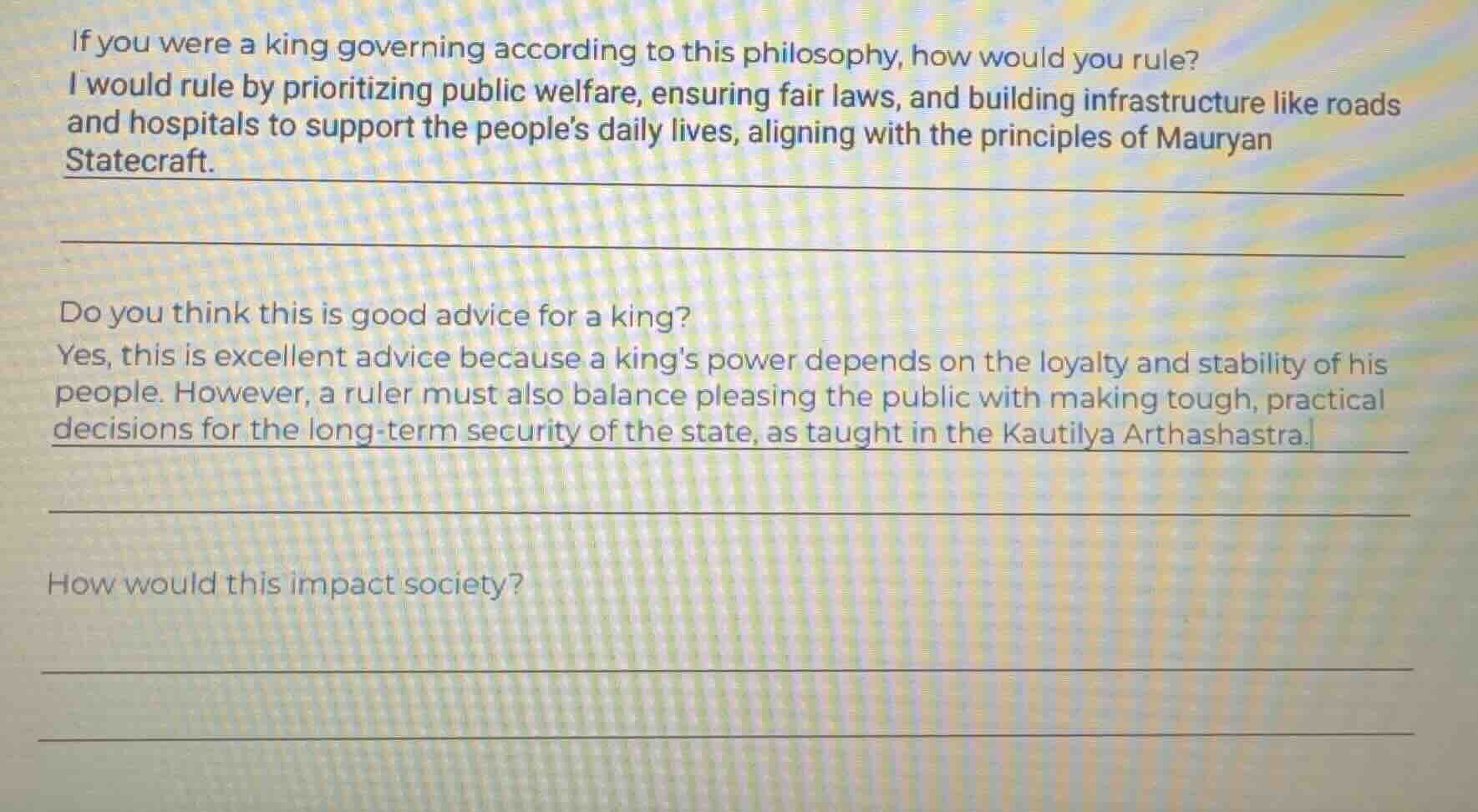
if you were a king governing according to this philosophy, how would you rule?
i would rule by prioritizing public welfare, ensuring fair laws, and building infrastructure like roads and hospitals to support the peoples daily lives, aligning with the principles of mauryan statecraft.
do you think this is good advice for a king?
yes, this is excellent advice because a kings power depends on the loyalty and stability of his people. however, a ruler must also balance pleasing the public with making tough, practical decisions for the long-term security of the state, as taught in the kautilya arthashastra.
how would this impact society?
Analyze the first prompt and response
The first question asks: "If you were a king governing according to this philosophy, how would you rule?"
The handwritten/typed response states: "I would rule by prioritizing public welfare, ensuring fair laws, and building infrastructure like roads and hospitals to support the people's daily lives, aligning with the principles of Mauryan Statecraft."
This aligns perfectly with Mauryan Statecraft, specifically the welfare-oriented policies found in the Ashoka Edicts, which emphasize moral duty, public works, and the well-being of all subjects.
Analyze the second prompt and response
The second question asks: "Do you think this is good advice for a king?"
The response states: "Yes, this is excellent advice because a king's power depends on the loyalty and stability of his people. However, a ruler must also balance pleasing the public with making tough, practical decisions for the long-term security of the state, as taught in the Kautilya Arthashastra."
This demonstrates a sophisticated understanding of the Kautilya Arthashastra, showing how pragmatic realism must balance moral idealism to maintain state security and stability.
Analyze the third prompt
The third question asks: "How would this impact society?"
This question is blank and needs to be answered. We must analyze how a balanced governance approach—combining Ashoka's welfare-centered philosophy with Kautilya's pragmatic statecraft—would impact society.
A balanced approach would lead to:
- High social cohesion, trust, and loyalty due to public welfare, infrastructure, and fair laws.
- Strong internal stability and protection from external threats due to realistic security measures and practical administration.
- Economic prosperity facilitated by safe trade routes, public infrastructure, and organized state support.
Formulate the final response for the third question
To answer "How would this impact society?", we can write a thoughtful response that synthesizes these elements:
"Governing with this balanced approach would create a highly stable, prosperous, and cohesive society. Prioritizing public welfare and infrastructure would foster deep loyalty, reduce social unrest, and improve daily life. Meanwhile, maintaining strong, practical security measures would protect the population from external threats and ensure long-term order, allowing trade, culture, and community life to flourish safely."

Snap & solve any problem in the app
Get step-by-step solutions on Sovi AI
Photo-based solutions with guided steps
Explore more problems and detailed explanations
Question 1
If you were a king governing according to this philosophy, how would you rule?
<blank>I would rule by prioritizing public welfare, ensuring fair laws, and building infrastructure like roads and hospitals to support the people's daily lives, aligning with the principles of Mauryan Statecraft.</blank>
Question 2
Do you think this is good advice for a king?
<blank>Yes, this is excellent advice because a king's power depends on the loyalty and stability of his people. However, a ruler must also balance pleasing the public with making tough, practical decisions for the long-term security of the state, as taught in the Kautilya Arthashastra.</blank>
Question 3
How would this impact society?
<blank>This balanced approach would create a highly stable, prosperous, and cohesive society. Prioritizing public welfare and infrastructure would foster deep loyalty, reduce social unrest, and improve daily life. Meanwhile, maintaining strong, practical security measures would protect the population from external threats and ensure long-term order, allowing trade, culture, and community life to flourish safely.</blank>