QUESTION IMAGE
Question
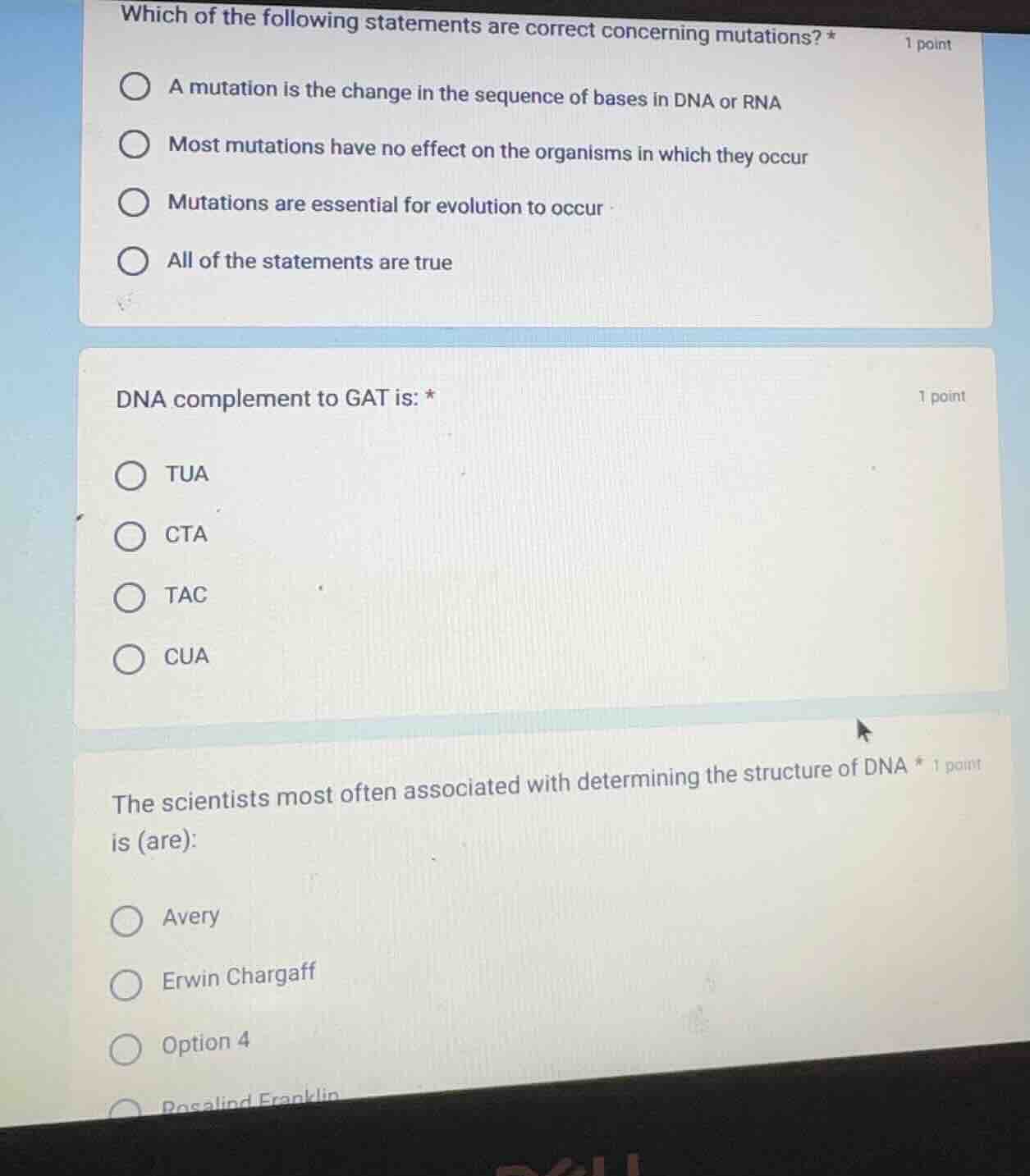
which of the following statements are correct concerning mutations? *
a mutation is the change in the sequence of bases in dna or rna
most mutations have no effect on the organisms in which they occur
mutations are essential for evolution to occur
all of the statements are true
dna complement to gat is: *
tua
cta
tac
cua
the scientists most often associated with determining the structure of dna * is (are):
avery
erwin chargaff
option 4
rosalind franklin
<pre_analysis>
{
"quality": "clear",
"question_count": 3,
"skills_matched": [
"direct_cot",
"multiple_choice_formatter",
"explain_then_answer",
"tutor"
],
"needs_drawing": false,
"concepts_used": [
"DNA Base Pairing",
"DNA Double Helix"
],
"new_concepts": [
"Genetic Mutations",
"History of DNA Discovery"
],
"current_concepts": [
"Genetic Mutations",
"DNA Base Pairing",
"DNA Double Helix",
"History of DNA Discovery"
]
}
</pre_analysis>
<reasoning>
Analyze statements about mutations
To evaluate the first question, we analyze each statement concerning mutations:
- "A mutation is the change in the sequence of bases in DNA or RNA": This is the fundamental definition of a genetic mutation.
- "Most mutations have no effect on the organisms in which they occur": This is true because many mutations are neutral, occurring in non-coding regions or resulting in synonymous codons that do not alter the amino acid sequence.
- "Mutations are essential for evolution to occur": This is true because mutations are the primary source of new genetic variation, which is necessary for natural selection and evolution.
Since all three individual statements are correct, the correct choice is "All of the statements are true".
Determine DNA complement to GAT
Using the DNA Base Pairing rules:
- Adenine (A) pairs with Thymine (T).
- Cytosine (C) pairs with Guanine (G).
For the given template sequence GAT:
- G pairs with C.
- A pairs with T.
- T pairs with A.
Thus, the complementary DNA sequence is CTA.
Identify scientists associated with DNA structure
We look at the scientists associated with determining the DNA Double Helix structure:
- Avery showed that DNA is the hereditary material.
- Erwin Chargaff discovered the base-pairing ratios (A=T, G=C).
- Rosalind Franklin produced the X-ray diffraction images (Photo 51) that directly revealed the helical structure of DNA.
Among the visible options, Rosalind Franklin is the scientist most directly associated with determining the physical structure of DNA.
</reasoning>
<answer>
Question 1
<mcq-option>A mutation is the change in the sequence of bases in DNA or RNA</mcq-option>
<mcq-option>Most mutations have no effect on the organisms in which they occur</mcq-option>
<mcq-option>Mutations are essential for evolution to occur</mcq-option>
<mcq-correct>All of the statements are true</mcq-correct>
Question 2
<mcq-option>TUA</mcq-option>
<mcq-correct>CTA</mcq-correct>
<mcq-option>TAC</mcq-option>
<mcq-option>CUA</mcq-option>
Question 3
<mcq-option>Avery</mcq-option>
<mcq-option>Erwin Chargaff</mcq-option>
<mcq-option>Option 4</mcq-option>
<mcq-correct>Rosalind Franklin</mcq-correct>
</answer>
<post_analysis>
{
"subject": "Natural Science",
"question_type": "Multiple Choice",
"knowledge_point": [
"Natural Science",
"Biology",
"Molecular Genetics"
]
}
</post_analysis>
Snap & solve any problem in the app
Get step-by-step solutions on Sovi AI
Photo-based solutions with guided steps
Explore more problems and detailed explanations
<pre_analysis>
{
"quality": "clear",
"question_count": 3,
"skills_matched": [
"direct_cot",
"multiple_choice_formatter",
"explain_then_answer",
"tutor"
],
"needs_drawing": false,
"concepts_used": [
"DNA Base Pairing",
"DNA Double Helix"
],
"new_concepts": [
"Genetic Mutations",
"History of DNA Discovery"
],
"current_concepts": [
"Genetic Mutations",
"DNA Base Pairing",
"DNA Double Helix",
"History of DNA Discovery"
]
}
</pre_analysis>
<reasoning>
Analyze statements about mutations
To evaluate the first question, we analyze each statement concerning mutations:
- "A mutation is the change in the sequence of bases in DNA or RNA": This is the fundamental definition of a genetic mutation.
- "Most mutations have no effect on the organisms in which they occur": This is true because many mutations are neutral, occurring in non-coding regions or resulting in synonymous codons that do not alter the amino acid sequence.
- "Mutations are essential for evolution to occur": This is true because mutations are the primary source of new genetic variation, which is necessary for natural selection and evolution.
Since all three individual statements are correct, the correct choice is "All of the statements are true".
Determine DNA complement to GAT
Using the DNA Base Pairing rules:
- Adenine (A) pairs with Thymine (T).
- Cytosine (C) pairs with Guanine (G).
For the given template sequence GAT:
- G pairs with C.
- A pairs with T.
- T pairs with A.
Thus, the complementary DNA sequence is CTA.
Identify scientists associated with DNA structure
We look at the scientists associated with determining the DNA Double Helix structure:
- Avery showed that DNA is the hereditary material.
- Erwin Chargaff discovered the base-pairing ratios (A=T, G=C).
- Rosalind Franklin produced the X-ray diffraction images (Photo 51) that directly revealed the helical structure of DNA.
Among the visible options, Rosalind Franklin is the scientist most directly associated with determining the physical structure of DNA.
</reasoning>
<answer>
Question 1
<mcq-option>A mutation is the change in the sequence of bases in DNA or RNA</mcq-option>
<mcq-option>Most mutations have no effect on the organisms in which they occur</mcq-option>
<mcq-option>Mutations are essential for evolution to occur</mcq-option>
<mcq-correct>All of the statements are true</mcq-correct>
Question 2
<mcq-option>TUA</mcq-option>
<mcq-correct>CTA</mcq-correct>
<mcq-option>TAC</mcq-option>
<mcq-option>CUA</mcq-option>
Question 3
<mcq-option>Avery</mcq-option>
<mcq-option>Erwin Chargaff</mcq-option>
<mcq-option>Option 4</mcq-option>
<mcq-correct>Rosalind Franklin</mcq-correct>
</answer>
<post_analysis>
{
"subject": "Natural Science",
"question_type": "Multiple Choice",
"knowledge_point": [
"Natural Science",
"Biology",
"Molecular Genetics"
]
}
</post_analysis>