QUESTION IMAGE
Question
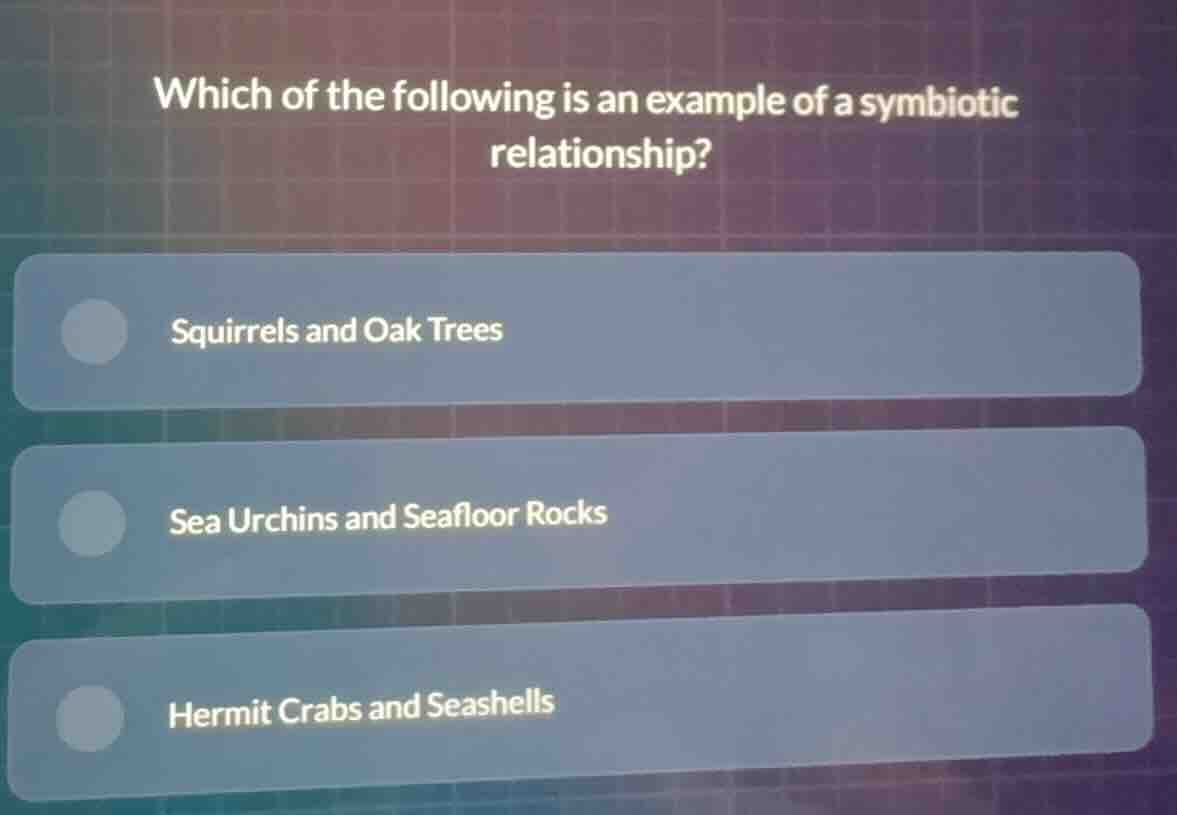
which of the following is an example of a symbiotic relationship?
squirrels and oak trees
sea urchins and seafloor rocks
hermit crabs and seashells
🆕 New Concept Discovered: Symbiotic Relationships
Close, long-term interactions between different biological species.
Step 1: Define Symbiosis
A symbiotic relationship is a close, long-term interaction between two different biological organisms (living species). These interactions can be mutually beneficial (mutualism), beneficial to one and neutral to the other (commensalism), or beneficial to one and harmful to the other (parasitism). The key requirement is that both participants must be living organisms.
Step 2: Evaluate the Options
- Squirrels and Oak Trees: Both squirrels (animals) and oak trees (plants) are living organisms. They share a close, long-term ecological relationship. Squirrels get food (acorns) and shelter from the oak trees, while helping the trees reproduce by burying acorns that later grow into new trees. This is a classic example of a mutualistic symbiotic relationship.
- Sea Urchins and Seafloor Rocks: Sea urchins are living organisms, but seafloor rocks are non-living (abiotic) physical structures. Because symbiosis only occurs between living species, this interaction does not qualify.
- Hermit Crabs and Seashells: Hermit crabs are living organisms, but the empty seashells they use for shelter are non-living, discarded structures (usually made by dead mollusks). Since the shell itself is not a living organism, this is not a biological symbiosis.

Snap & solve any problem in the app
Get step-by-step solutions on Sovi AI
Photo-based solutions with guided steps
Explore more problems and detailed explanations
Squirrels and Oak Trees