QUESTION IMAGE
Question
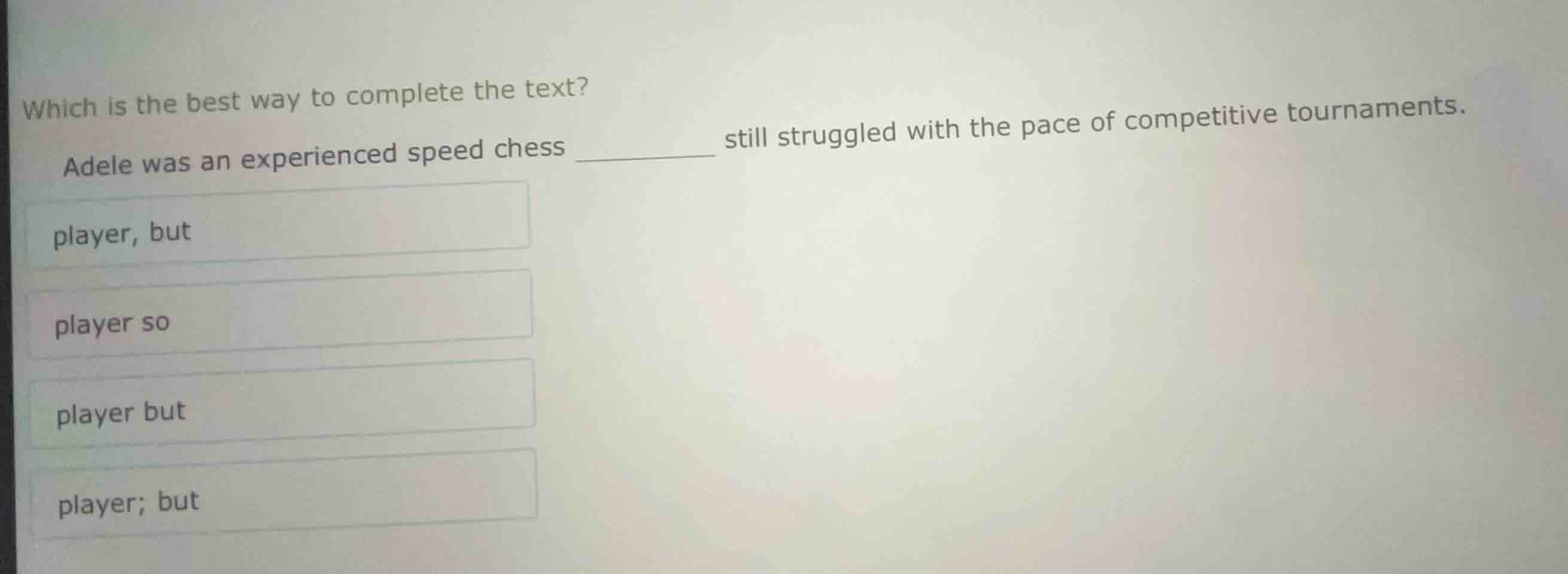
which is the best way to complete the text?
adele was an experienced speed chess ______ still struggled with the pace of competitive tournaments.
player, but
player so
player but
player; but
Analyze the sentence structure
The sentence consists of two independent clauses:
- "Adele was an experienced speed chess player"
- "she still struggled with the pace of competitive tournaments" (implied subject "she" is omitted here, making the second part "still struggled with..." function as a predicate sharing the subject, or rather, the sentence connects two independent clauses where the second has an implied subject, or it is a compound predicate. Let's look closer: "Adele was an experienced speed chess player" and "[she] still struggled...". Actually, with "but" connecting them, "Adele was an experienced speed chess player, but still struggled..." or "player, but she still struggled...". Wait, looking at the options:
- "player, but"
- "player so"
- "player but"
- "player; but"
Let's evaluate the relationship. Being an experienced player contrasts with struggling with the pace. Therefore, a coordinating conjunction showing contrast ("but") is required, ruling out "so".
Determine correct punctuation
When connecting two parts of a compound predicate (or clauses) with a coordinating conjunction like "but", we look at whether a comma is needed.
- "Adele was an experienced speed chess player, but still struggled..."
A comma is typically used before "but" when it joins two independent clauses, or to provide a distinct pause/contrast before a coordinating conjunction joining parts of a compound predicate. Let's verify standard conventions for this specific test style (commonly ACT/SAT or middle school grammar diagnostics):
Usually, joining two independent clauses requires a comma + coordinating conjunction. Here, the second part is "still struggled with the pace of competitive tournaments." Since there is no explicit subject "she" in the second part, it is a compound predicate: "was... but still struggled...". Generally, a comma is not strictly required before "but" in a simple compound predicate unless it is necessary for clarity or to emphasize contrast. However, in many standardized grammar curricula, a comma is preferred before "but" when it expresses a strong contrast, or the question might treat the second part as a clause. Let's compare the options:
- "player, but" (comma + but)
- "player so" (wrong conjunction)
- "player but" (no punctuation + but)
- "player; but" (semicolon + but is incorrect punctuation usage)
Between "player, but" and "player but", the comma before "but" is the standard correct choice to clearly set off the contrasting coordinate element and ensure proper Sentence Structure.

Snap & solve any problem in the app
Get step-by-step solutions on Sovi AI
Photo-based solutions with guided steps
Explore more problems and detailed explanations
- (A) player, but (Correct answer)
- (B) player so
- (C) player but
- (D) player; but