Sovi.AI - AI Math Tutor

Scan to solve math questions

QUESTION IMAGE

when during development in humans does the brain start to be continuous…

Question

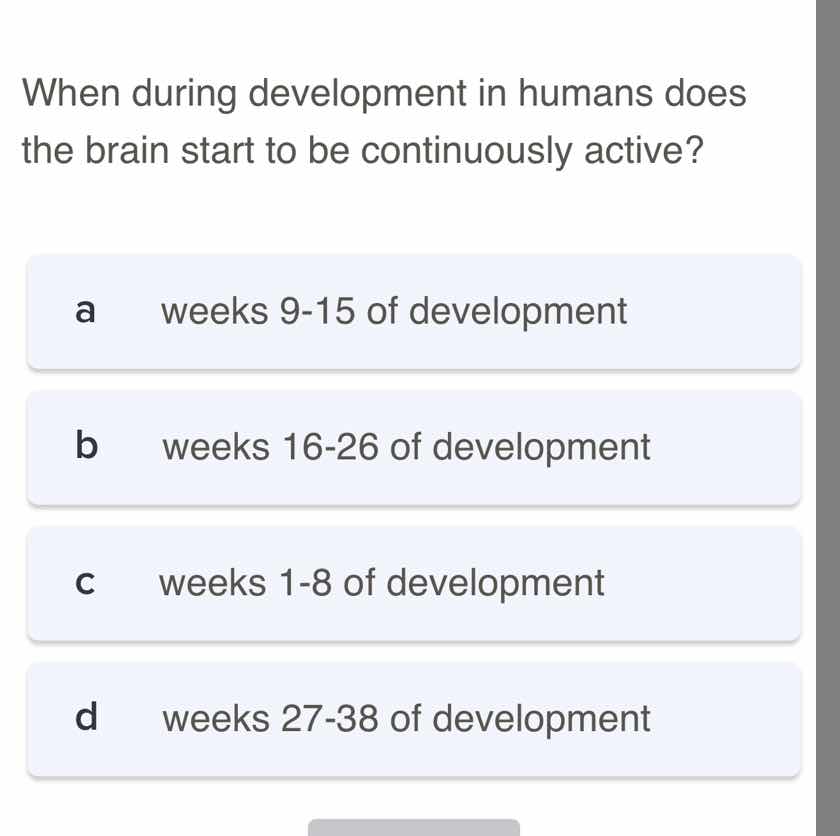
when during development in humans does the brain start to be continuously active?

a weeks 9-15 of development
b weeks 16-26 of development
c weeks 1-8 of development
d weeks 27-38 of development

Explanation:

Response

<pre_analysis>
{
"quality": "clear",
"question_count": 1,
"skills_matched": [
"direct_cot",
"multiple_choice_formatter",
"explain_then_answer",
"tutor"
],
"needs_drawing": false,
"concepts_used": [],
"new_concepts": [
"Human Prenatal Development",
"Fetal Brain Activity"
],
"current_concepts": [
"Human Prenatal Development",
"Fetal Brain Activity"
]
}
</pre_analysis>

<reasoning>

Identify the developmental milestone

The question asks when the human brain begins to show continuous electrical activity during prenatal development.

Analyze early brain development

During the embryonic period (weeks 1–8), the neural tube forms and basic structures begin to differentiate, but organized, continuous electrical brain activity is absent.

Analyze mid-gestation milestones

During the early fetal period (weeks 9–15), the first sporadic, intermittent electrical signals (EEG bursts) can be detected, but they are highly discontinuous.

Determine onset of continuous activity

Continuous, sustained brain activity (EEG patterns showing regular sleep-wake cycles and continuous background activity) begins to establish during the late second trimester and early third trimester, specifically around weeks 27–38 of development.

Select the correct option

Comparing the options, weeks 27–38 of development (option d) represents the period when the brain starts to be continuously active.
</reasoning>

<answer>
<mcq-option>a weeks 9-15 of development</mcq-option>
<mcq-option>b weeks 16-26 of development</mcq-option>
<mcq-option>c weeks 1-8 of development</mcq-option>
<mcq-correct>d weeks 27-38 of development</mcq-correct>
</answer>

<post_analysis>
{
"subject": "Natural Science",
"question_type": "Multiple Choice",
"knowledge_point": [
"Natural Science",
"Biology",
"Human Prenatal Development"
]
}
</post_analysis>

Answer:

<pre_analysis>
{
"quality": "clear",
"question_count": 1,
"skills_matched": [
"direct_cot",
"multiple_choice_formatter",
"explain_then_answer",
"tutor"
],
"needs_drawing": false,
"concepts_used": [],
"new_concepts": [
"Human Prenatal Development",
"Fetal Brain Activity"
],
"current_concepts": [
"Human Prenatal Development",
"Fetal Brain Activity"
]
}
</pre_analysis>

<reasoning>

Identify the developmental milestone

The question asks when the human brain begins to show continuous electrical activity during prenatal development.

Analyze early brain development

During the embryonic period (weeks 1–8), the neural tube forms and basic structures begin to differentiate, but organized, continuous electrical brain activity is absent.

Analyze mid-gestation milestones

During the early fetal period (weeks 9–15), the first sporadic, intermittent electrical signals (EEG bursts) can be detected, but they are highly discontinuous.

Determine onset of continuous activity

Continuous, sustained brain activity (EEG patterns showing regular sleep-wake cycles and continuous background activity) begins to establish during the late second trimester and early third trimester, specifically around weeks 27–38 of development.

Select the correct option

Comparing the options, weeks 27–38 of development (option d) represents the period when the brain starts to be continuously active.
</reasoning>

<answer>
<mcq-option>a weeks 9-15 of development</mcq-option>
<mcq-option>b weeks 16-26 of development</mcq-option>
<mcq-option>c weeks 1-8 of development</mcq-option>
<mcq-correct>d weeks 27-38 of development</mcq-correct>
</answer>

<post_analysis>
{
"subject": "Natural Science",
"question_type": "Multiple Choice",
"knowledge_point": [
"Natural Science",
"Biology",
"Human Prenatal Development"
]
}
</post_analysis>