QUESTION IMAGE
Question
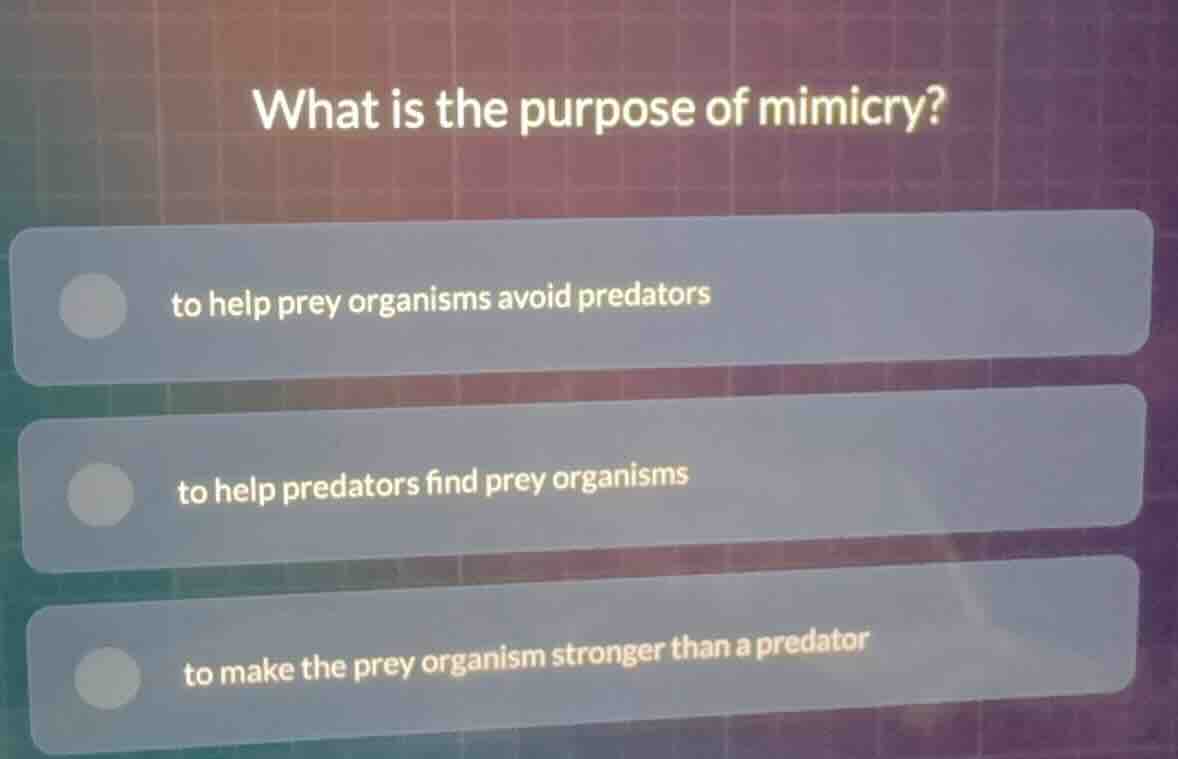
what is the purpose of mimicry?
to help prey organisms avoid predators
to help predators find prey organisms
to make the prey organism stronger than a predator
🆕 New Concept Discovered: Evolutionary Adaptations for Survival
How organisms evolve traits to stay alive
Step 1: Define Mimicry
Mimicry is an evolutionary adaptation where one organism (the mimic) closely resembles another organism or object (the model). This visual, auditory, or chemical resemblance provides a survival advantage.
For example, a harmless insect might evolve to look like a stinging wasp so that other animals leave it alone.
Step 2: Analyze the Options
- "to help prey organisms avoid predators": By resembling a dangerous, toxic, or unpalatable species, a harmless prey organism can trick predators into thinking it is unsafe to eat. This keeps the prey safe from being hunted.
- "to help predators find prey organisms": While some rare predators use aggressive mimicry to lure prey, the primary and most common evolutionary purpose of mimicry is defensive. It does not help a predator "find" prey.
- "to make the prey organism stronger than a predator": Mimicry is a trick of appearance or behavior; it does not physically change the muscle strength, size, or physical power of the prey.
Step 3: Select the Best Fit
The primary ecological purpose of mimicry is defense. It allows vulnerable prey species to avoid detection or deter attacks from predators by copying the warning signals of more dangerous species.

Snap & solve any problem in the app
Get step-by-step solutions on Sovi AI
Photo-based solutions with guided steps
Explore more problems and detailed explanations
to help prey organisms avoid predators