Sovi.AI - AI Math Tutor

Scan to solve math questions

QUESTION IMAGE

what major process takes place in the ribosome? what are the two types …

Question

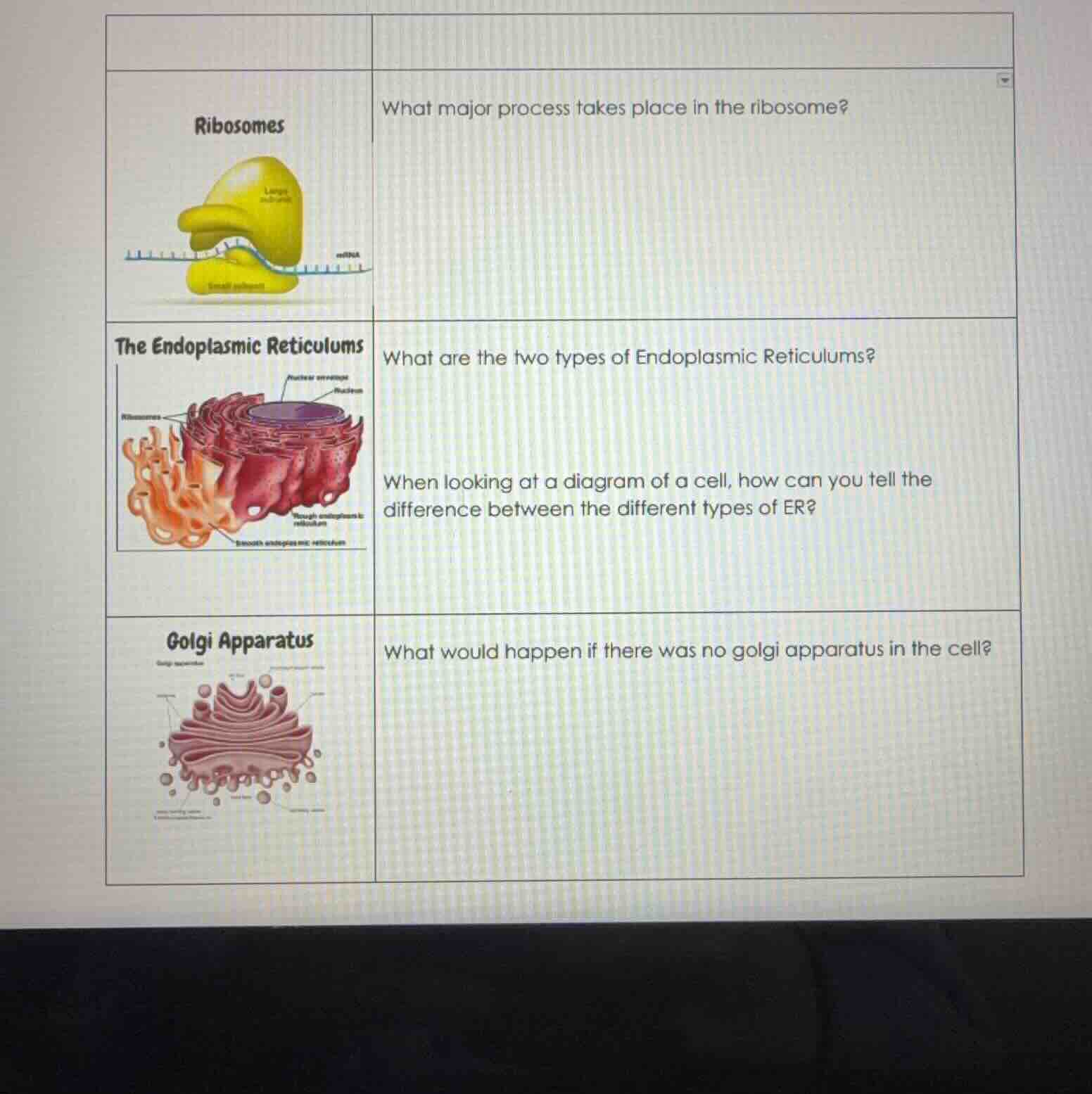
what major process takes place in the ribosome?

what are the two types of endoplasmic reticulums?

when looking at a diagram of a cell, how can you tell the difference between the different types of er?

what would happen if there was no golgi apparatus in the cell?

Explanation:

Response

<pre_analysis>
{
"quality": "clear",
"question_count": 4,
"skills_matched": [
"direct_cot",
"explain_then_answer",
"quick"
],
"needs_drawing": false,
"concepts_used": [
"Ribosome Function",
"Endoplasmic Reticulum Structure",
"Golgi Apparatus Function"
],
"new_concepts": [],
"current_concepts": [
"Ribosome Function",
"Endoplasmic Reticulum Structure",
"Golgi Apparatus Function"
]
}
</pre_analysis>

<reasoning>

Ribosome function

Translation / Protein synthesis

Endoplasmic reticulum types and identification

  • Types: Rough Endoplasmic Reticulum (RER) and Smooth Endoplasmic Reticulum (SER)
  • Identification: Rough ER is studded with ribosomes on its outer surface, giving it a bumpy/rough appearance, whereas Smooth ER lacks ribosomes and has a smooth, tubular appearance.

Golgi apparatus absence consequences

Proteins and lipids would not be properly modified, sorted, packaged, or transported to their correct destinations inside or outside the cell, leading to cell dysfunction.
</reasoning>

<answer>

Question 1

What major process takes place in the ribosome?

  • Protein synthesis (translation)

Question 2

What are the two types of Endoplasmic Reticulums?

  • Rough Endoplasmic Reticulum (RER) and Smooth Endoplasmic Reticulum (SER)

Question 3

When looking at a diagram of a cell, how can you tell the difference between the different types of ER?

  • Rough ER is covered with ribosomes (giving it a bumpy/rough appearance), while Smooth ER lacks ribosomes and has a smooth, tubular appearance.

Question 4

What would happen if there was no golgi apparatus in the cell?

  • Proteins and lipids would not be modified, sorted, packaged, or shipped to their correct destinations, causing cellular transport and function to fail.

</answer>

<post_analysis>
{
"subject": "Natural Science",
"question_type": "Multi-part",
"knowledge_point": [
"Natural Science",
"Biology",
"Organelle Identification"
]
}
</post_analysis>

Answer:

<pre_analysis>
{
"quality": "clear",
"question_count": 4,
"skills_matched": [
"direct_cot",
"explain_then_answer",
"quick"
],
"needs_drawing": false,
"concepts_used": [
"Ribosome Function",
"Endoplasmic Reticulum Structure",
"Golgi Apparatus Function"
],
"new_concepts": [],
"current_concepts": [
"Ribosome Function",
"Endoplasmic Reticulum Structure",
"Golgi Apparatus Function"
]
}
</pre_analysis>

<reasoning>

Ribosome function

Translation / Protein synthesis

Endoplasmic reticulum types and identification

  • Types: Rough Endoplasmic Reticulum (RER) and Smooth Endoplasmic Reticulum (SER)
  • Identification: Rough ER is studded with ribosomes on its outer surface, giving it a bumpy/rough appearance, whereas Smooth ER lacks ribosomes and has a smooth, tubular appearance.

Golgi apparatus absence consequences

Proteins and lipids would not be properly modified, sorted, packaged, or transported to their correct destinations inside or outside the cell, leading to cell dysfunction.
</reasoning>

<answer>

Question 1

What major process takes place in the ribosome?

  • Protein synthesis (translation)

Question 2

What are the two types of Endoplasmic Reticulums?

  • Rough Endoplasmic Reticulum (RER) and Smooth Endoplasmic Reticulum (SER)

Question 3

When looking at a diagram of a cell, how can you tell the difference between the different types of ER?

  • Rough ER is covered with ribosomes (giving it a bumpy/rough appearance), while Smooth ER lacks ribosomes and has a smooth, tubular appearance.

Question 4

What would happen if there was no golgi apparatus in the cell?

  • Proteins and lipids would not be modified, sorted, packaged, or shipped to their correct destinations, causing cellular transport and function to fail.

</answer>

<post_analysis>
{
"subject": "Natural Science",
"question_type": "Multi-part",
"knowledge_point": [
"Natural Science",
"Biology",
"Organelle Identification"
]
}
</post_analysis>