QUESTION IMAGE
Question
week 5 - assessment
0:51:09 remaining
anthropoids
- a
hominins
- b
dry-nosed
- c
- d
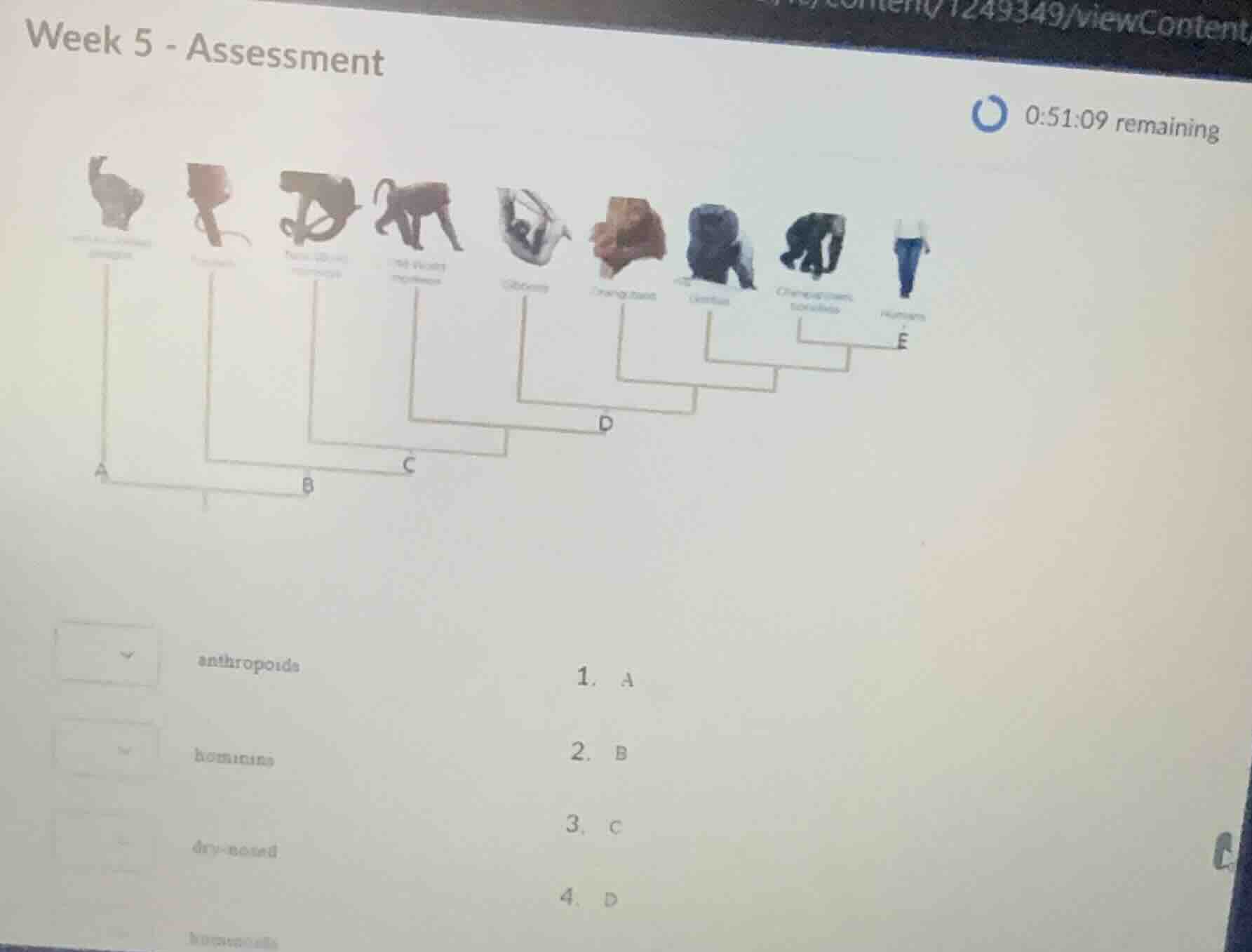
Identify the nodes on the primate phylogenetic tree
Using the Phylogeny and Systematics knowledge points
- Node A represents the common ancestor of all primates shown (wet-nosed primates/strepsirrhines and dry-nosed primates/haplorhines).
- Node B represents the common ancestor of dry-nosed primates (haplorhines), which split into tarsiers and anthropoids. Thus, B marks the dry-nosed primates clade.
- Node C represents the common ancestor of anthropoids (monkeys and apes), separating them from tarsiers.
- Node D represents the common ancestor of hominoids (apes: gibbons, orangutans, gorillas, chimpanzees, and humans).
- Node E represents the common ancestor of hominins (humans and their extinct bipedal ancestors), separating them from chimpanzees/bonobos.
Match the taxonomic groups to the corresponding nodes
Using the Phylogeny knowledge point
- anthropoids: This group includes New World monkeys, Old World monkeys, and apes (including humans). The common ancestor of this clade is represented by Node C.
- hominins: This group includes humans and our closest extinct relatives after the split from chimpanzees. The lineage leading uniquely to humans is represented by Node E.
- dry-nosed: This group (haplorhines) includes tarsiers, monkeys, and apes. The common ancestor of this clade is represented by Node B.
- hominoids: This group (apes) includes gibbons, orangutans, gorillas, chimpanzees, and humans. The common ancestor of this clade is represented by Node D.

Snap & solve any problem in the app
Get step-by-step solutions on Sovi AI
Photo-based solutions with guided steps
Explore more problems and detailed explanations
Match the taxonomic groups to the corresponding nodes on the phylogenetic tree:
- anthropoids: <blank>3. C</blank>
- hominins: <blank>E</blank>
- dry-nosed: <blank>2. B</blank>
- hominoids: <blank>4. D</blank>