QUESTION IMAGE
Question
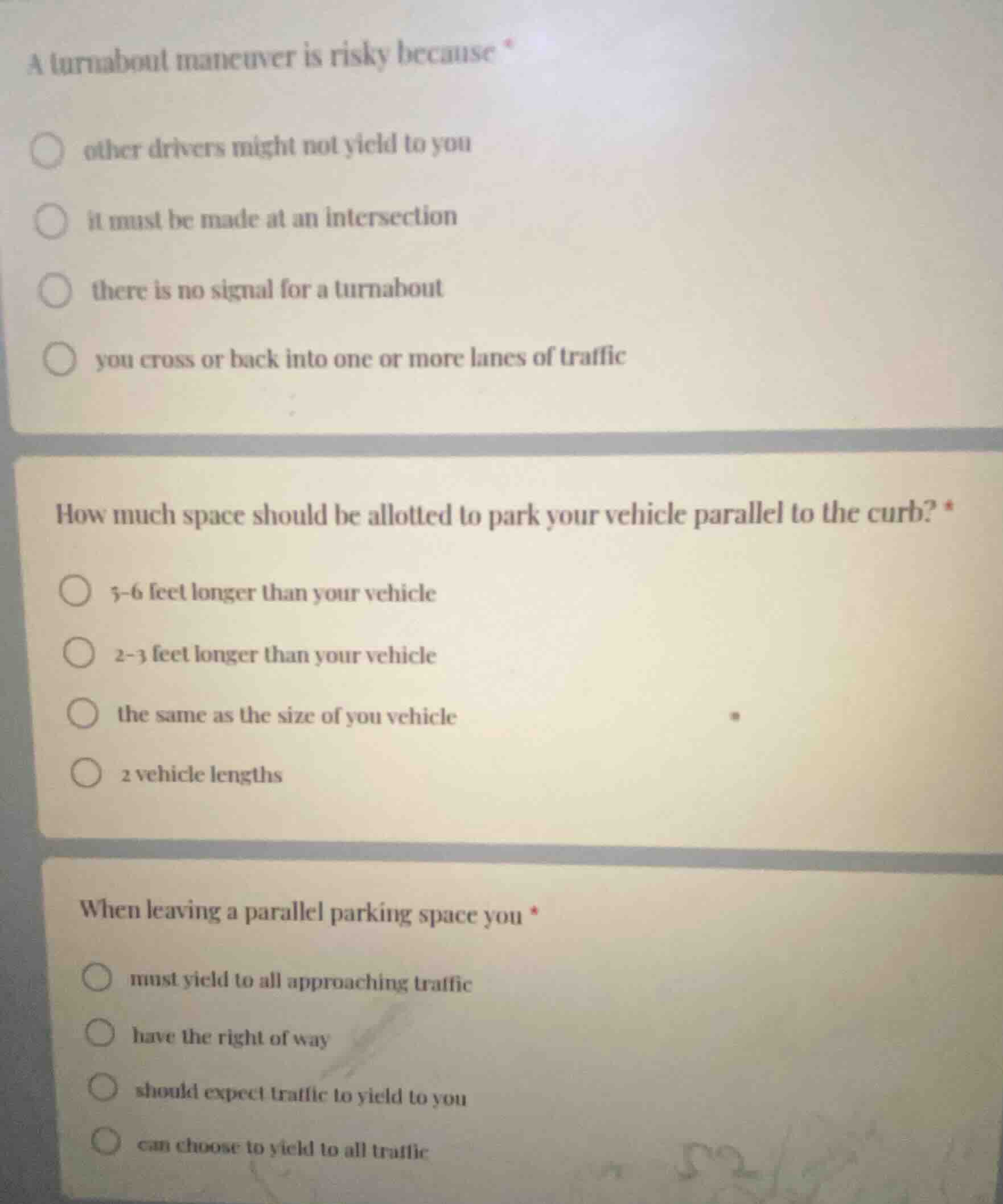
a turnabout maneuver is risky because *
other drivers might not yield to you
it must be made at an intersection
there is no signal for a turnabout
you cross or back into one or more lanes of traffic
how much space should be allotted to park your vehicle parallel to the curb? *
5-6 feet longer than your vehicle
2-3 feet longer than your vehicle
the same as the size of you vehicle
2 vehicle lengths
when leaving a parallel parking space you *
must yield to all approaching traffic
have the right of way
should expect traffic to yield to you
can choose to yield to all traffic
Analyze turnabout maneuver risks
A turnabout is a maneuver used to turn a vehicle around to go in the opposite direction. This action is inherently risky because it requires the driver to cross over or back into active lanes of traffic, exposing the vehicle to oncoming traffic from multiple directions. While other drivers failing to yield is a hazard, the fundamental reason the maneuver itself is classified as high-risk is the physical action of crossing or backing into active travel lanes. Therefore, the most complete and accurate reason is that you cross or back into one or more lanes of traffic. This relates to Defensive Driving principles where minimizing conflict points is key.
Determine parallel parking space requirements
When parallel parking along a curb, a driver needs enough space to maneuver the vehicle safely into the spot without hitting the vehicles in front or behind. Standard driver education guidelines state that the parking space should be approximately 5 to 6 feet longer than the length of your vehicle to allow adequate room for maneuvering.
Analyze yielding rules when leaving a parking space
When leaving a parallel parking space to enter the flow of traffic, you are entering an active roadway from a stopped, parked position. According to standard Yielding Rules, vehicles already traveling in the active lanes of traffic have the right of way. Therefore, you must yield to all approaching traffic before merging into the lane.

Snap & solve any problem in the app
Get step-by-step solutions on Sovi AI
Photo-based solutions with guided steps
Explore more problems and detailed explanations
Question 1
- other drivers might not yield to you
- it must be made at an intersection
- there is no signal for a turnabout
- you cross or back into one or more lanes of traffic (Correct answer)
Question 2
- 5-6 feet longer than your vehicle (Correct answer)
- 2-3 feet longer than your vehicle
- the same as the size of you vehicle
- 2 vehicle lengths
Question 3
- must yield to all approaching traffic (Correct answer)
- have the right of way
- should expect traffic to yield to you
- can choose to yield to all traffic