QUESTION IMAGE
Question
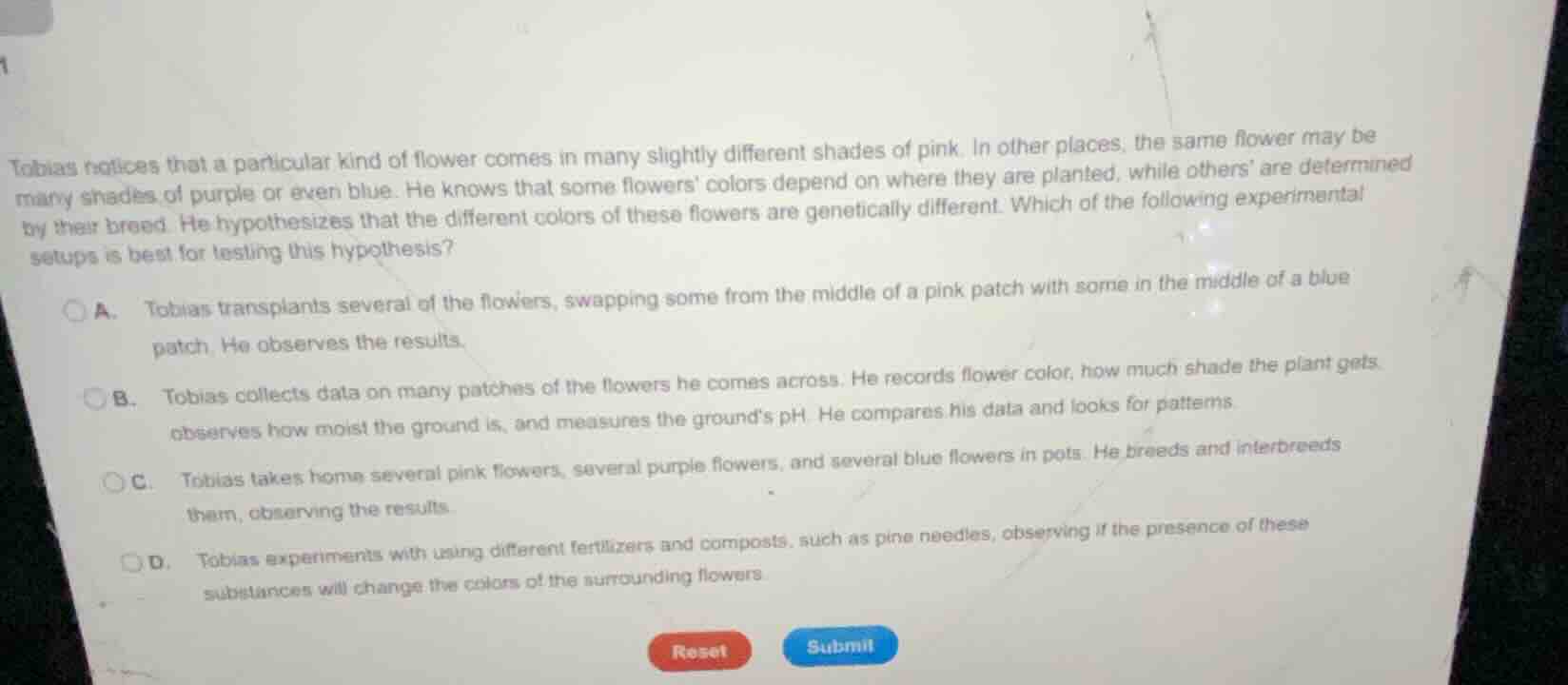
tobias notices that a particular kind of flower comes in many slightly different shades of pink. in other places, the same flower may be many shades of purple or even blue. he knows that some flowers colors depend on where they are planted, while others are determined by their breed. he hypothesizes that the different colors of these flowers are genetically different. which of the following experimental setups is best for testing this hypothesis?
a. tobias transplants several of the flowers, swapping some from the middle of a pink patch with some in the middle of a blue patch. he observes the results.
b. tobias collects data on many patches of the flowers he comes across. he records flower color, how much shade the plant gets, observes how moist the ground is, and measures the grounds ph. he compares his data and looks for patterns.
c. tobias takes home several pink flowers, several purple flowers, and several blue flowers in pots. he breeds and interbreeds them, observing the results.
d. tobias experiments with using different fertilizers and composts, such as pine needles, observing if the presence of these substances will change the colors of the surrounding flowers.
Identify the hypothesis to test
Using the Hypothesis Testing knowledge point
The student's hypothesis is that the different colors of these flowers are genetically determined (due to their breed) rather than environmentally determined (due to where they are planted).
Evaluate the experimental setups
Using the Experimental Design and Genetics vs Environment knowledge points
- Option A (Transplanting): Swapping flowers between a pink patch and a blue patch tests environmental influence. If transplanted flowers change color to match their new location, the cause is environmental. If they keep their original color, it suggests a genetic basis. This is a classic transplant experiment to distinguish genetic from environmental factors.
- Option B (Observational data): Collecting observational data on soil pH, moisture, and shade only identifies correlations with environmental factors, but cannot establish direct genetic causation.
- Option C (Breeding): Breeding and interbreeding the flowers in controlled pots allows Tobias to observe inheritance patterns. If flower color is genetically determined, breeding pink with pink, or blue with blue, will yield predictable genetic ratios in offspring regardless of the soil, directly testing the genetic hypothesis.
- Option D (Fertilizers/Composts): Testing different fertilizers and composts only tests specific environmental variables, not whether the trait is genetic.
Determine the best genetic test
Using the Genetics vs Environment knowledge point
To directly test if a trait is genetically determined (by their breed), controlled breeding experiments (Option C) are the most definitive scientific method. By breeding and interbreeding the different colored flowers in a uniform environment (pots), Tobias can observe if the color traits are inherited across generations according to genetic principles.

Snap & solve any problem in the app
Get step-by-step solutions on Sovi AI
Photo-based solutions with guided steps
Explore more problems and detailed explanations
- (A) Tobias transplants several of the flowers, swapping some from the middle of a pink patch with some in the middle of a blue patch. He observes the results.
- (B) Tobias collects data on many patches of the flowers he comes across. He records flower color, how much shade the plant gets, observes how moist the ground is, and measures the ground's pH. He compares his data and looks for patterns.
- (C) Tobias takes home several pink flowers, several purple flowers, and several blue flowers in pots. He breeds and interbreeds them, observing the results. (Correct answer)
- (D) Tobias experiments with using different fertilizers and composts, such as pine needles, observing if the presence of these substances will change the colors of the surrounding flowers.