QUESTION IMAGE
Question
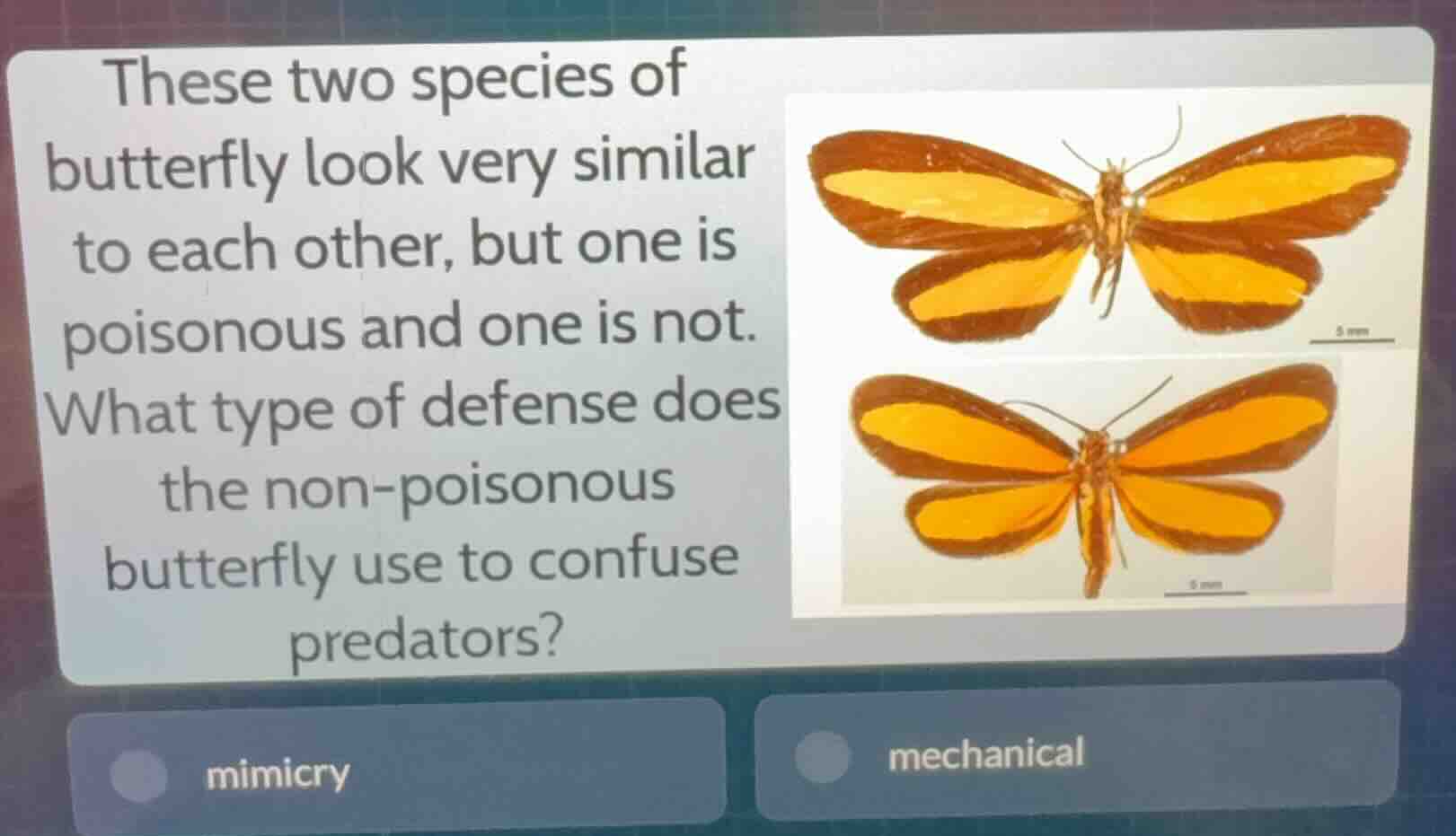
these two species of butterfly look very similar to each other, but one is poisonous and one is not. what type of defense does the non-poisonous butterfly use to confuse predators?
mimicry
mechanical
🆕 New Concept Discovered: Evolutionary Defense Mechanisms
How organisms protect themselves from predators
Step 1: Analyze the Scenario
The problem describes two species of butterflies that look very similar.
- One species is poisonous (harmful to predators).
- The other species is non-poisonous (harmless).
We need to identify the type of defense mechanism the harmless butterfly uses by copying the appearance of the poisonous one.
Step 2: Define the Options
- Mimicry: An evolutionary adaptation where one species evolves to resemble another species (the model) that possesses a strong defense mechanism (like being poisonous, venomous, or bad-tasting). This tricks predators into avoiding the harmless species.
- Mechanical defense: Physical structures or barriers on an organism's body that discourage or prevent predation (such as thorns on a plant, shells on a turtle, or spines on a porcupine).
Step 3: Select the Correct Defense
Because the non-poisonous butterfly relies on looking like the poisonous butterfly to trick predators, it is using mimicry (specifically, Batesian mimicry).

Snap & solve any problem in the app
Get step-by-step solutions on Sovi AI
Photo-based solutions with guided steps
Explore more problems and detailed explanations
mimicry