QUESTION IMAGE
Question
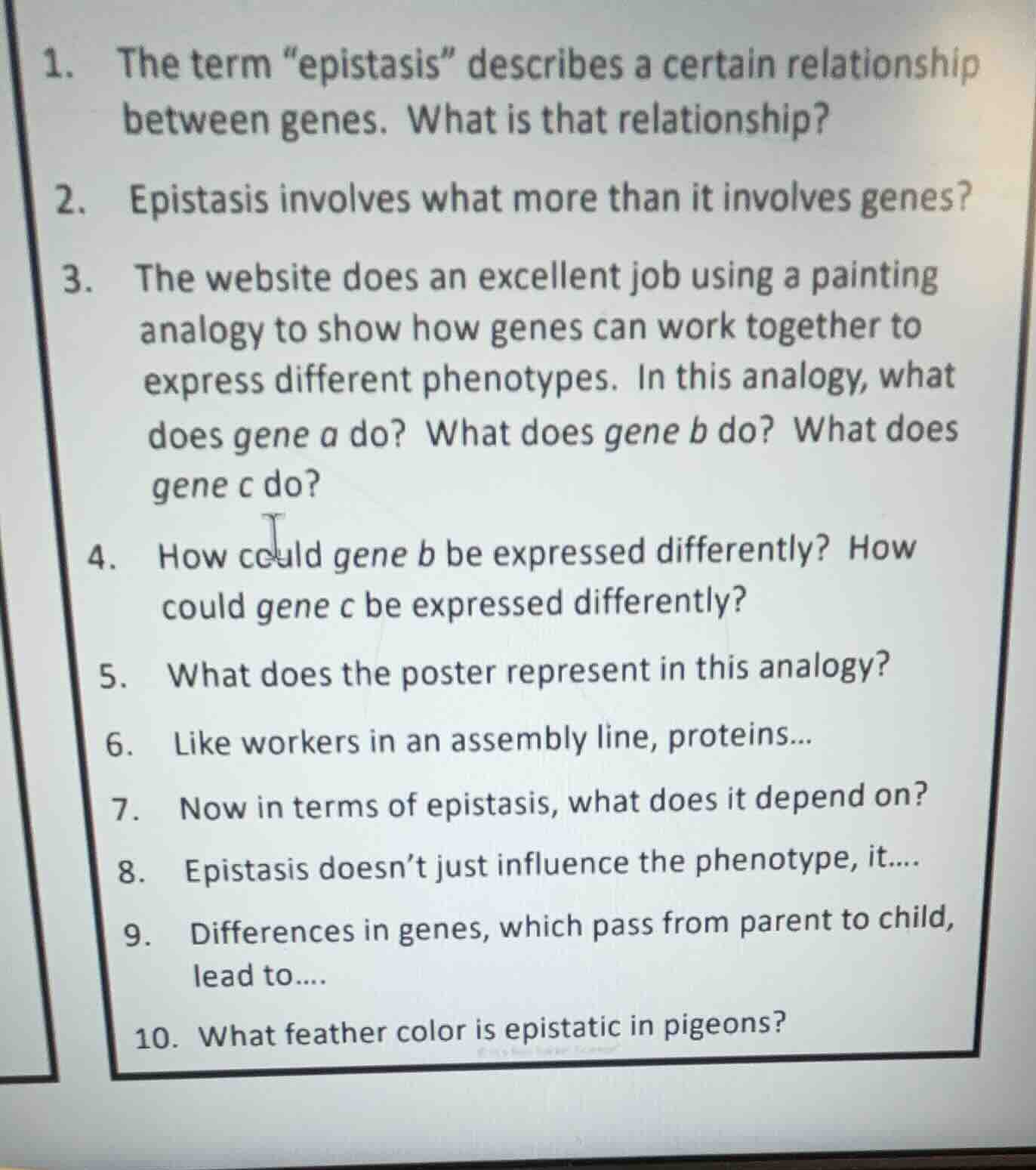
- the term \epistasis\ describes a certain relationship between genes. what is that relationship?
- epistasis involves what more than it involves genes?
- the website does an excellent job using a painting analogy to show how genes can work together to express different phenotypes. in this analogy, what does gene a do? what does gene b do? what does gene c do?
- how could gene b be expressed differently? how could gene c be expressed differently?
- what does the poster represent in this analogy?
- like workers in an assembly line, proteins...
- now in terms of epistasis, what does it depend on?
- epistasis doesnt just influence the phenotype, it....
- differences in genes, which pass from parent to child, lead to....
- what feather color is epistatic in pigeons?
Define epistasis gene relationship
Epistasis is a genetic interaction where one gene masks or interferes with the phenotypic expression of another gene.
Explain alleles and proteins
Epistasis involves the interaction of alleles and their protein products rather than just the genes themselves.
Analyze painting analogy roles
In the painting analogy, gene a determines the canvas background, gene b adds specific colors, and gene c acts as a sealer or mask.
Describe alternative expressions
Gene b can express different colors, while gene c can be active or inactive to allow or block color expression.
Identify poster representation
The poster represents the final observable phenotype resulting from the combined action of all genes.
Complete protein assembly line
Like workers in an assembly line, proteins act sequentially in metabolic pathways to produce a final product.
Determine epistasis dependencies
Epistasis depends on the specific combination of alleles at different loci and their biochemical pathway order.
Explain phenotypic influence
Epistasis doesn't just influence the phenotype, it alters expected Mendelian inheritance ratios.
Connect genetic differences
Differences in genes, which pass from parent to child, lead to phenotypic variation.
Identify pigeon epistasis
In pigeons, the dominant white feather color is epistatic over other color genes.

Snap & solve any problem in the app
Get step-by-step solutions on Sovi AI
Photo-based solutions with guided steps
Explore more problems and detailed explanations
- Epistasis is a relationship where the expression of one gene masks or modifies the phenotypic expression of another gene.
- Epistasis involves alleles and their protein products more than it involves genes in isolation.
- In this analogy, gene a provides the base canvas, gene b applies the paint colors, and gene c acts as a clear coat or mask that determines if the paint is visible.
- Gene b could be expressed differently by producing different paint colors, and gene c could be expressed differently by either allowing the paint to show or completely masking it.
- The poster represents the final observable phenotype of the organism.
- Like workers in an assembly line, proteins work in a sequential biochemical pathway to synthesize a final pigment or trait.
- In terms of epistasis, it depends on the functional interaction of proteins produced by different gene loci.
- Epistasis doesn't just influence the phenotype, it alters the classical Mendelian phenotypic ratios (such as changing a 9:3:3:1 ratio to 9:3:4 or 12:3:1).
- Differences in genes, which pass from parent to child, lead to variation in the physical traits (phenotypes) of the offspring.
- In pigeons, dominant white (or red in some specific genetic contexts) is epistatic to other feather colors.