QUESTION IMAGE
Question
taste sensation to the root of the tongue
eye movement
skin of the external acoustic meatus
heart rhythm
colon
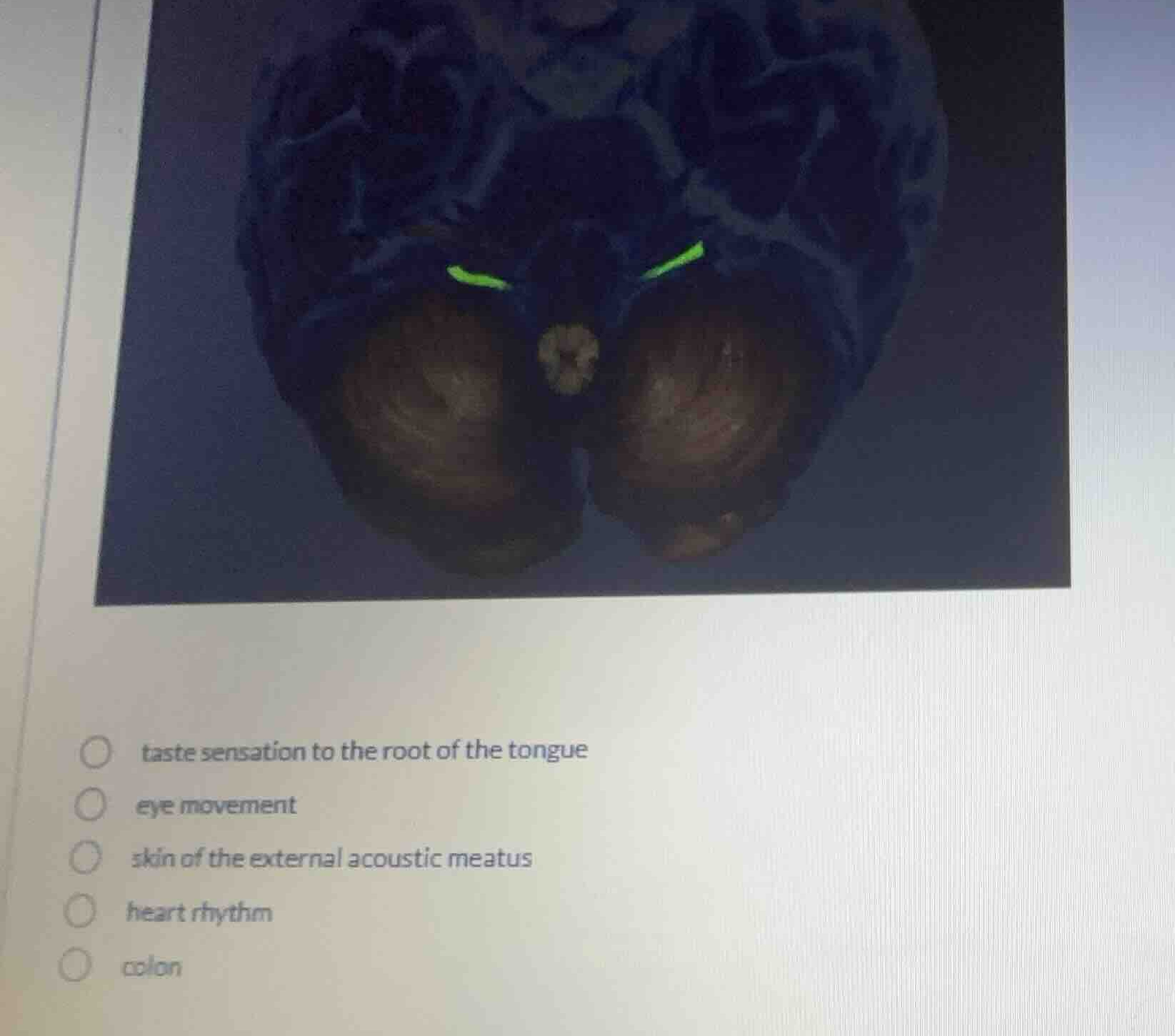
Identify the highlighted anatomical structure
The image shows a posterior (dorsal) view of the brainstem and cerebellum (with the cerebellum partially removed or reflected). We can see the posterior aspect of the midbrain and pons. Specifically, emerging from the dorsal aspect of the midbrain, just inferior to the inferior colliculi, are two thin nerves wrapping anteriorly around the brainstem. These nerves are highlighted in bright green. This dorsal emergence is unique to Cranial Nerve IV, the trochlear nerve.
Determine the function of the identified nerve
Using the Cranial Nerve Identification knowledge point, we identify the highlighted structure as the trochlear nerve (CN IV). The trochlear nerve is a motor nerve that innervates a single muscle: the superior oblique muscle of the eye. Therefore, its primary function is to control eye movement (specifically, intorsion, depression, and abduction of the eyeball).
Evaluate the given options
Let's match the function of the trochlear nerve with the provided choices:
- "taste sensation to the root of the tongue": This is a function of the glossopharyngeal nerve (CN IX), which we know from the Glossopharyngeal Nerve Function knowledge point.
- "eye movement": This directly matches the motor function of the trochlear nerve (CN IV) controlling the superior oblique muscle.
- "skin of the external acoustic meatus": This sensory area is innervated by branches of the vagus nerve (CN X), facial nerve (CN VII), and glossopharyngeal nerve (CN IX).
- "heart rhythm": This parasympathetic regulation is mediated by the vagus nerve (CN X).
- "colon": Parasympathetic innervation to the distal colon is supplied by pelvic splanchnic nerves (S2-S4), while the proximal colon is supplied by the vagus nerve (CN X).

Snap & solve any problem in the app
Get step-by-step solutions on Sovi AI
Photo-based solutions with guided steps
Explore more problems and detailed explanations
- taste sensation to the root of the tongue
- eye movement (Correct answer)
- skin of the external acoustic meatus
- heart rhythm
- colon