QUESTION IMAGE
Question
synthesis of the leading and lagging strands (bioflix tutorial)
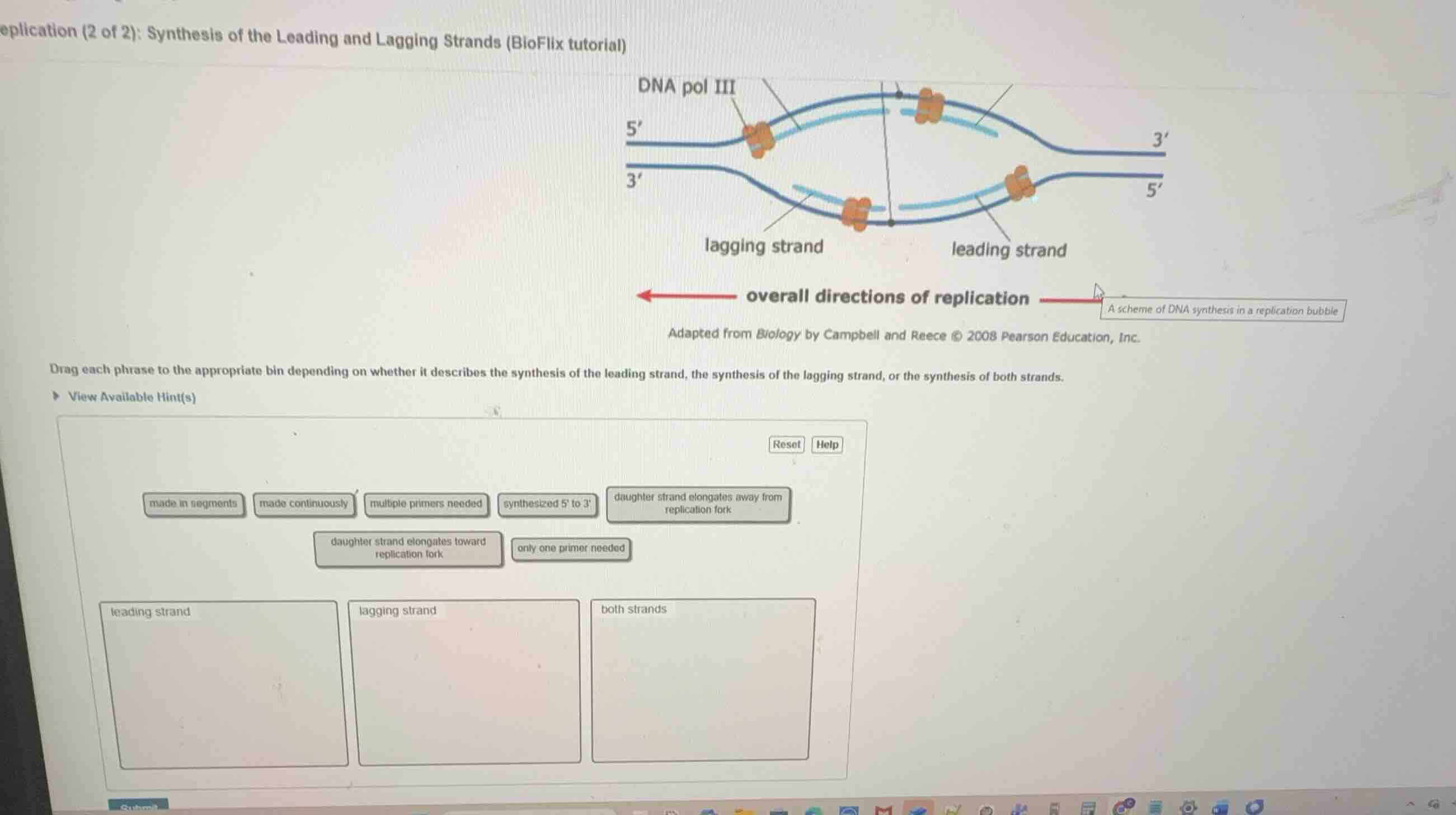
drag each phrase to the appropriate bin depending on whether it describes the synthesis of the leading strand, the synthesis of the lagging strand, or the synthesis of both strands.
phrases:
- made in segments
- made continuously
- multiple primers needed
- synthesized 5 to 3
- daughter strand elongates away from replication fork
- daughter strand elongates toward replication fork
- only one primer needed
bins:
- leading strand
- lagging strand
- both strands
Analyze leading strand synthesis
The leading strand is synthesized continuously in the direction of the replication fork movement. Because synthesis is continuous, it requires only one primer to initiate replication. As the replication fork opens, the daughter strand elongates toward replication fork. This process is part of Leading and Lagging Strand Synthesis.
Analyze lagging strand synthesis
The lagging strand is synthesized discontinuously because DNA polymerase can only add nucleotides in the 5' to 3' direction. This strand is made in segments (Okazaki fragments). Because it is made in segments, multiple primers needed are required (one for each segment). The direction of synthesis means the daughter strand elongates away from replication fork.
Analyze features of both strands
Both the leading and lagging strands are synthesized by DNA polymerases that can only add nucleotides to the 3' end of a growing strand. Therefore, the new DNA on both strands is synthesized 5' to 3'.

Snap & solve any problem in the app
Get step-by-step solutions on Sovi AI
Photo-based solutions with guided steps
Explore more problems and detailed explanations
- leading strand
- made continuously
- only one primer needed
- daughter strand elongates toward replication fork
- lagging strand
- made in segments
- multiple primers needed
- daughter strand elongates away from replication fork
- both strands
- synthesized 5' to 3'