QUESTION IMAGE
Question
station 4: vestigial structures
- research the following vestigial structures to find their names and theorized origins.
image #1
whale skeleton
image #2
human eye
image #3
human wrist
Identify the structures
We analyze the three images to identify each specific vestigial structure circled or highlighted.
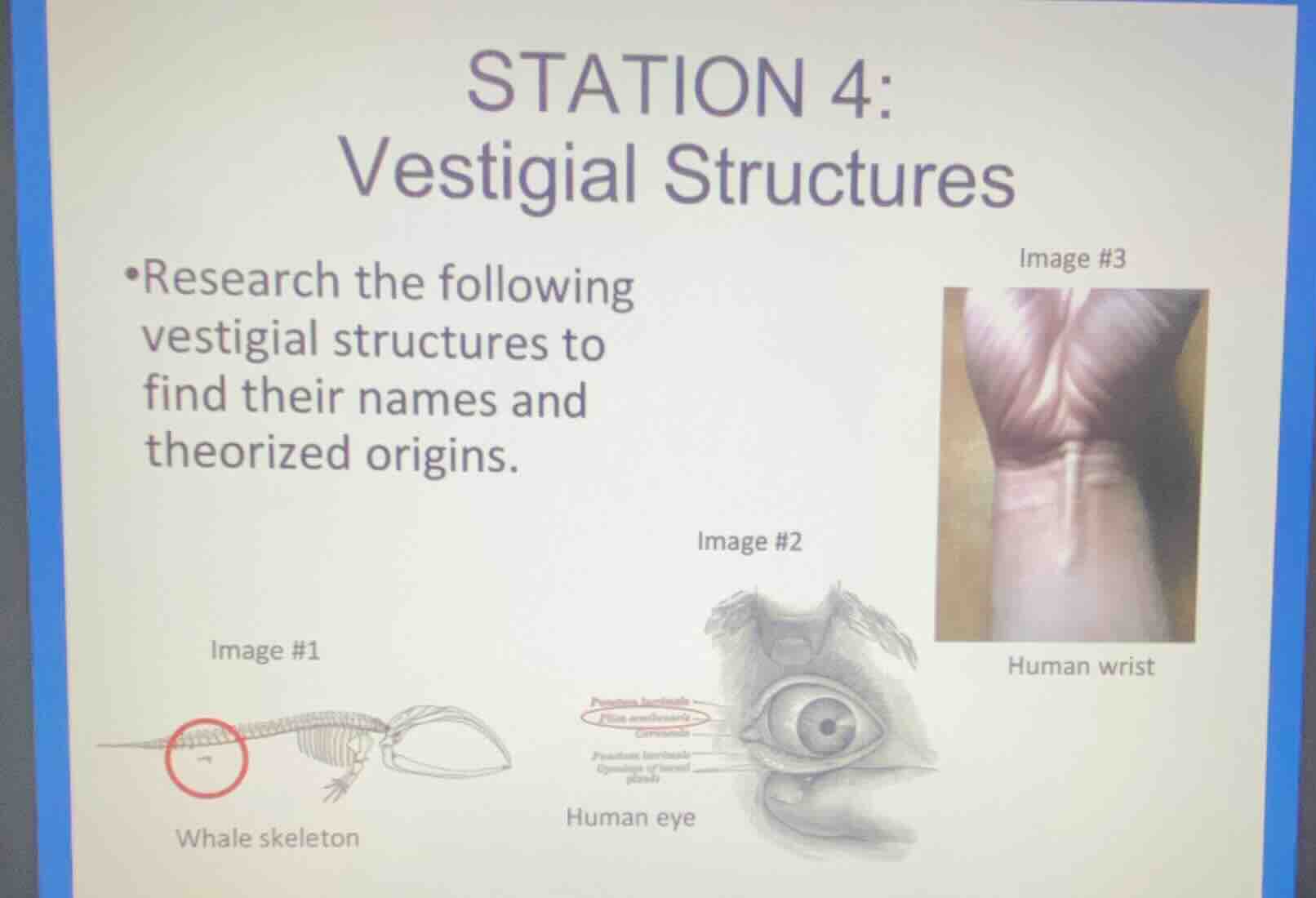
- Image #1 (Whale skeleton): The red circle highlights the pelvic bones (pelvis and femur remnants) located near the rear of the whale's skeletal structure.
- Image #2 (Human eye): The red circle highlights the plica semilunaris, which is the small fold of tissue on the inner corner of the human eye.
- Image #3 (Human wrist): The image shows a prominent tendon popping up in the wrist when the thumb and pinky are touched together, which is the tendon of the palmaris longus muscle.
Determine theorized origins
We research and explain the evolutionary origins and ancestral functions of these structures.
- Whale pelvic bones: Whales evolved from four-legged terrestrial mammalian ancestors (such as Pakicetus). These bones are remnants of hind limbs used for walking on land.
- Plica semilunaris: This is a vestigial remnant of the nictitating membrane (or "third eyelid"), which is fully functional in birds, reptiles, and some mammals to moisten and protect the eye.
- Palmaris longus tendon: This muscle was used by arboreal ancestors for hanging, climbing, and gripping tree branches. It is absent in about 14% of the modern human population without affecting grip strength.

Snap & solve any problem in the app
Get step-by-step solutions on Sovi AI
Photo-based solutions with guided steps
Explore more problems and detailed explanations
Based on the provided images, here are the names and theorized evolutionary origins of the highlighted vestigial structures:
Image #1: Whale Skeleton
- Name: Pelvic bones (pelvis and femur remnants)
- Theorized Origin: These bones are remnants of hind limbs inherited from the terrestrial, four-legged mammalian ancestors of modern whales (such as Pakicetus), which walked on land millions of years ago.
Image #2: Human Eye
- Name: Plica semilunaris
- Theorized Origin: This is the vestigial remnant of the nictitating membrane, or "third eyelid." In ancestral species (and many modern reptiles, birds, and sharks), this membrane sweeps horizontally across the eye to protect and moisten it while maintaining visibility.
Image #3: Human Wrist
- Name: Palmaris longus tendon
- Theorized Origin: This muscle and its tendon were used by our tree-dwelling (arboreal) primate ancestors to assist in climbing, swinging, and gripping branches. In modern humans, it is no longer necessary for daily survival and is completely absent in about 14% of the population with no loss in hand strength.