QUESTION IMAGE
Question
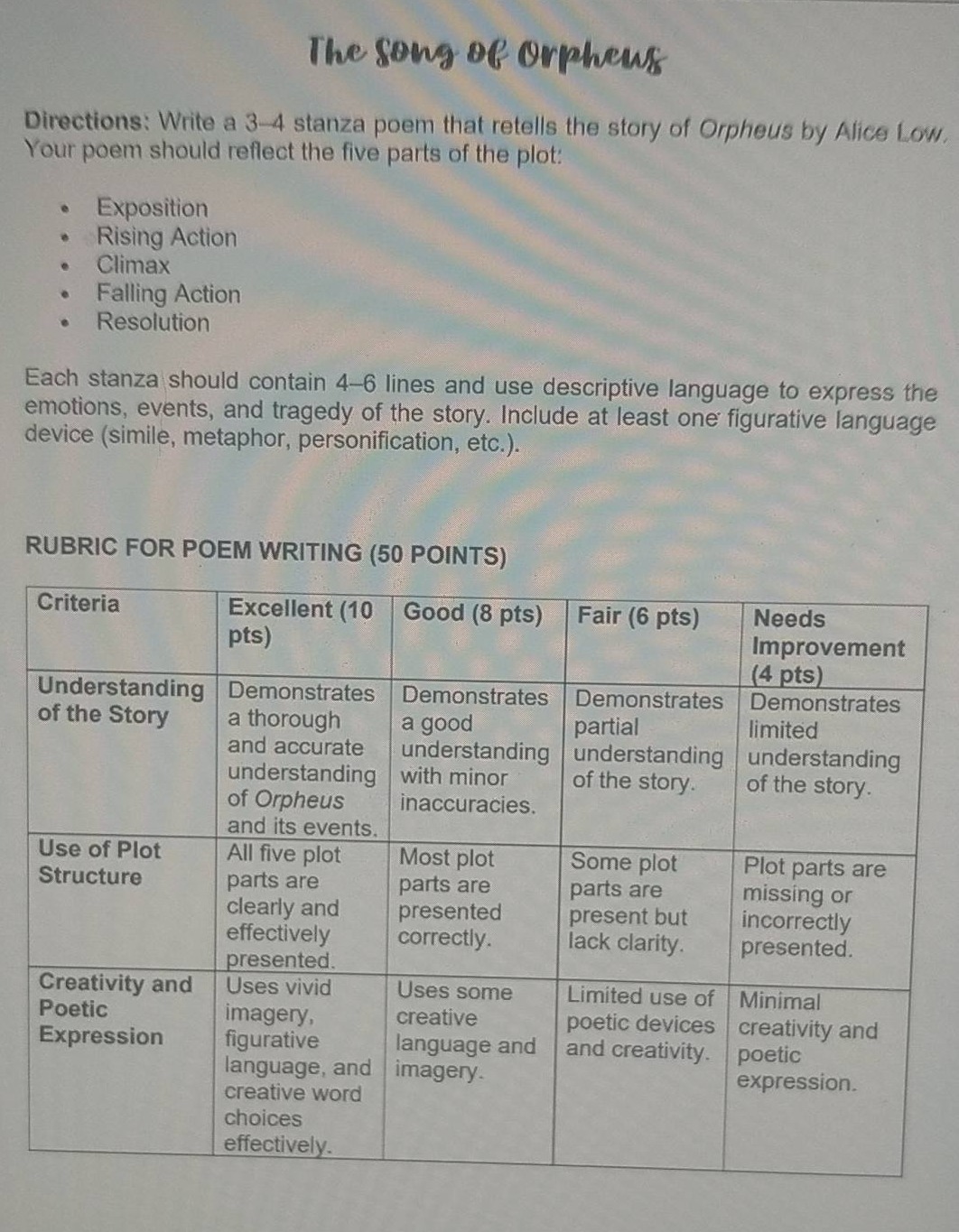
the song of orpheus
directions: write a 3-4 stanza poem that retells the story of orpheus by alice low. your poem should reflect the five parts of the plot:
- exposition
- rising action
- climax
- falling action
- resolution
each stanza should contain 4-6 lines and use descriptive language to express the emotions, events, and tragedy of the story. include at least one figurative language device (simile, metaphor, personification, etc.).
rubric for poem writing (50 points)
| criteria | excellent (10 pts) | good (8 pts) | fair (6 pts) | needs improvement (4 pts) |
|---|---|---|---|---|
| use of plot structure | all five plot parts are clearly and effectively presented. | most plot parts are presented correctly. | some plot parts are present but lack clarity. | plot parts are missing or incorrectly presented. |
| creativity and poetic expression | uses vivid imagery, figurative language, and creative word choices effectively. | uses some creative language and imagery. | limited use of poetic devices and creativity. | minimal creativity and poetic expression. |
⚡ Using what you learned: structural components of narrative plot · 🆕 New Concept Discovered: Poetic Retelling
Translating a narrative arc into structured, figurative verses.
Step 1: Map the Narrative Plot to Stanzas
To retell the story of Orpheus by Alice Low in a 4-stanza poem, we must map the five essential plot components across the stanzas:
- Stanza 1 (Exposition): Introduce Orpheus, his divine music, and his deep love for his bride, Eurydice.
- Stanza 2 (Rising Action): Eurydice's tragic death from a snakebite, and Orpheus's daring journey down into the dark Underworld to rescue her.
- Stanza 3 (Climax): Orpheus charms Hades with his lyre, securing her release on one condition: he must not look back. At the very last moment, doubt overcomes him, and he turns around.
- Stanza 4 (Falling Action & Resolution): Eurydice slips back into the shadows forever. Orpheus is left in inconsolable grief, singing his sorrow to the world until his own end.
Step 2: Incorporate Poetic Devices and Constraints
We will write 4 stanzas, each containing exactly 5 lines (meeting the 4–6 lines requirement). To ensure an "Excellent" rubric score, we will weave in vivid imagery and clear figurative language:
- Metaphor: "His lyre was a key to the locked gates of death."
- Personification: "The shadows wept."
- Simile: "She slipped away like morning mist."
Step 3: Draft the Poem
Stanza 1: Exposition
With a golden lyre and a voice of pure light,
Orpheus charmed the wild beasts and the trees.
His world became whole, shining brilliant and bright,
When lovely Eurydice brought him to his knees;
Their love was a sunbeam, untouched by the night.
Stanza 2: Rising Action
But death's silent serpent struck swift in the grass,
And dragged his sweet bride to the cold world below.
Through caverns of shadow where pale spirits pass,
He followed her down with his music in tow,
Determined to shatter the gates made of brass.
Stanza 3: Climax
His melody softened the dark king's cold heart,
"She may follow behind, but you must not look back!"
Yet doubt, like a poison, tore Orpheus apart;
He turned near the exit, the cavern went black,
As fate ripped their hands and their futures apart.
Stanza 4: Falling Action & Resolution
She slipped from his reach like a vapor of smoke,
Lost to the shadows of Hades forevermore.
No second chance came, and his sad spirit broke;
He wept by the rivers and sang on the shore,
Till silence reclaimed him and never awoke.

Snap & solve any problem in the app
Get step-by-step solutions on Sovi AI
Photo-based solutions with guided steps
Explore more problems and detailed explanations
The Song of Orpheus
With a golden lyre and a voice of pure light,
Orpheus charmed the wild beasts and the trees.
His world became whole, shining brilliant and bright,
When lovely Eurydice brought him to his knees;
Their love was a sunbeam, untouched by the night.
But death's silent serpent struck swift in the grass,
And dragged his sweet bride to the cold world below.
Through caverns of shadow where pale spirits pass,
He followed her down with his music in tow,
Determined to shatter the gates made of brass.
His melody softened the dark king's cold heart,
"She may follow behind, but you must not look back!"
Yet doubt, like a poison, tore Orpheus apart;
He turned near the exit, the cavern went black,
As fate ripped their hands and their futures apart.
She slipped from his reach like a vapor of smoke,
Lost to the shadows of Hades forevermore.
No second chance came, and his sad spirit broke;
He wept by the rivers and sang on the shore,
Till silence reclaimed him and never awoke.