QUESTION IMAGE
Question
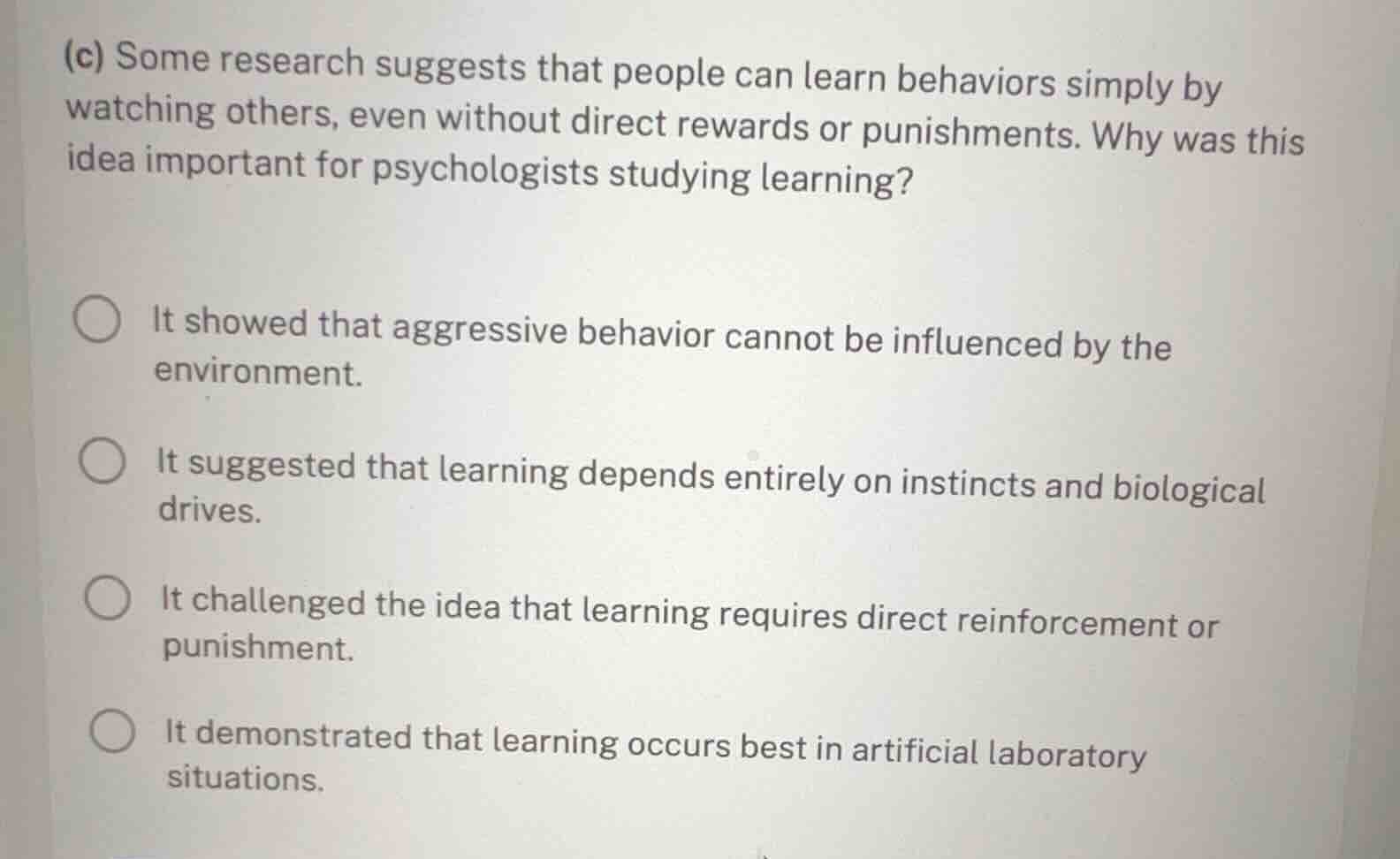
(c) some research suggests that people can learn behaviors simply by watching others, even without direct rewards or punishments. why was this idea important for psychologists studying learning?
- it showed that aggressive behavior cannot be influenced by the environment.
- it suggested that learning depends entirely on instincts and biological drives.
- it challenged the idea that learning requires direct reinforcement or punishment.
- it demonstrated that learning occurs best in artificial laboratory situations.
<pre_analysis>
{
"quality": "clear",
"question_count": 1,
"skills_matched": [
"direct_cot",
"multiple_choice_formatter",
"explain_then_answer",
"tutor",
"mastery_adaptive_brevity"
],
"needs_drawing": false,
"concepts_used": [
"Observational Learning",
"Operant Conditioning"
],
"new_concepts": [],
"current_concepts": [
"Observational Learning",
"Operant Conditioning",
"Classical Conditioning"
]
}
</pre_analysis>
<reasoning>
Identify the core concept
Using the Observational Learning knowledge point, we analyze the premise that individuals can acquire new behaviors simply by watching others, a process known as observational learning or modeling (most famously studied by Albert Bandura).
Evaluate the historical context of learning theories
Using the Operant Conditioning knowledge point, traditional behaviorist models (such as those proposed by B.F. Skinner) asserted that learning occurs primarily through direct reinforcement (rewards) or punishment following a behavior.
Analyze the impact of the new finding
The discovery of observational learning demonstrated that learning can occur cognitively without direct, personal experience of consequences. This directly challenged the strict behaviorist view that direct reinforcement or punishment is a necessary condition for learning to take place.
Evaluate the given options
- Option 1: Incorrect. Observational learning (e.g., the Bobo doll experiment) showed that aggressive behavior is heavily influenced by environmental models.
- Option 2: Incorrect. It emphasized cognitive and social factors rather than purely biological drives or instincts.
- Option 3: Correct. It directly challenged the behaviorist dogma that learning requires direct reinforcement or punishment.
- Option 4: Incorrect. Observational learning occurs naturally in everyday social environments, not just artificial laboratories.
</reasoning>
<answer>
<mcq-option>It showed that aggressive behavior cannot be influenced by the environment.</mcq-option>
<mcq-option>It suggested that learning depends entirely on instincts and biological drives.</mcq-option>
<mcq-correct>It challenged the idea that learning requires direct reinforcement or punishment.</mcq-correct>
<mcq-option>It demonstrated that learning occurs best in artificial laboratory situations.</mcq-option>
</answer>
<post_analysis>
{
"subject": "Social Science",
"question_type": "Multiple Choice",
"knowledge_point": [
"Social Science",
"Psychology",
"Observational Learning"
]
}
</post_analysis>
Snap & solve any problem in the app
Get step-by-step solutions on Sovi AI
Photo-based solutions with guided steps
Explore more problems and detailed explanations
<pre_analysis>
{
"quality": "clear",
"question_count": 1,
"skills_matched": [
"direct_cot",
"multiple_choice_formatter",
"explain_then_answer",
"tutor",
"mastery_adaptive_brevity"
],
"needs_drawing": false,
"concepts_used": [
"Observational Learning",
"Operant Conditioning"
],
"new_concepts": [],
"current_concepts": [
"Observational Learning",
"Operant Conditioning",
"Classical Conditioning"
]
}
</pre_analysis>
<reasoning>
Identify the core concept
Using the Observational Learning knowledge point, we analyze the premise that individuals can acquire new behaviors simply by watching others, a process known as observational learning or modeling (most famously studied by Albert Bandura).
Evaluate the historical context of learning theories
Using the Operant Conditioning knowledge point, traditional behaviorist models (such as those proposed by B.F. Skinner) asserted that learning occurs primarily through direct reinforcement (rewards) or punishment following a behavior.
Analyze the impact of the new finding
The discovery of observational learning demonstrated that learning can occur cognitively without direct, personal experience of consequences. This directly challenged the strict behaviorist view that direct reinforcement or punishment is a necessary condition for learning to take place.
Evaluate the given options
- Option 1: Incorrect. Observational learning (e.g., the Bobo doll experiment) showed that aggressive behavior is heavily influenced by environmental models.
- Option 2: Incorrect. It emphasized cognitive and social factors rather than purely biological drives or instincts.
- Option 3: Correct. It directly challenged the behaviorist dogma that learning requires direct reinforcement or punishment.
- Option 4: Incorrect. Observational learning occurs naturally in everyday social environments, not just artificial laboratories.
</reasoning>
<answer>
<mcq-option>It showed that aggressive behavior cannot be influenced by the environment.</mcq-option>
<mcq-option>It suggested that learning depends entirely on instincts and biological drives.</mcq-option>
<mcq-correct>It challenged the idea that learning requires direct reinforcement or punishment.</mcq-correct>
<mcq-option>It demonstrated that learning occurs best in artificial laboratory situations.</mcq-option>
</answer>
<post_analysis>
{
"subject": "Social Science",
"question_type": "Multiple Choice",
"knowledge_point": [
"Social Science",
"Psychology",
"Observational Learning"
]
}
</post_analysis>