QUESTION IMAGE
Question
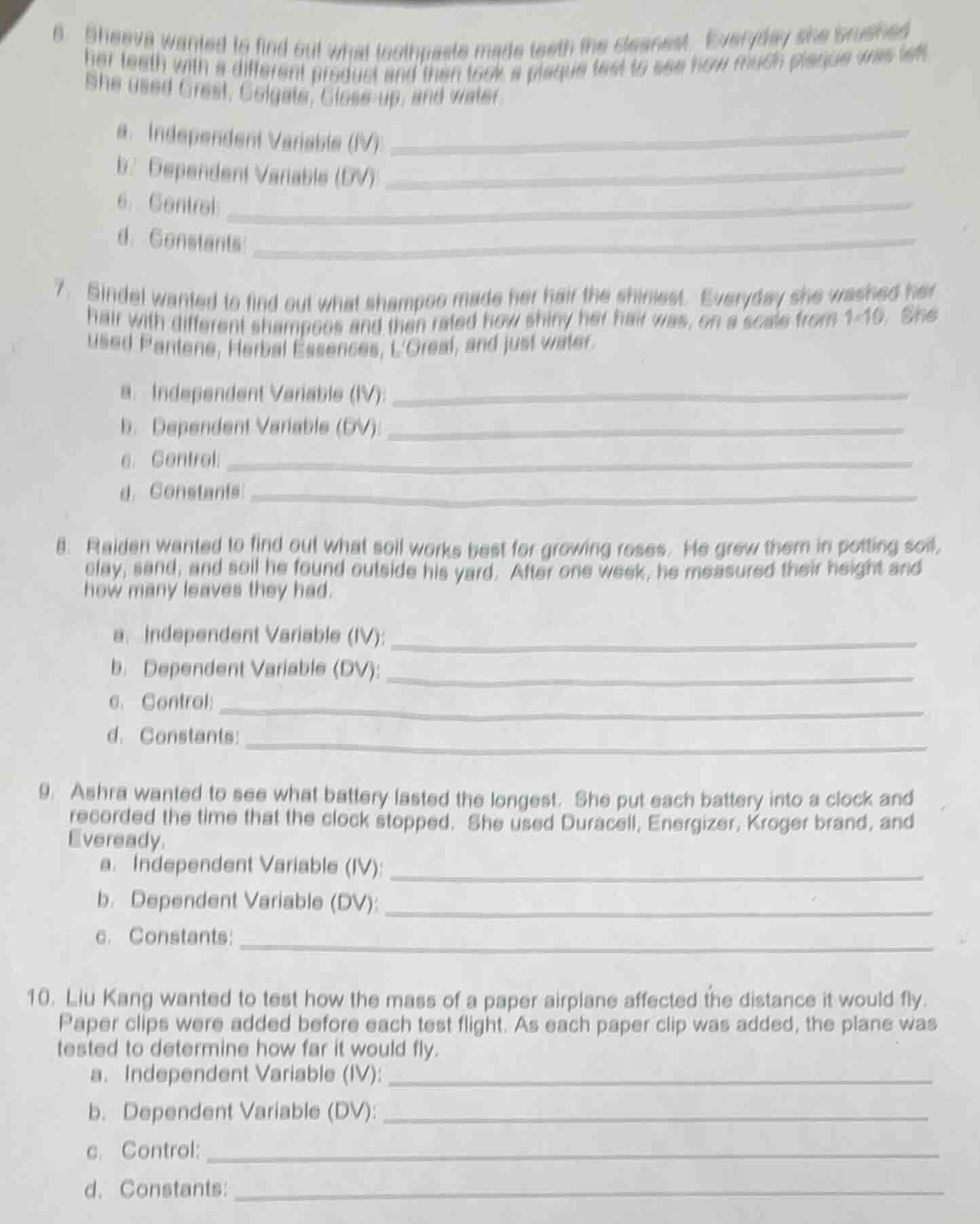
- sheeva wanted to find out what toothpaste made teeth the cleanest. everyday she brushed her teeth with a different product and then took a plaque test to see how much plaque was left. she used crest, colgate, close-up, and water.
a. independent variable (iv):
b. dependent variable (dv):
c. control:
d. constants:
- sindel wanted to find out what shampoo made her hair the shiniest. everyday she washed her hair with different shampoos and then rated how shiny her hair was, on a scale from 1-10. she used pantene, herbal essences, loreal, and just water.
a. independent variable (iv):
b. dependent variable (dv):
c. control:
d. constants:
- raiden wanted to find out what soil works best for growing roses. he grew them in potting soil, clay, sand, and soil he found outside his yard. after one week, he measured their height and how many leaves they had.
a. independent variable (iv):
b. dependent variable (dv):
c. control:
d. constants:
- ashra wanted to see what battery lasted the longest. she put each battery into a clock and recorded the time that the clock stopped. she used duracell, energizer, kroger brand, and eveready.
a. independent variable (iv):
b. dependent variable (dv):
c. constants:
- liu kang wanted to test how the mass of a paper airplane affected the distance it would fly. paper clips were added before each test flight. as each paper clip was added, the plane was tested to determine how far it would fly.
a. independent variable (iv):
b. dependent variable (dv):
c. control:
d. constants:
🆕 New Concept Discovered: Scientific Variables
Identifying what changes, what is measured, and what stays the same in an experiment.
---
Step 1: Understand the Core Concepts
To solve these problems, we need to identify four key components of a scientific experiment:
- Independent Variable (IV): The factor that the experimenter deliberately changes or manipulates (the "cause").
- Dependent Variable (DV): The factor that is measured or observed to see how it responds to the independent variable (the "effect").
- Control: The standard or baseline group used for comparison. It represents the "normal" condition or receives no special treatment (e.g., using plain water instead of a product).
- Constants: The factors that must be kept exactly the same throughout the experiment to ensure a fair test.
---
Step 2: Solve Question 6 (Sheeva's Toothpaste Experiment)
- Scenario: Sheeva tests different toothpastes (Crest, Colgate, Close-up, and water) to see which leaves teeth the cleanest by measuring plaque left behind.
- Independent Variable (IV): What she changes deliberately is the type of toothpaste (or brand of toothpaste).
- Dependent Variable (DV): What she measures is the amount of plaque left on her teeth (or teeth cleanliness).
- Control: The baseline group that does not contain the active testing agent (toothpaste) is brushing with water.
- Constants: To make it fair, she must keep things the same, such as the type of toothbrush used, brushing duration (time), brushing technique, and her diet/eating habits before testing.
---
Step 3: Solve Question 7 (Sindel's Shampoo Experiment)
- Scenario: Sindel washes her hair with different shampoos (Pantene, Herbal Essences, L'Oreal, and water) and rates hair shininess on a scale of 1–10.
- Independent Variable (IV): The factor being changed is the type of shampoo (or brand of shampoo).
- Dependent Variable (DV): The factor being measured/rated is the shininess of her hair (on a scale of 1–10).
- Control: The baseline comparison group is washing with just water.
- Constants: Factors kept the same include the amount of water used, water temperature, washing duration, hair drying method, and the person rating the shininess.
---
Step 4: Solve Question 8 (Raiden's Soil Experiment)
- Scenario: Raiden grows roses in different soils (potting soil, clay, sand, and yard soil) and measures their height and number of leaves after one week.
- Independent Variable (IV): The factor being changed is the type of soil.
- Dependent Variable (DV): The factors being measured are the height of the roses and the number of leaves.
- Control: The baseline comparison is the soil found outside his yard (representing the natural/normal condition).
- Constants: Factors kept the same include the type of roses, amount of water given, amount of sunlight, pot size, and growth duration (one week).
---
Step 5: Solve Question 9 (Ashra's Battery Experiment)
- Scenario: Ashra tests different battery brands (Duracell, Energizer, Kroger brand, Eveready) in a clock to see which lasts the longest by recording when the clock stops.
- Independent Variable (IV): The factor being changed is the brand of battery.
- Dependent Variable (DV): The factor being measured is the time the clock stopped (or battery lifespan/how long the battery lasted).
- Constants: Factors kept the same include using the **same type of clock…

Snap & solve any problem in the app
Get step-by-step solutions on Sovi AI
Photo-based solutions with guided steps
Explore more problems and detailed explanations
6. Sheeva's Toothpaste Experiment
- a. Independent Variable (IV): Type of toothpaste (Crest, Colgate, Close-up)
- b. Dependent Variable (DV): Amount of plaque left on teeth (cleanliness)
- c. Control: Brushing with plain water
- d. Constants: Type of toothbrush, brushing time, brushing technique, diet
7. Sindel's Shampoo Experiment
- a. Independent Variable (IV): Type of shampoo (Pantene, Herbal Essences, L'Oreal)
- b. Dependent Variable (DV): Shininess of hair (rated on a scale of 1–10)
- c. Control: Washing with just water
- d. Constants: Water temperature, washing time, drying method, amount of water used
8. Raiden's Soil Experiment
- a. Independent Variable (IV): Type of soil (potting soil, clay, sand, yard soil)
- b. Dependent Variable (DV): Height of the roses and number of leaves
- c. Control: Soil found outside his yard (natural condition)
- d. Constants: Type of rose plant, amount of water, amount of sunlight, pot size, duration of experiment (one week)
9. Ashra's Battery Experiment
- a. Independent Variable (IV): Brand of battery (Duracell, Energizer, Kroger, Eveready)
- b. Dependent Variable (DV): Time the clock stopped (how long the battery lasted)
- c. Constants: Same type of clock, same size of battery (e.g., AA)
10. Liu Kang's Paper Airplane Experiment
- a. Independent Variable (IV): Mass of the paper airplane (number of paper clips added)
- b. Dependent Variable (DV): Distance the plane flies
- c. Control: Paper airplane with no paper clips added
- d. Constants: Airplane design, type of paper, throwing force, throwing angle, wind conditions (indoor testing)