QUESTION IMAGE
Question
select the correct text in the passage.
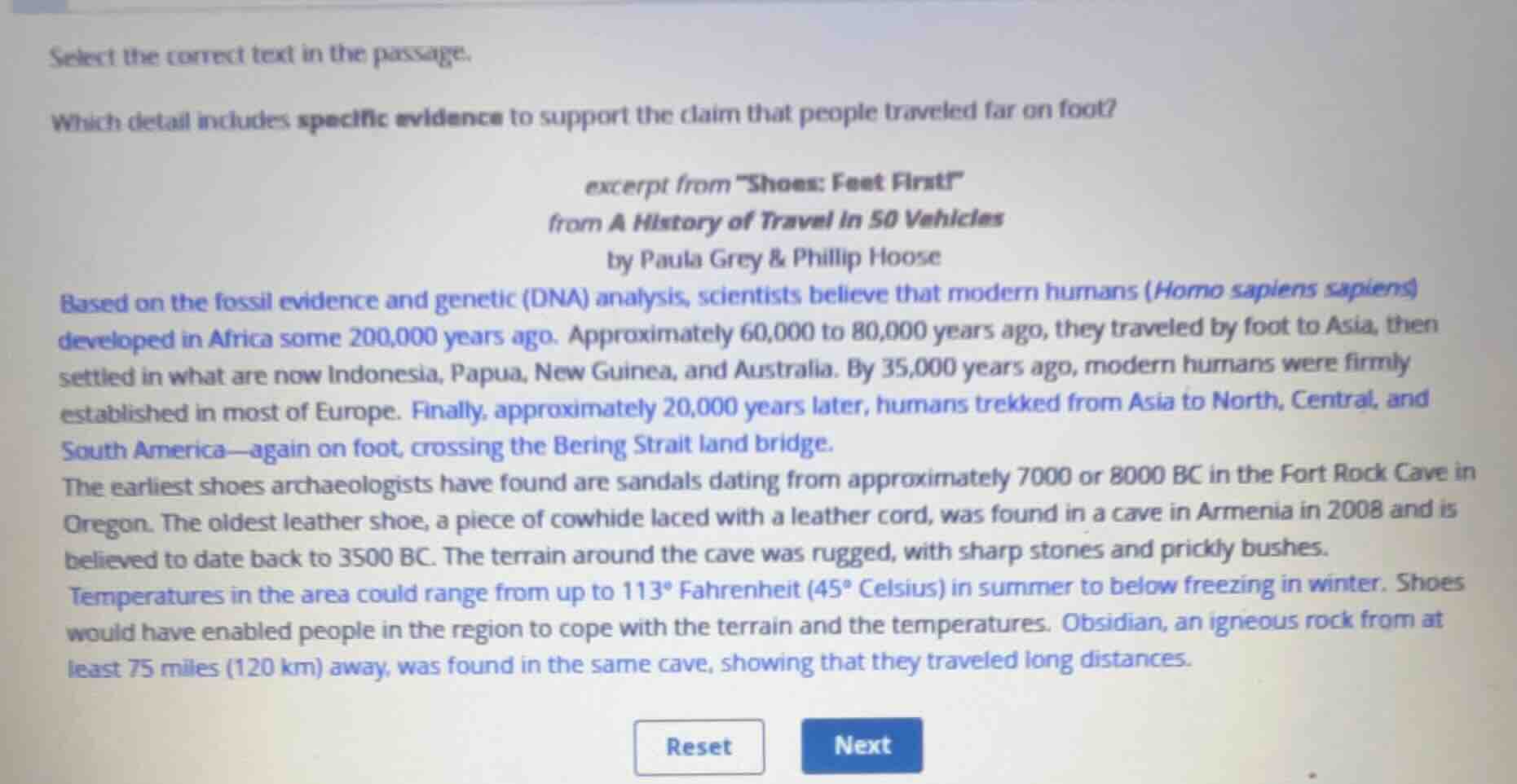
which detail includes specific evidence to support the claim that people traveled far on foot?
excerpt from \shoes: feet first!\
from a history of travel in 50 vehicles
by paula grey & phillip hoose
based on the fossil evidence and genetic (dna) analysis, scientists believe that modern humans (homo sapiens sapiens) developed in africa some 200,000 years ago. approximately 60,000 to 80,000 years ago, they traveled by foot to asia, then settled in what are now indonesia, papua, new guinea, and australia. by 35,000 years ago, modern humans were firmly established in most of europe. finally, approximately 20,000 years later, humans trekked from asia to north, central, and south america-again on foot, crossing the bering strait land bridge.
the earliest shoes archaeologists have found are sandals dating from approximately 7000 or 8000 bc in the fort rock cave in oregon. the oldest leather shoe, a piece of cowhide laced with a leather cord, was found in a cave in armenia in 2008 and is believed to date back to 3500 bc. the terrain around the cave was rugged, with sharp stones and prickly bushes. temperatures in the area could range from up to 113° fahrenheit (45° celsius) in summer to below freezing in winter. shoes would have enabled people in the region to cope with the terrain and the temperatures. obsidian, an igneous rock from at least 75 miles (120 km) away, was found in the same cave, showing that they traveled long distances.
Identify the target claim
The target claim is that "people traveled far on foot."
Analyze the passage for supporting evidence
The passage contains two potential sections discussing travel:
- The first paragraph mentions early humans traveling by foot to Asia, Europe, and the Americas, but these are broad historical/evolutionary assertions rather than specific archaeological physical evidence found in a particular location.
- The second paragraph discusses specific archaeological findings in a cave. It states: "Obsidian, an igneous rock from at least 75 miles (120 km) away, was found in the same cave, showing that they traveled long distances."
Select the specific evidence
The presence of obsidian sourced from 75 miles (120 km) away inside the cave provides direct, physical, and specific evidence that the people who inhabited the cave traveled long distances.

Snap & solve any problem in the app
Get step-by-step solutions on Sovi AI
Photo-based solutions with guided steps
Explore more problems and detailed explanations
"Obsidian, an igneous rock from at least 75 miles (120 km) away, was found in the same cave, showing that they traveled long distances."