QUESTION IMAGE
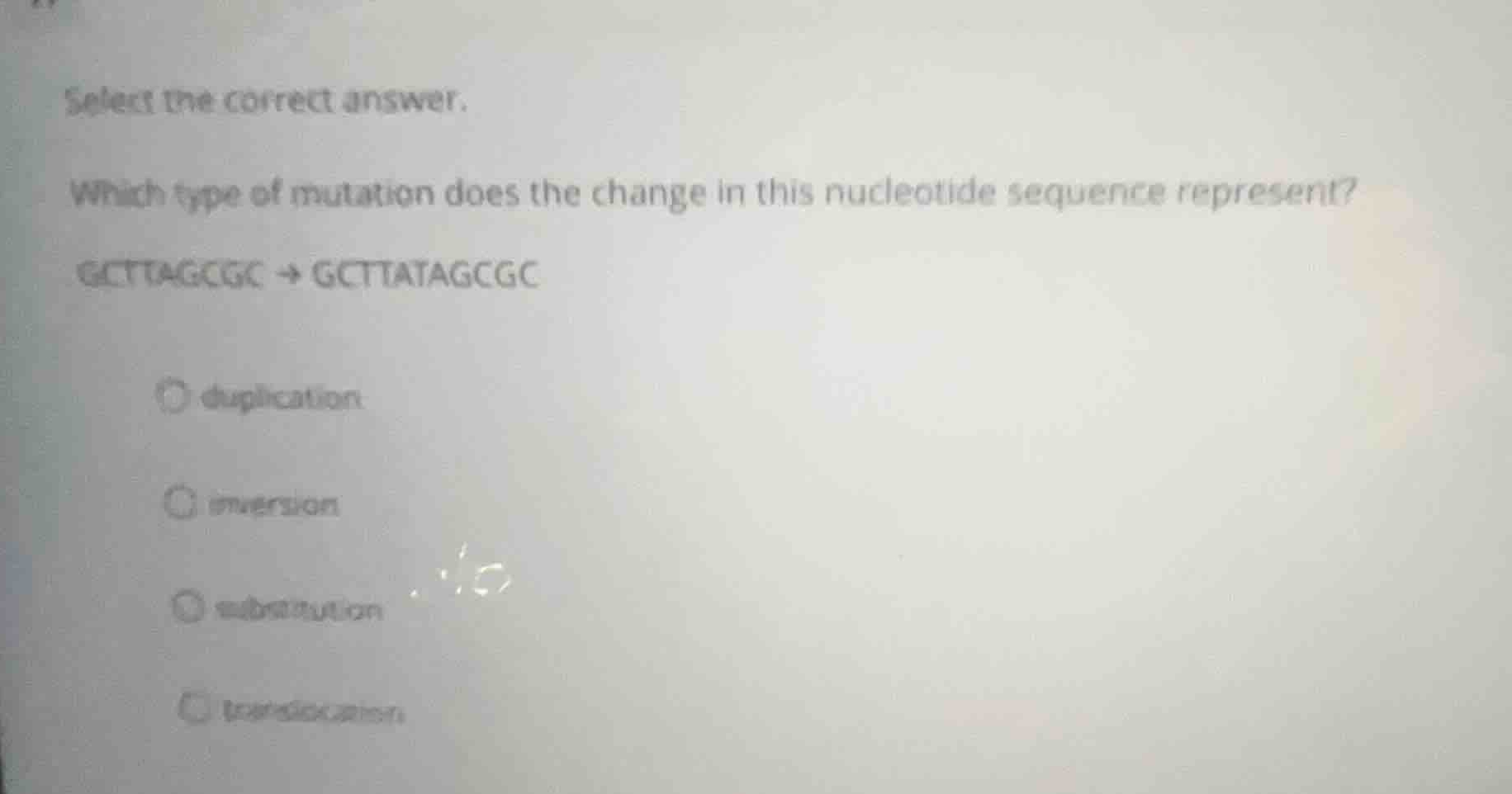
Question
select the correct answer.
which type of mutation does the change in this nucleotide sequence represent?
gcttagcgc \\(\
ightarrow\\) gcttatagcgc
- duplication
- inversion
- substitution
- translocation
Compare the original and mutated sequences
We align the original sequence with the mutated sequence to identify the exact change:
- Original:
G C T T A G C G C(9 nucleotides) - Mutated:
G C T T A T A G C G C(11 nucleotides)
Identify the inserted segment
By aligning the sequences, we see:
- Original:
G C T T A _ _ G C G C - Mutated:
G C T T A T A G C G C
The nucleotides T A have been inserted after the fifth nucleotide A.
Analyze the origin of the insertion
Looking closely at the original sequence:
- The nucleotides at positions 3 and 4 are
T T. - The nucleotides at positions 4 and 5 are
T A. - The inserted sequence is
T A, which is an exact copy of the adjacent preceding sequenceT A(positions 4 and 5). - When a sequence of nucleotides is repeated or copied adjacent to the original, it is classified as a duplication.
Evaluate the given options
- duplication: Correct, as the segment
TAis duplicated. - inversion: Incorrect, as no segment is reversed in orientation.
- substitution: Incorrect, as the sequence length increased and no bases were replaced.
- translocation: Incorrect, as this does not involve a segment moving to a non-homologous chromosome.

Snap & solve any problem in the app
Get step-by-step solutions on Sovi AI
Photo-based solutions with guided steps
Explore more problems and detailed explanations
- duplication (Correct answer)
- inversion
- substitution
- translocation