QUESTION IMAGE
Question
select the correct answer.
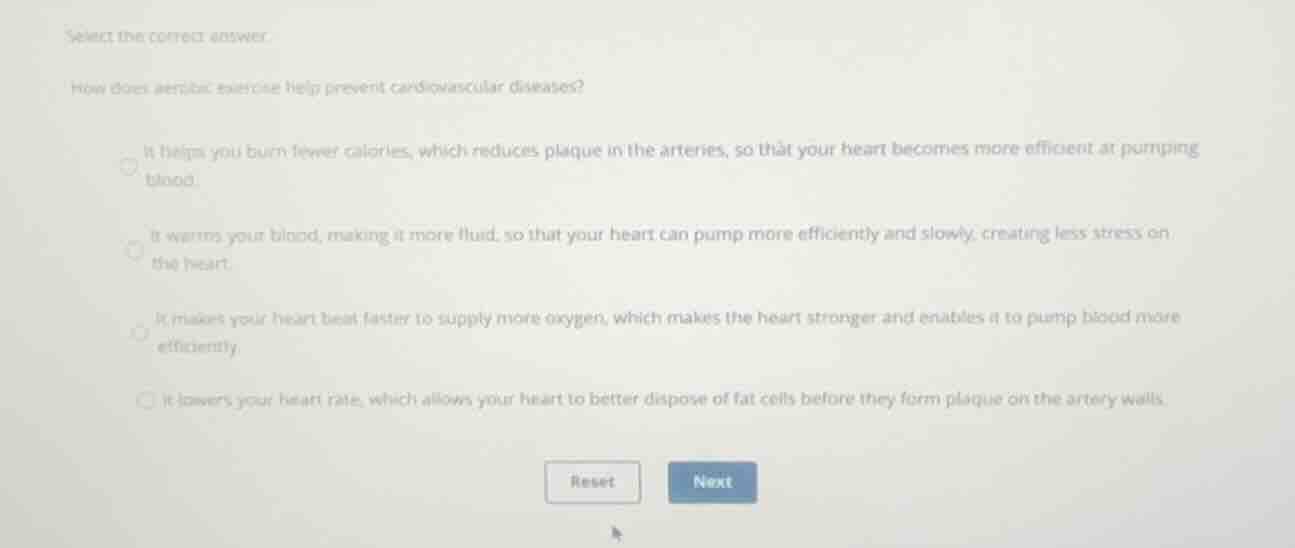
how does aerobic exercise help prevent cardiovascular diseases?
it helps you burn fewer calories, which reduces plaque in the arteries, so that your heart becomes more efficient at pumping blood.
it warms your blood, making it more fluid, so that your heart can pump more efficiently and slowly, creating less stress on the heart.
it makes your heart beat faster to supply more oxygen, which makes the heart stronger and enables it to pump blood more efficiently.
it lowers your heart rate, which allows your heart to better dispose of fat cells before they form plaque on the artery walls.
Analyze the physiological mechanism of aerobic exercise
Aerobic exercise increases the heart rate to supply oxygen-rich blood to working muscles. Over time, this cardiovascular demand strengthens the heart muscle, allowing it to pump blood more efficiently with less effort.
Evaluate the given options
- Option 1 suggests burning fewer calories reduces plaque, which is scientifically incorrect.
- Option 2 suggests warming the blood makes it more fluid, which is not the primary mechanism of cardiovascular conditioning.
- Option 3 correctly states that aerobic exercise makes the heart beat faster to supply more oxygen, strengthening the heart muscle and improving pumping efficiency.
- Option 4 suggests lowering the heart rate disposes of fat cells to prevent plaque, which is biologically inaccurate.

Snap & solve any problem in the app
Get step-by-step solutions on Sovi AI
Photo-based solutions with guided steps
Explore more problems and detailed explanations
- (A) It helps you burn fewer calories, which reduces plaque in the arteries, so that your heart becomes more efficient at pumping blood.
- (B) It warms your blood, making it more fluid, so that your heart can pump more efficiently and slowly, creating less stress on the heart.
- (C) It makes your heart beat faster to supply more oxygen, which makes the heart stronger and enables it to pump blood more efficiently. (Correct answer)
- (D) It lowers your heart rate, which allows your heart to better dispose of fat cells before they form plaque on the artery walls.