QUESTION IMAGE
Question
select the correct answer from each drop-down menu.
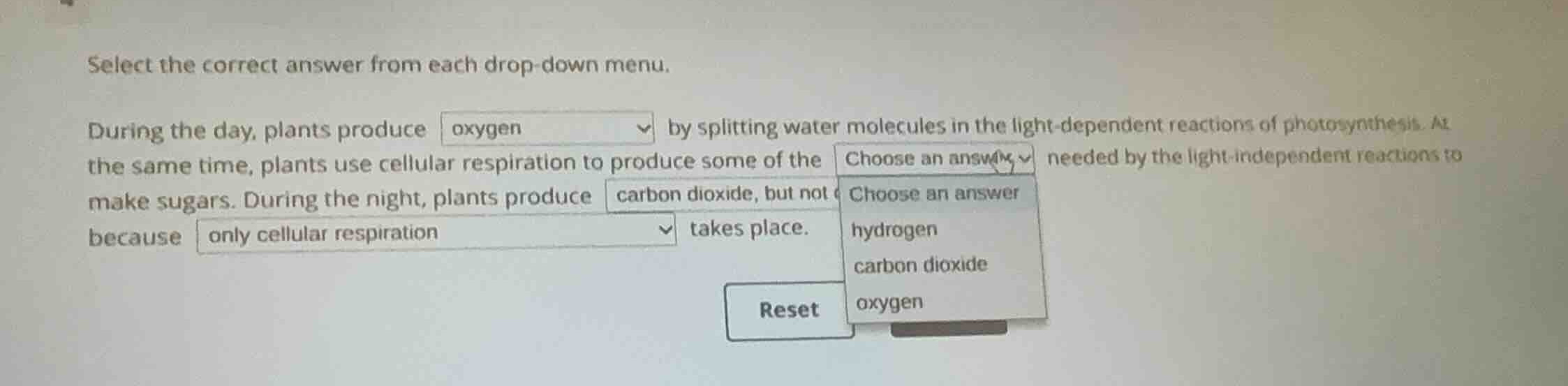
during the day, plants produce oxygen by splitting water molecules in the light-dependent reactions of photosynthesis. at the same time, plants use cellular respiration to produce some of the choose an answer needed by the light-independent reactions to make sugars. during the night, plants produce carbon dioxide, but not oxygen because only cellular respiration takes place.
dropdown options for the second blank:
- choose an answer
- hydrogen
- carbon dioxide
- oxygen
Analizar la fotólisis del agua
Using the Light-Dependent Reactions knowledge point
Durante el día, la energía lumínica rompe las moléculas de agua en protones, electrones y oxígeno gaseoso. Por lo tanto, el primer espacio en blanco es "oxygen".
Identificar el producto de la respiración celular
Using the Plant Respiration and Calvin Cycle knowledge points
La respiración celular produce dióxido de carbono como desecho metabólico. El ciclo de Calvin (reacciones independientes de la luz) requiere este dióxido de carbono para fijar el carbono y sintetizar azúcares. Por lo tanto, el segundo espacio en blanco es "carbon dioxide".
Evaluar el metabolismo nocturno de las plantas
Using the Diurnal Metabolic Cycles knowledge point
Durante la noche, al no haber luz solar, la fotosíntesis se detiene. Sin embargo, la respiración celular continúa de forma constante para mantener las funciones vitales de la planta. Como resultado, la planta consume oxígeno y libera dióxido de carbono. Por lo tanto, el tercer espacio en blanco es "carbon dioxide, but not oxygen" y el cuarto espacio en blanco es "only cellular respiration".

Snap & solve any problem in the app
Get step-by-step solutions on Sovi AI
Photo-based solutions with guided steps
Explore more problems and detailed explanations
During the day, plants produce <blank>oxygen</blank> by splitting water molecules in the light-dependent reactions of photosynthesis. At the same time, plants use cellular respiration to produce some of the <blank>carbon dioxide</blank> needed by the light-independent reactions to make sugars. During the night, plants produce <blank>carbon dioxide, but not oxygen</blank> because <blank>only cellular respiration</blank> takes place.