QUESTION IMAGE
Question
select the correct answer.
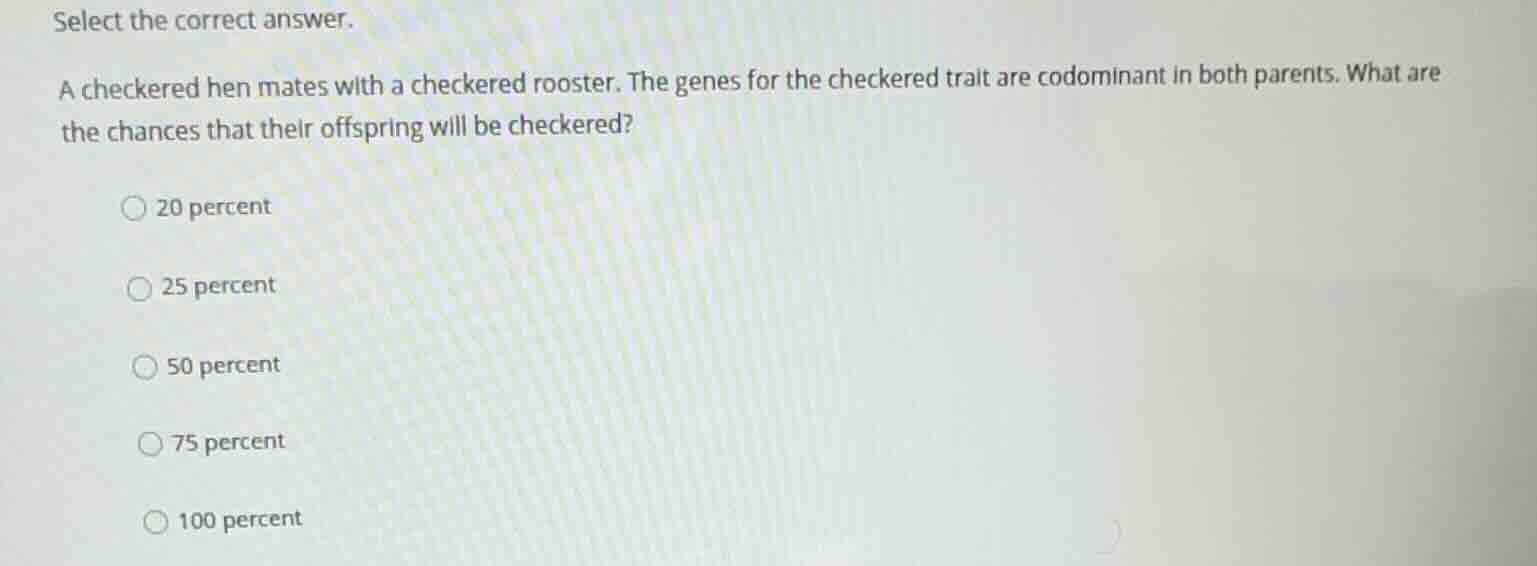
a checkered hen mates with a checkered rooster. the genes for the checkered trait are codominant in both parents. what are the chances that their offspring will be checkered?
20 percent
25 percent
50 percent
75 percent
100 percent
Identify the genotypes of the parents
Using the Genetic Inheritance knowledge point, we analyze the alleles involved in codominance. In codominance, both alleles are fully expressed in the heterozygote. Let the allele for black feathers be \(B\) and the allele for white feathers be \(W\). A checkered chicken is heterozygous, carrying both alleles. Therefore, both the checkered hen and the checkered rooster have the genotype \(BW\).
Set up the genetic cross
We cross the two heterozygous checkered parents:
Each parent can produce two types of gametes, carrying either the \(B\) allele or the \(W\) allele with equal probability.
Determine offspring genotypes using a Punnett square
We combine the gametes from both parents to find the possible genotypes of the offspring:
- Top row (Hen gametes): \(B\) and \(W\)
- Left column (Rooster gametes): \(B\) and \(W\)
The resulting combinations in the grid are:
- \(B \times B
ightarrow BB\) (Black phenotype)
- \(B \times W
ightarrow BW\) (Checkered phenotype)
- \(W \times B
ightarrow BW\) (Checkered phenotype)
- \(W \times W
ightarrow WW\) (White phenotype)
Calculate the probability of checkered offspring
Out of the 4 possible genetic combinations, 2 result in the heterozygous \(BW\) genotype, which expresses the checkered trait:
Thus, there is a \(50\%\) chance that their offspring will be checkered.

Snap & solve any problem in the app
Get step-by-step solutions on Sovi AI
Photo-based solutions with guided steps
Explore more problems and detailed explanations
- 20 percent
- 25 percent
- 50 percent (Correct answer)
- 75 percent
- 100 percent