QUESTION IMAGE
Question
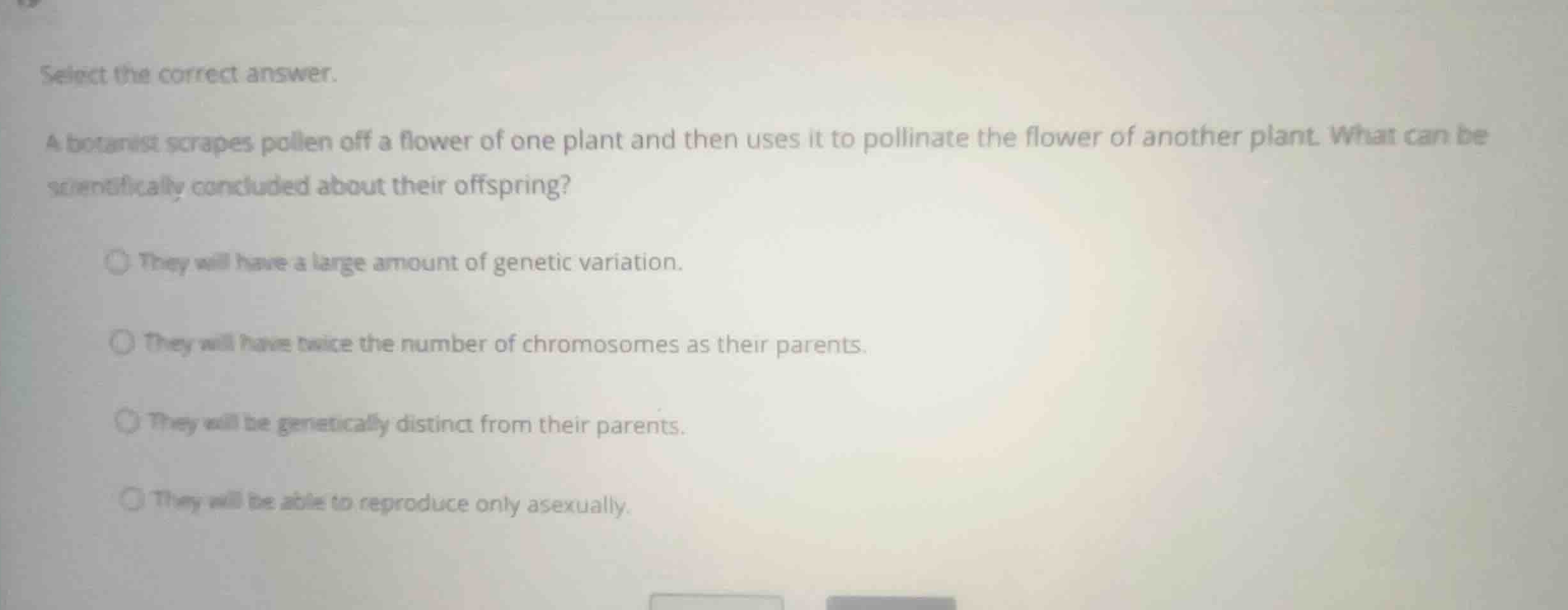
select the correct answer.
a botanist scrapes pollen off a flower of one plant and then uses it to pollinate the flower of another plant. what can be scientifically concluded about their offspring?
they will have a large amount of genetic variation.
they will have twice the number of chromosomes as their parents.
they will be genetically distinct from their parents.
they will be able to reproduce only asexually.
Identify the mode of reproduction
The scenario describes cross-pollination, where pollen (containing male gametes) from one plant is transferred to the flower of another plant (containing female gametes). This process represents Sexual Reproduction, which involves the fusion of haploid gametes from two different parents to form a diploid zygote.
Analyze genetic outcomes of sexual reproduction
Using the Sexual Reproduction knowledge point, we know that sexual reproduction combines genetic material from two distinct parents. Due to independent assortment, crossing over during meiosis, and random fertilization, the offspring will inherit a unique combination of alleles, making them genetically distinct from both parents.
Evaluate the given options
- They will have a large amount of genetic variation: While sexual reproduction introduces variation, "a large amount" is relative and less precise than stating they are genetically distinct.
- They will have twice the number of chromosomes as their parents: Fertilization restores the diploid number (\(2n\)) from haploid gametes (\(n\)), so chromosome number remains constant, not doubled.
- They will be genetically distinct from their parents: This is a direct, scientifically accurate consequence of combining genes from two different parent plants.
- They will be able to reproduce only asexually: Offspring of flowering plants typically retain the ability to reproduce sexually.

Snap & solve any problem in the app
Get step-by-step solutions on Sovi AI
Photo-based solutions with guided steps
Explore more problems and detailed explanations
- They will have a large amount of genetic variation.
- They will have twice the number of chromosomes as their parents.
- They will be genetically distinct from their parents. (Correct answer)
- They will be able to reproduce only asexually.