QUESTION IMAGE
Question
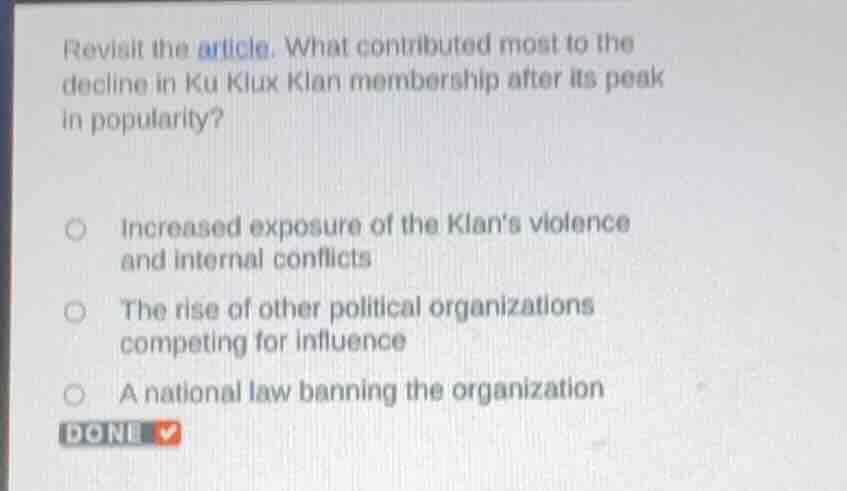
revisit the article. what contributed most to the decline in ku klux klan membership after its peak in popularity?
- increased exposure of the klans violence and internal conflicts
- the rise of other political organizations competing for influence
- a national law banning the organization
Identify the historical context of the second Ku Klux Klan's decline
The second Ku Klux Klan peaked in popularity in the mid-1920s. Its rapid decline was primarily driven by public exposure of its violent activities, financial corruption, and severe internal power struggles and scandals (such as the conviction of Indiana Grand Dragon D.C. Stephenson in 1925).
Evaluate the provided multiple-choice options
- Option 1 ("Increased exposure of the Klan's violence and internal conflicts"): This aligns directly with historical consensus. Public revelations of internal power struggles, financial fraud, and heinous crimes committed by leadership shattered the organization's respectable "fraternal" image.
- Option 2 ("The rise of other political organizations competing for influence"): No single competing organization directly caused their mass exodus.
- Option 3 ("A national law banning the organization"): No such federal law banning the Klan was passed during this era.

Snap & solve any problem in the app
Get step-by-step solutions on Sovi AI
Photo-based solutions with guided steps
Explore more problems and detailed explanations
- Increased exposure of the Klan's violence and internal conflicts (Correct answer)
- The rise of other political organizations competing for influence
- A national law banning the organization