QUESTION IMAGE
Question
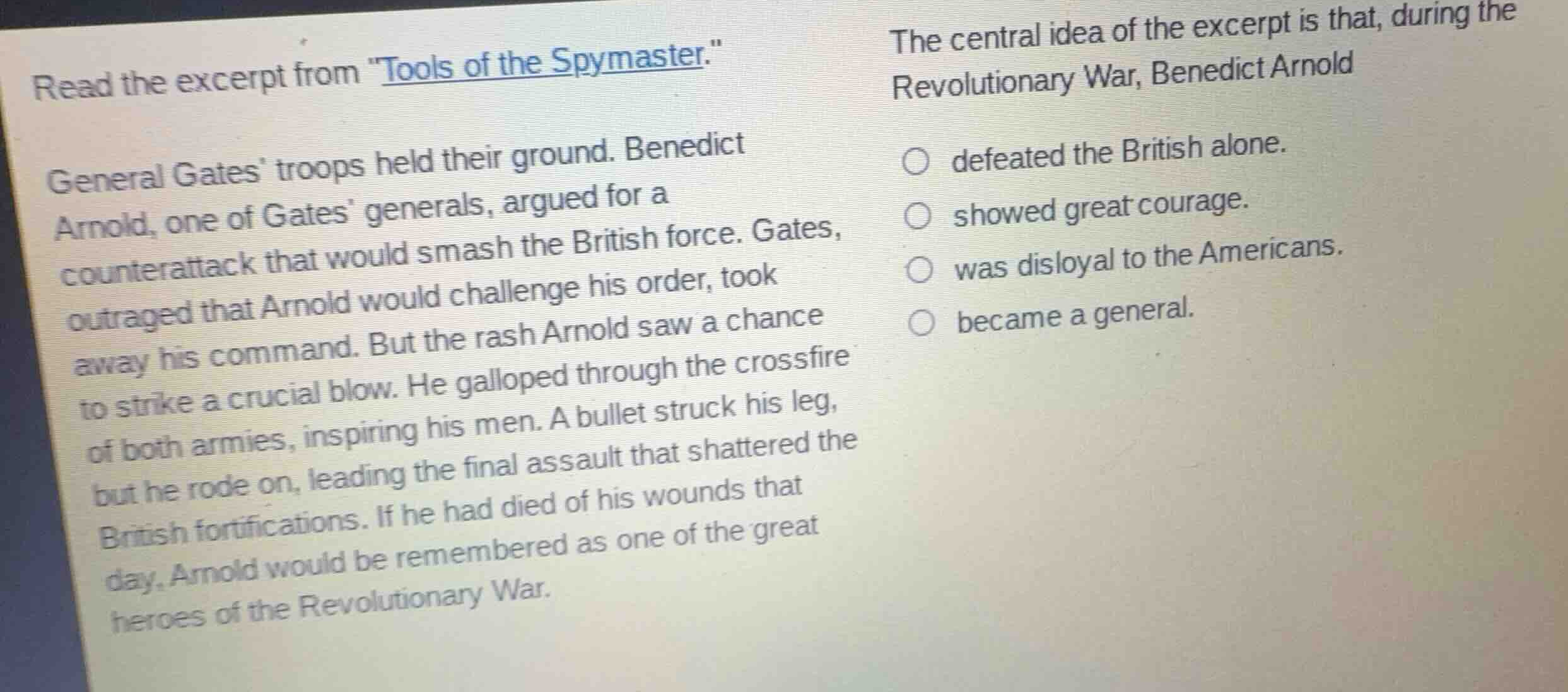
read the excerpt from \tools of the spymaster.\
general gates troops held their ground. benedict arnold, one of gates generals, argued for a counterattack that would smash the british force. gates, outraged that arnold would challenge his order, took away his command. but the rash arnold saw a chance to strike a crucial blow. he galloped through the crossfire of both armies, inspiring his men. a bullet struck his leg, but he rode on, leading the final assault that shattered the british fortifications. if he had died of his wounds that day, arnold would be remembered as one of the great heroes of the revolutionary war.
the central idea of the excerpt is that, during the revolutionary war, benedict arnold
- defeated the british alone.
- showed great courage.
- was disloyal to the americans.
- became a general.
Analyze the excerpt
Using the Textual Analysis knowledge point, we examine the provided text from "Tools of the Spymaster." The passage describes Benedict Arnold's actions during a battle in the Revolutionary War. It notes that despite having his command taken away by General Gates, Arnold "saw a chance to strike a crucial blow," "galloped through the crossfire," and "rode on" after being shot in the leg to lead a successful assault.
Determine the central idea
Using the Central Idea knowledge point, we synthesize these details to find the main message. The text highlights Arnold's bravery: he risked his life, ignored an injury, and inspired his men to defeat the British fortifications. The passage concludes by stating that if he had died that day, he "would be remembered as one of the great heroes of the Revolutionary War." This directly supports the idea that he showed great courage.
Evaluate the options
- "defeated the British alone": Incorrect, as he led "his men" and Gates' troops were also present.
- "showed great courage": Correct, as his actions (riding through crossfire, continuing after being shot) demonstrate immense bravery.
- "was disloyal to the Americans": Incorrect, the text portrays his battlefield actions here as heroic and inspiring to the American troops, not disloyal.
- "became a general": Incorrect, the text mentions he was already "one of Gates' generals" at the start of the excerpt.

Snap & solve any problem in the app
Get step-by-step solutions on Sovi AI
Photo-based solutions with guided steps
Explore more problems and detailed explanations
- defeated the British alone.
- showed great courage. (Correct answer)
- was disloyal to the Americans.
- became a general.