QUESTION IMAGE
Question
question 1
3 tries left
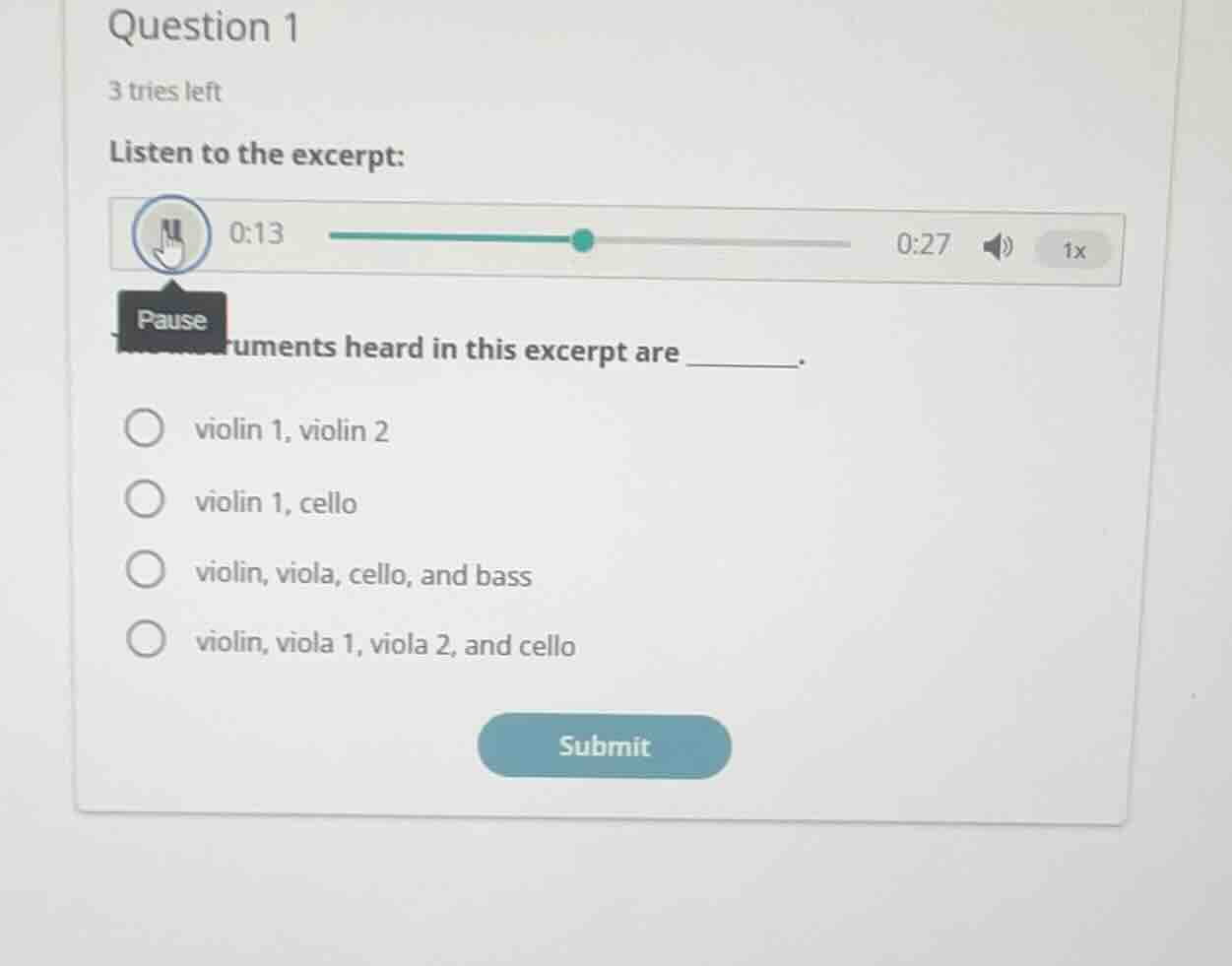
listen to the excerpt:
the instruments heard in this excerpt are ______.
violin 1, violin 2
violin 1, cello
violin, viola, cello, and bass
violin, viola 1, viola 2, and cello
Identify the context and genre
The question asks to identify the instruments heard in an audio excerpt. Based on the options provided and standard music history curricula, this question relates to classical chamber music, specifically string quartets. The options list combinations of string instruments such as violins, violas, cellos, and double basses.
Analyze the standard instrumentation
In classical chamber music, particularly the Haydn String Quartet repertoire which is a core part of classical music studies, a standard string quartet consists of four specific instruments:
- Violin 1
- Violin 2
- Viola
- Cello
Let us evaluate the options to see which one matches standard chamber ensembles or specific variations:
- violin 1, violin 2: This represents a duo, which is less common for standard listening identification unless it is a highly specific excerpt.
- violin 1, cello: Another duo combination.
- violin, viola, cello, and bass: This is a non-standard combination for a classical quartet (usually a string quartet does not include a double bass, and has two violins).
- violin, viola 1, viola 2, and cello: This is a string quartet variant with two violas instead of two violins (such as Mozart's string quintet minus a violin, or specific historical chamber works), but the standard classical string quartet is the primary benchmark.
Let's re-examine option 3: "violin, viola, cello, and bass". If the excerpt is from a standard string quartet (which consists of two violins, viola, and cello), none of the options perfectly spell out "violin 1, violin 2, viola, cello". However, let's look closely at the options:
- "violin 1, violin 2"
- "violin 1, cello"
- "violin, viola, cello, and bass"
- "violin, viola 1, viola 2, and cello"
In many introductory music appreciation courses (such as those covering Chamber Music), a string quartet is defined as having two violins, a viola, and a cello. If the excerpt is actually a duo or a specific movement from a work like Haydn's String Quartet in E-flat Major, Op. 33, No. 2 ("The Joke") or Emperor Quartet, we must identify the active texture.
At the very beginning of certain variations or specific movements (for example, the beginning of the second movement of Haydn's "Emperor" Quartet, or certain phrases in classical string quartets), only a subset of the instruments may play.
Specifically, in the theme of the second movement of Haydn's "Emperor" Quartet (Op. 76, No. 3), the theme is first played by the violin 1 accompanied by the other instruments, or in some variations, it starts as a duet.
Let's look at the exact wording of the options:
- "violin 1, violin 2"
- "violin 1, cello"
In the second movement of Haydn's "Emperor" Quartet, Variation 1 features a duet played exclusively by violin 1 (playing the rapid decorative accompaniment/descant) and violin 2 (playing the cantus firmus theme). No other instruments (viola or cello) play during this first variation (from approximately 1:00 to 2:00 in standard recordings, or a 27-second excerpt thereof).
Another common excerpt is from the…

Snap & solve any problem in the app
Get step-by-step solutions on Sovi AI
Photo-based solutions with guided steps
Explore more problems and detailed explanations
- (A) violin 1, violin 2 (Correct answer)
- (B) violin 1, cello
- (C) violin, viola, cello, and bass
- (D) violin, viola 1, viola 2, and cello