Sovi.AI - AI Math Tutor

Scan to solve math questions

QUESTION IMAGE

question 7 the main function of lipids in living things is __. - to pro…

Question

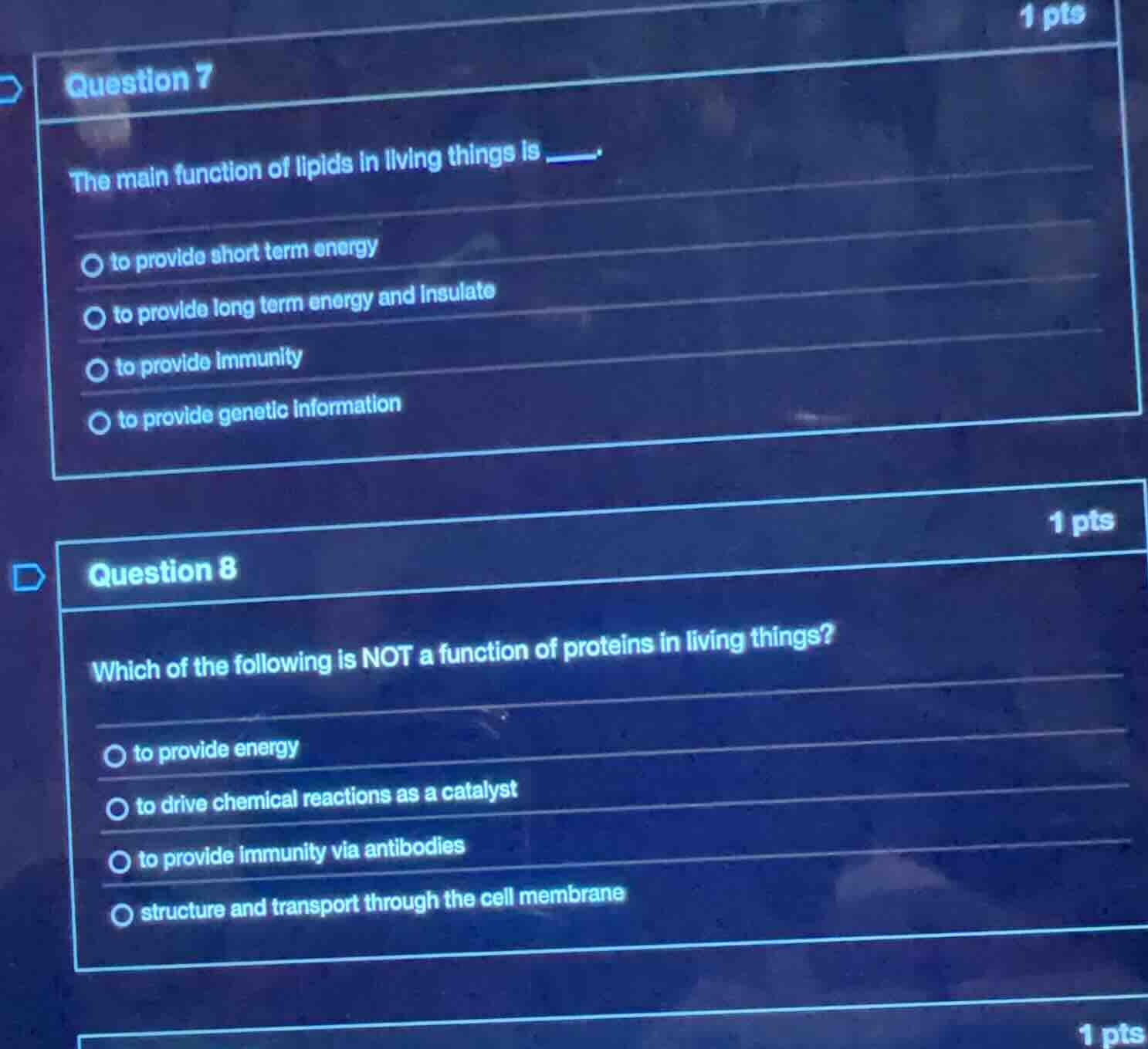
question 7

the main function of lipids in living things is __.

  • to provide short term energy
  • to provide long term energy and insulate
  • to provide immunity
  • to provide genetic information

question 8

which of the following is not a function of proteins in living things?

  • to provide energy
  • to drive chemical reactions as a catalyst
  • to provide immunity via antibodies
  • structure and transport through the cell membrane

Explanation:

Response

<pre_analysis>
{
"quality": "clear",
"question_count": 2,
"skills_matched": [
"direct_cot",
"multiple_choice_formatter",
"explain_then_answer",
"quick"
],
"needs_drawing": false,
"concepts_used": [
"Lipid Functions",
"Protein Functions"
],
"new_concepts": [],
"current_concepts": [
"Lipid Functions",
"Protein Functions"
]
}
</pre_analysis>

<reasoning>

Analyze Question 7

The question asks for the main function of lipids in living things.

  • Short-term energy storage is primarily the role of carbohydrates.
  • Long-term energy storage and insulation are key functions of lipids (fats).
  • Immunity is primarily assisted by proteins (antibodies).
  • Genetic information is stored and transmitted by nucleic acids (DNA and RNA).

Therefore, the correct option is the second one.

Analyze Question 8

The question asks which of the options is NOT a function of proteins in living things.

  • Driving chemical reactions as a catalyst is a primary function of enzymatic proteins.
  • Providing immunity via antibodies is a key function of defensive proteins.
  • Structure and transport through the cell membrane are essential roles of structural and transport proteins.
  • Providing energy is not a primary function of proteins; carbohydrates and lipids are the main energy sources, while proteins are spared for structural and functional roles.

Therefore, the correct option is the first one.
</reasoning>

<answer>

Question 7

<mcq-option>to provide short term energy</mcq-option>
<mcq-correct>to provide long term energy and insulate</mcq-correct>
<mcq-option>to provide immunity</mcq-option>
<mcq-option>to provide genetic information</mcq-option>

Question 8

<mcq-correct>to provide energy</mcq-correct>
<mcq-option>to drive chemical reactions as a catalyst</mcq-option>
<mcq-option>to provide immunity via antibodies</mcq-option>
<mcq-option>structure and transport through the cell membrane</mcq-option>
</answer>

<post_analysis>
{
"subject": "Natural Science",
"question_type": "Multiple Choice",
"knowledge_point": [
"Natural Science",
"Biology",
"Biomolecules"
]
}
</post_analysis>

Answer:

<pre_analysis>
{
"quality": "clear",
"question_count": 2,
"skills_matched": [
"direct_cot",
"multiple_choice_formatter",
"explain_then_answer",
"quick"
],
"needs_drawing": false,
"concepts_used": [
"Lipid Functions",
"Protein Functions"
],
"new_concepts": [],
"current_concepts": [
"Lipid Functions",
"Protein Functions"
]
}
</pre_analysis>

<reasoning>

Analyze Question 7

The question asks for the main function of lipids in living things.

  • Short-term energy storage is primarily the role of carbohydrates.
  • Long-term energy storage and insulation are key functions of lipids (fats).
  • Immunity is primarily assisted by proteins (antibodies).
  • Genetic information is stored and transmitted by nucleic acids (DNA and RNA).

Therefore, the correct option is the second one.

Analyze Question 8

The question asks which of the options is NOT a function of proteins in living things.

  • Driving chemical reactions as a catalyst is a primary function of enzymatic proteins.
  • Providing immunity via antibodies is a key function of defensive proteins.
  • Structure and transport through the cell membrane are essential roles of structural and transport proteins.
  • Providing energy is not a primary function of proteins; carbohydrates and lipids are the main energy sources, while proteins are spared for structural and functional roles.

Therefore, the correct option is the first one.
</reasoning>

<answer>

Question 7

<mcq-option>to provide short term energy</mcq-option>
<mcq-correct>to provide long term energy and insulate</mcq-correct>
<mcq-option>to provide immunity</mcq-option>
<mcq-option>to provide genetic information</mcq-option>

Question 8

<mcq-correct>to provide energy</mcq-correct>
<mcq-option>to drive chemical reactions as a catalyst</mcq-option>
<mcq-option>to provide immunity via antibodies</mcq-option>
<mcq-option>structure and transport through the cell membrane</mcq-option>
</answer>

<post_analysis>
{
"subject": "Natural Science",
"question_type": "Multiple Choice",
"knowledge_point": [
"Natural Science",
"Biology",
"Biomolecules"
]
}
</post_analysis>