QUESTION IMAGE
Question
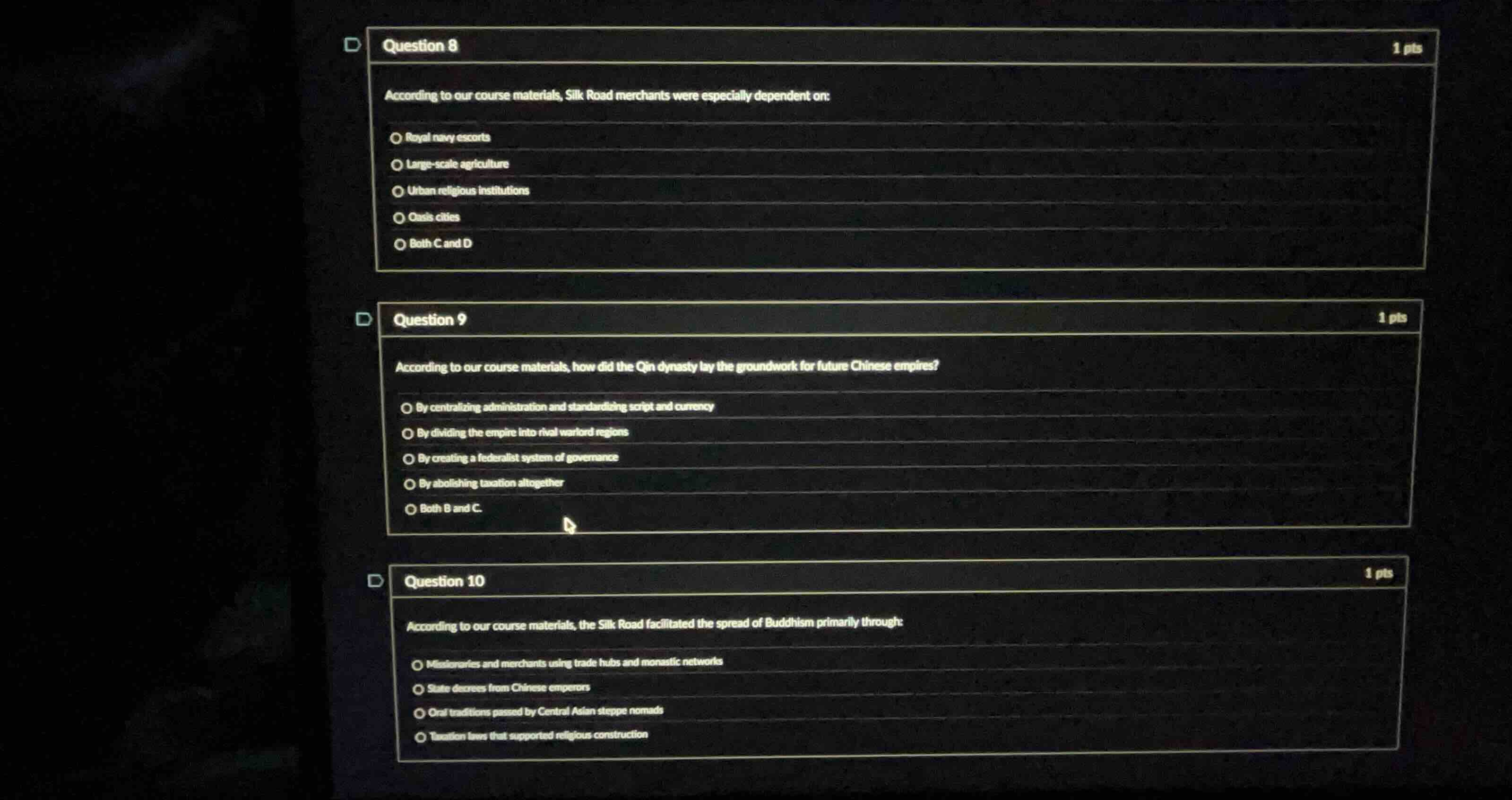
question 8
according to our course materials, silk road merchants were especially dependent on:
royal navy escorts
large-scale agriculture
urban religious institutions
oasis cities
both c and d
question 9
according to our course materials, how did the qin dynasty lay the groundwork for future chinese empires?
by centralizing administration and standardizing script and currency
by dividing the empire into rival warlord regions
by creating a federalist system of governance
by abolishing taxation altogether
both b and c.
question 10
according to our course materials, the silk road facilitated the spread of buddhism primarily through:
missionaries and merchants using trade hubs and monastic networks
state decrees from chinese emperors
oral traditions passed by central asian steppe nomads
taxation laws that supported religious construction
Analyze Question 8
Silk Road merchants traveling across the arid terrains of Central Asia relied heavily on oasis cities for water, food, shelter, and trade exchanges.
Analyze Question 9
The Qin dynasty laid the foundation for future Chinese imperial rule by centralizing the administrative system (replacing feudalism with commanderies) and standardizing writing scripts, currency, weights, and measures.
Analyze Question 10
Buddhism spread along the Silk Road primarily through the movement of Buddhist missionaries and merchants who utilized trade hubs, oasis towns, and monastic networks established along the trade routes.

Snap & solve any problem in the app
Get step-by-step solutions on Sovi AI
Photo-based solutions with guided steps
Explore more problems and detailed explanations
Question 8
- O Royal navy escorts
- O Large-scale agriculture
- O Urban religious institutions
- O Oasis cities (Correct answer)
- O Both C and D
Question 9
- O By centralizing administration and standardizing script and currency (Correct answer)
- O By dividing the empire into rival warlord regions
- O By creating a federalist system of governance
- O By abolishing taxation altogether
- O Both B and C.
Question 10
- O Missionaries and merchants using trade hubs and monastic networks (Correct answer)
- O State decrees from Chinese emperors
- O Oral traditions passed by Central Asian steppe nomads
- O Taxation laws that supported religious construction