QUESTION IMAGE
Question
question 44
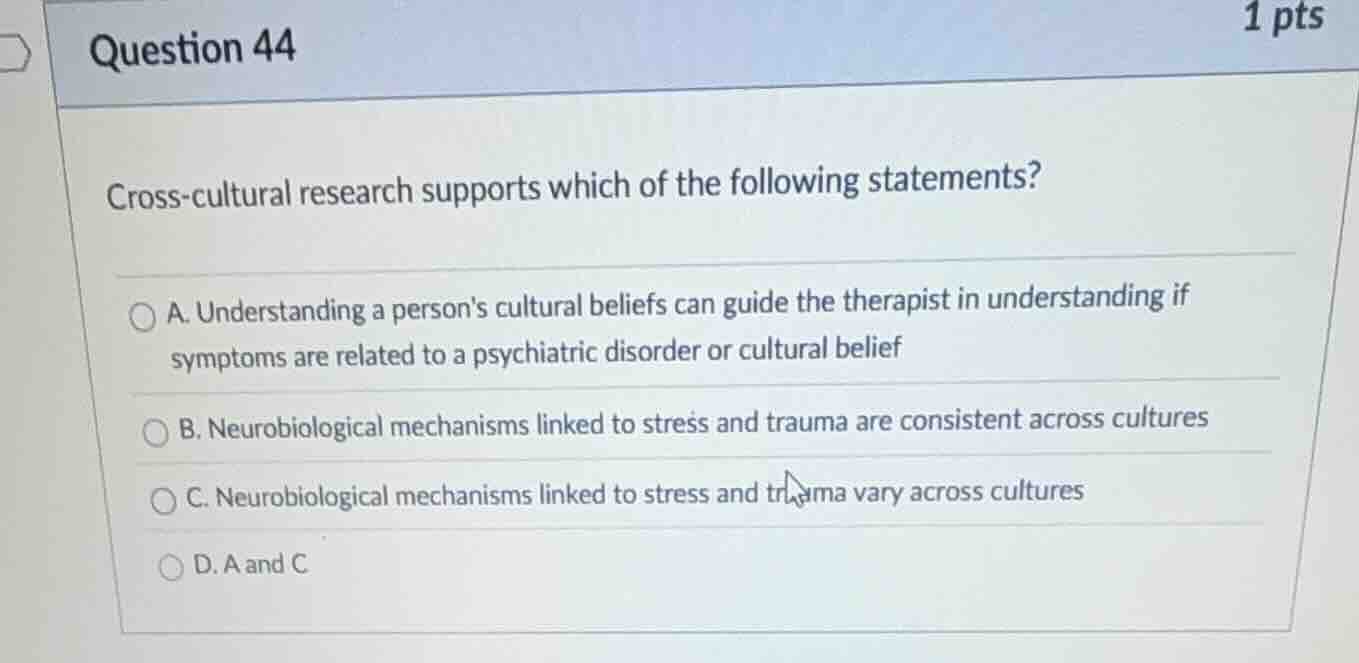
cross-cultural research supports which of the following statements?
a. understanding a persons cultural beliefs can guide the therapist in understanding if symptoms are related to a psychiatric disorder or cultural belief
b. neurobiological mechanisms linked to stress and trauma are consistent across cultures
c. neurobiological mechanisms linked to stress and trauma vary across cultures
d. a and c
🆕 New Concept Discovered: Cultural Formulation in Psychiatry
How culture shapes clinical presentation and biological stress responses.
Step 1: Analyze Statement A
Statement A suggests that understanding a patient's cultural beliefs helps a clinician distinguish between culturally normative behaviors/beliefs and actual psychiatric pathology.
In clinical psychology and psychiatry (such as outlined in the DSM-5 Cultural Formulation Interview), this is a fundamental principle. For example, hearing voices or experiencing visions may be a normative spiritual practice in one culture but a symptom of psychosis in another. Therefore, Statement A is supported by cross-cultural research.
Step 2: Analyze Statements B and C
Statements B and C address the neurobiological mechanisms of stress and trauma across cultures:
- Statement B asserts that these biological mechanisms (such as the activation of the hypothalamic-pituitary-adrenal (HPA) axis, cortisol release, and sympathetic nervous system activation) are consistent across human populations.
- Statement C asserts that these neurobiological mechanisms vary across cultures.
Basic neurobiological and physiological responses to acute stress and trauma (the "fight-or-flight" response, autonomic nervous system activation, and core endocrine pathways) are evolutionary adaptations shared by all humans, regardless of cultural background. While the expression, interpretation, and coping mechanisms of distress are highly shaped by culture, the underlying neurobiological machinery itself remains consistent across human populations. Therefore, Statement B is supported by cross-cultural research, while Statement C is incorrect.
Step 3: Evaluate the Options
- A is correct.
- B is correct, which automatically makes C incorrect.
- Since C is incorrect, D (A and C) must also be incorrect.
Because the options do not offer a combined "A and B" choice, we must identify the primary, most universally emphasized takeaway of cross-cultural clinical training. The core clinical utility of cross-cultural research is to prevent misdiagnosis by helping clinicians differentiate between cultural expressions and psychiatric disorders. Thus, Statement A is the intended correct answer.

Snap & solve any problem in the app
Get step-by-step solutions on Sovi AI
Photo-based solutions with guided steps
Explore more problems and detailed explanations
A. Understanding a person's cultural beliefs can guide the therapist in understanding if symptoms are related to a psychiatric disorder or cultural belief