QUESTION IMAGE
Question
question 25
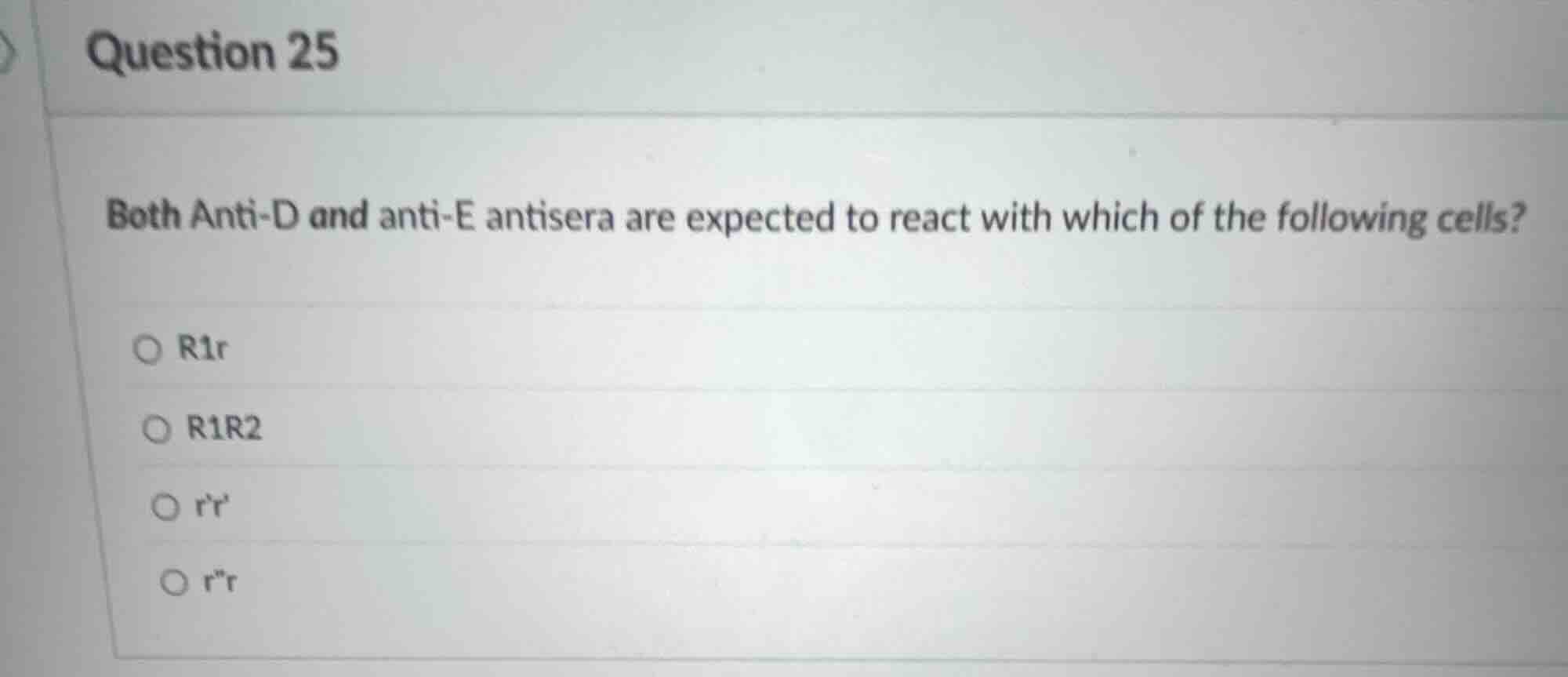
both anti-d and anti-e antisera are expected to react with which of the following cells?
o r1r
o r1r2
o rr
o r
Identify target antigens
Using the Rh Blood Group System knowledge point
To react with both anti-D and anti-E, red blood cells must express both the D antigen and the E antigen on their surface.
Translate Wiener nomenclature
Using the Wiener Nomenclature knowledge point
- \(R_1\) represents \(DCe\)
- \(R_2\) represents \(DcE\)
- \(r\) represents \(dce\)
- \(r'\) represents \(dCe\)
- \(r''\) represents \(dcE\)
Analyze each option
Using the Wiener Nomenclature and Rh Blood Group System knowledge points
- \(R_1r\) translates to \(DCe/dce\). These cells express D, C, e, and c. They lack E.
- \(R_1R_2\) translates to \(DCe/DcE\). These cells express D, C, e, c, and E. They possess both D and E.
- \(r'r'\) translates to \(dCe/dCe\). These cells express C and e. They lack both D and E.
- \(r''r\) translates to \(dcE/dce\). These cells express c, E, and e. They possess E but lack D.
Address student query
Using the Wiener Nomenclature knowledge point
The option \(r'r'\) represents a homozygous genotype \(dCe/dCe\). These cells express only the C and e antigens. They lack the D antigen (indicated by lowercase \(r'\)) and the E antigen (which would require a double prime \(r''\) or \(R_2\)/\(R_z\)). Therefore, \(r'r'\) cells will not react with either anti-D or anti-E.

Snap & solve any problem in the app
Get step-by-step solutions on Sovi AI
Photo-based solutions with guided steps
Explore more problems and detailed explanations
- (A) R1r
- (B) R1R2 (Correct answer)
- (C) r'r'
- (D) r"r