QUESTION IMAGE
Question
question 4
20 pts
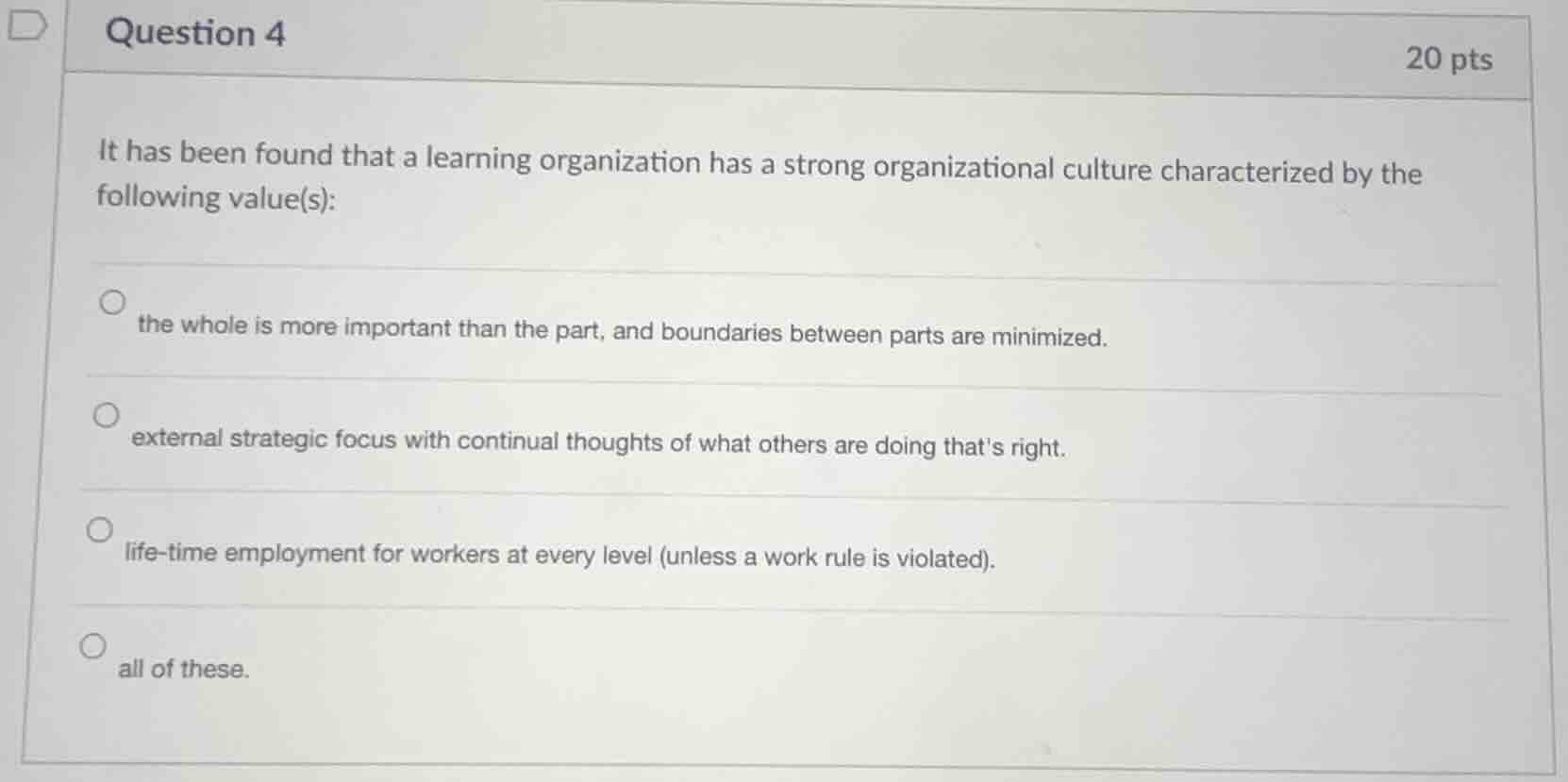
it has been found that a learning organization has a strong organizational culture characterized by the following value(s):
the whole is more important than the part, and boundaries between parts are minimized.
external strategic focus with continual thoughts of what others are doing thats right.
life-time employment for workers at every level (unless a work rule is violated).
all of these.
🆕 New Concept Discovered: Learning Organizations
Understanding how organizations continuously learn and adapt.
Step 1: Define a learning organization
A learning organization is one that facilitates the lifelong learning of its members and continuously transforms itself. According to organizational theory (specifically Peter Senge's systems thinking framework), a core value of a learning organization is looking at the system as a whole rather than isolated departments. This means that the entire organization (the whole) is prioritized over individual departments (the parts), and boundaries between these parts are minimized to encourage open communication and collaboration.
Step 2: Evaluate the options
- "the whole is more important than the part, and boundaries between parts are minimized."
This directly aligns with the systems thinking and boundaryless behavior characteristic of learning organizations.
- "external strategic focus with continual thoughts of what others are doing that's right."
While learning organizations look outward for benchmarking, this specific phrasing is not a defining core organizational culture value of a learning organization.
- "life-time employment for workers at every level..."
This is characteristic of traditional Japanese management styles (like Theory Z) rather than a defining value of a learning organization.
Therefore, only the first option is a recognized core value characterizing a learning organization's culture.

Snap & solve any problem in the app
Get step-by-step solutions on Sovi AI
Photo-based solutions with guided steps
Explore more problems and detailed explanations
the whole is more important than the part, and boundaries between parts are minimized.