QUESTION IMAGE
Question
question 17
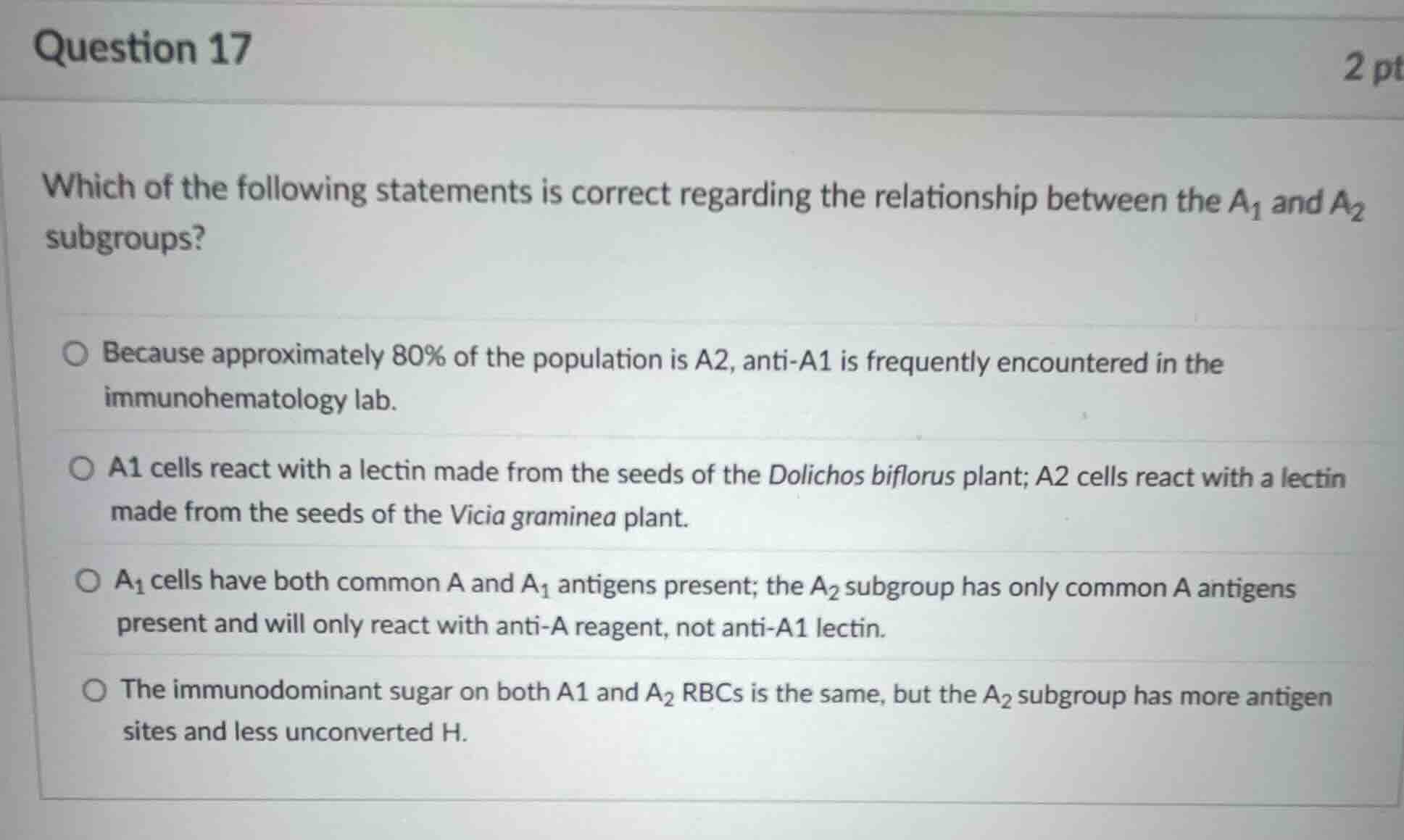
which of the following statements is correct regarding the relationship between the \\(a_1\\) and \\(a_2\\) subgroups?
because approximately 80% of the population is a2, anti-a1 is frequently encountered in the immunohematology lab.
a1 cells react with a lectin made from the seeds of the dolichos biflorus plant; a2 cells react with a lectin made from the seeds of the vicia graminea plant.
\\(a_1\\) cells have both common a and \\(a_1\\) antigens present; the \\(a_2\\) subgroup has only common a antigens present and will only react with anti-a reagent, not anti-a1 lectin.
the immunodominant sugar on both a1 and \\(a_2\\) rbcs is the same, but the \\(a_2\\) subgroup has more antigen sites and less unconverted h.
Analyze population demographics
The first option states that approximately 80% of the population is \(A_2\). In reality, approximately 80% of group A individuals are \(A_1\), while only about 20% are \(A_2\). Thus, this statement is incorrect.
Evaluate lectin reactivities
The second option mentions that \(A_1\) cells react with Dolichos biflorus lectin, which is correct (it acts as anti-\(A_1\)). However, it states that \(A_2\) cells react with Vicia graminea lectin. Vicia graminea lectin actually has anti-N specificity, not specificity for \(A_2\) cells. Thus, this statement is incorrect.
Examine antigen structures
The third option states that \(A_1\) cells have both common A and \(A_1\) antigens, whereas the \(A_2\) subgroup has only common A antigens and does not react with anti-\(A_1\) lectin (Dolichos biflorus). This accurately describes the antigenic differences and reactivity profiles of the two subgroups. Plant Lectins like Dolichos biflorus are used to differentiate them because \(A_2\) lacks the \(A_1\) antigen.
Compare antigen density
The fourth option states that the \(A_2\) subgroup has more antigen sites and less unconverted H. In fact, \(A_1\) cells have significantly more A antigen sites (about \(1 \times 10^6\) per cell) than \(A_2\) cells (about \(2.5 \times 10^5\) per cell), meaning \(A_2\) cells have more unconverted H antigen. Thus, this statement is incorrect.

Snap & solve any problem in the app
Get step-by-step solutions on Sovi AI
Photo-based solutions with guided steps
Explore more problems and detailed explanations
- Because approximately 80% of the population is A2, anti-A1 is frequently encountered in the immunohematology lab.
- A1 cells react with a lectin made from the seeds of the Dolichos biflorus plant; A2 cells react with a lectin made from the seeds of the Vicia graminea plant.
- A₁ cells have both common A and A₁ antigens present; the A₂ subgroup has only common A antigens present and will only react with anti-A reagent, not anti-A1 lectin. (Correct answer)
- The immunodominant sugar on both A1 and A2 RBCs is the same, but the A2 subgroup has more antigen sites and less unconverted H.