QUESTION IMAGE
Question
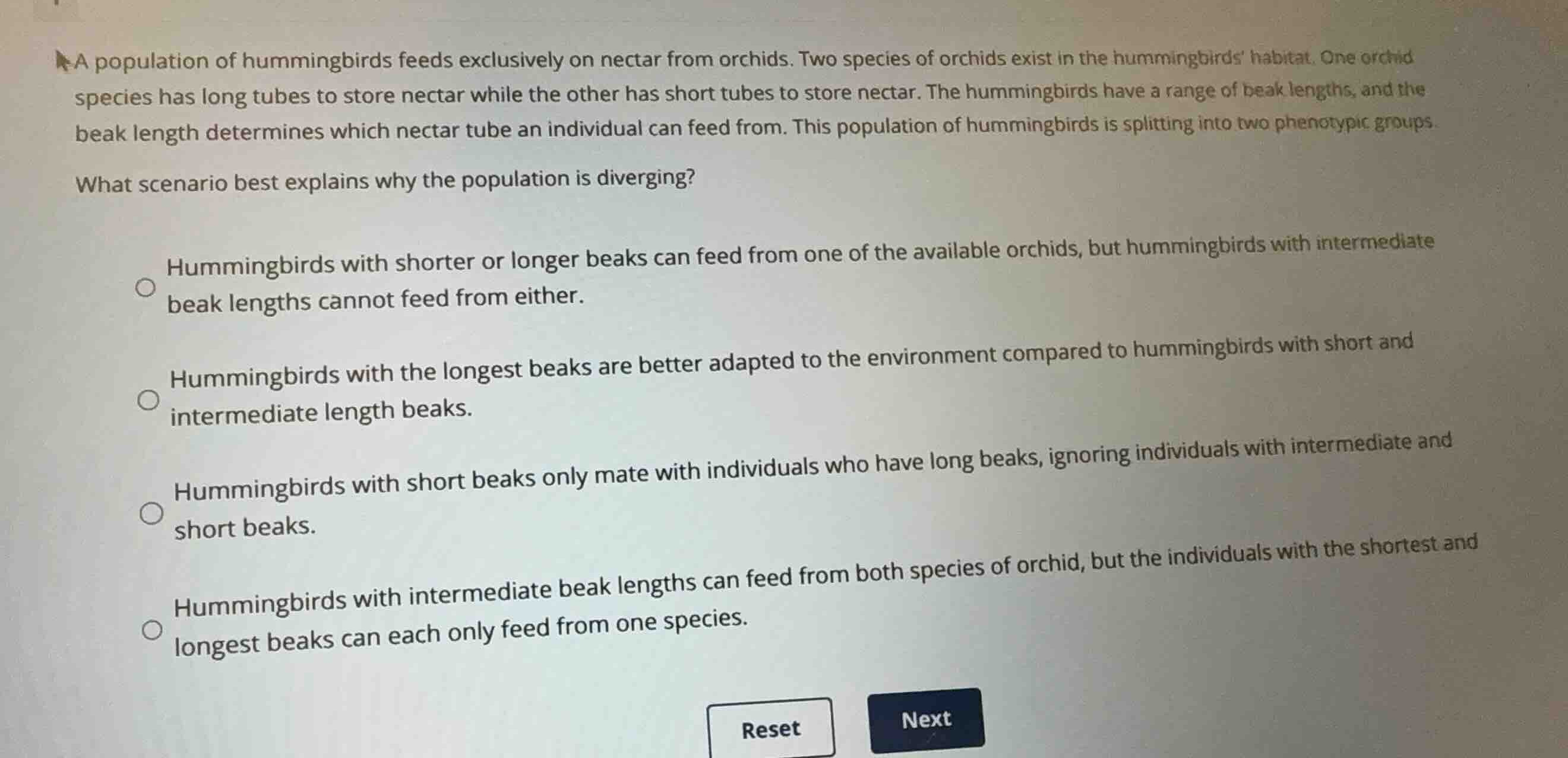
a population of hummingbirds feeds exclusively on nectar from orchids. two species of orchids exist in the hummingbirds habitat. one orchid species has long tubes to store nectar while the other has short tubes to store nectar. the hummingbirds have a range of beak lengths, and the beak length determines which nectar tube an individual can feed from. this population of hummingbirds is splitting into two phenotypic groups.
what scenario best explains why the population is diverging?
- hummingbirds with shorter or longer beaks can feed from one of the available orchids, but hummingbirds with intermediate beak lengths cannot feed from either.
- hummingbirds with the longest beaks are better adapted to the environment compared to hummingbirds with short and intermediate length beaks.
- hummingbirds with short beaks only mate with individuals who have long beaks, ignoring individuals with intermediate and short beaks.
- hummingbirds with intermediate beak lengths can feed from both species of orchid, but the individuals with the shortest and longest beaks can each only feed from one species.
Analizar el escenario evolutivo
El problema describe una población de colibríes que se está dividiendo en dos grupos fenotípicos debido a la disponibilidad de dos especies de orquídeas: una con tubos de néctar largos y otra con tubos cortos. Este fenómeno donde los extremos de un rasgo son favorecidos sobre el promedio es un ejemplo clásico de selección disruptiva, un aspecto clave dentro del Concepto de Evolución.
Evaluar las opciones de respuesta
Para que ocurra una divergencia o selección disruptiva que divida la población en dos grupos fenotípicos (picos cortos y picos largos), los individuos con características intermedias deben tener una desventaja selectiva (menor aptitud biológica).
- Opción 1: "Hummingbirds with shorter or longer beaks can feed from one of the available orchids, but hummingbirds with intermediate beak lengths cannot feed from either."
Esta opción explica perfectamente la selección disruptiva: los extremos (cortos y largos) sobreviven al alimentarse de una de las flores, mientras que los intermedios no pueden alimentarse de ninguna, promoviendo la divergencia.
- Opción 2: Favorece solo a los picos más largos, lo que causaría selección direccional, no divergencia en dos grupos.
- Opción 3: Describe un patrón de apareamiento que no es coherente con la división lógica de los dos grupos descritos.
- Opción 4: Si los intermedios pudieran alimentarse de ambas y los extremos solo de una, los intermedios tendrían ventaja, lo que resultaría en selección estabilizadora, evitando la divergencia.

Snap & solve any problem in the app
Get step-by-step solutions on Sovi AI
Photo-based solutions with guided steps
Explore more problems and detailed explanations
- (A) Hummingbirds with shorter or longer beaks can feed from one of the available orchids, but hummingbirds with intermediate beak lengths cannot feed from either. (Correct answer)
- (B) Hummingbirds with the longest beaks are better adapted to the environment compared to hummingbirds with short and intermediate length beaks.
- (C) Hummingbirds with short beaks only mate with individuals who have long beaks, ignoring individuals with intermediate and short beaks.
- (D) Hummingbirds with intermediate beak lengths can feed from both species of orchid, but the individuals with the shortest and longest beaks can each only feed from one species.