QUESTION IMAGE
Question
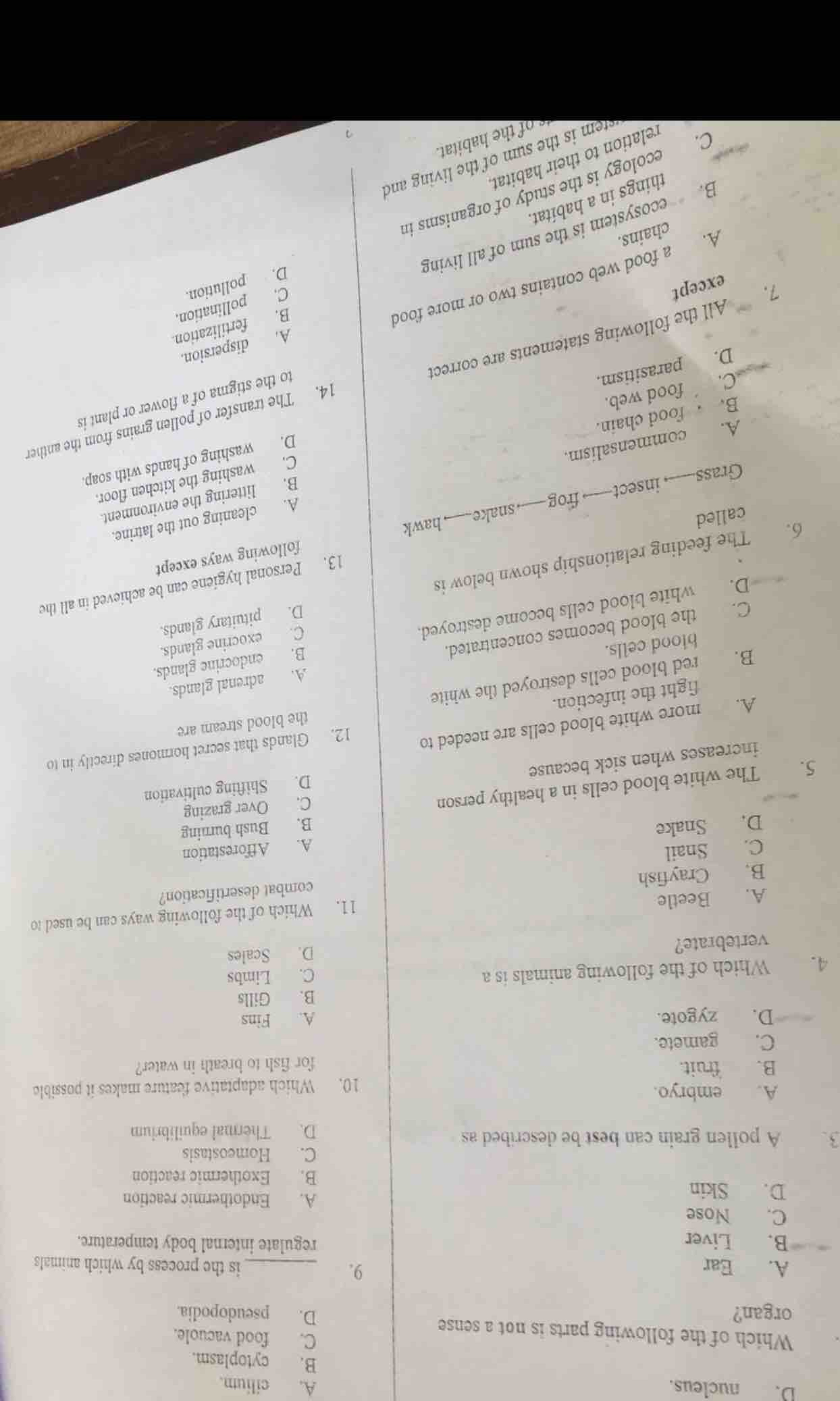
- a pollen grain can best be described as
a. embryo.
b. fruit.
c. gamete.
d. zygote.
- which of the following animals is a vertebrate?
a. beetle
b. crayfish
c. snail
d. snake
- the white blood cells in a healthy person increases when sick because
a. more white blood cells are needed to fight the infection.
b. red blood cells destroyed the white blood cells.
c. the blood becomes concentrated.
d. white blood cells become destroyed.
- the feeding relationship shown below is called
grass -> insect -> frog -> snake -> hawk
a. commensalism.
b. food chain.
c. food web.
d. parasitism.
- all the following statements are correct except
a. a food web contains two or more food chains.
b. ecosystem is the sum of all living things in a habitat.
c. ecology is the study of organisms in relation to their habitat.
d. system is the sum of the living and of the habitat.
- is the process by which animals regulate internal body temperature.
a. endothermic reaction
b. exothermic reaction
c. homeostasis
d. thermal equilibrium
- which adaptative feature makes it possible for fish to breath in water?
a. fins
b. gills
c. limbs
d. scales
- which of the following ways can be used to combat desertification?
a. afforestation
b. bush burning
c. over grazing
d. shifting cultivation
- glands that secret hormones directly in to the blood stream are
a. adrenal glands.
b. endocrine glands.
c. exocrine glands.
d. pituitary glands.
- personal hygiene can be achieved in all the following ways except
a. cleaning out the latrine.
b. littering the environment.
c. washing the kitchen floor.
d. washing of hands with soap.
- the transfer of pollen grains from the anther to the stigma of a flower or plant is
a. dispersion.
b. fertilization.
c. pollination.
d. pollution.
Analyze sensory organs and plant reproduction
- Question 2 asks which part is not a sense organ. The options are Ear, Liver, Nose, Skin. The liver is an internal organ, not a sensory organ.
- Question 3 asks what a pollen grain can best be described as. A pollen grain contains the male gametophyte, which produces male gametes. Thus, it is best described as a gamete.
- Question 4 asks which animal is a vertebrate. The options are Beetle, Crayfish, Snail, Snake. A snake is a reptile, which is a vertebrate.
Analyze immune response, food chains, and ecosystems
- Question 5 asks why white blood cells increase when sick. White blood cells are part of the immune system and increase to fight infections.
- Question 6 shows a feeding relationship: Grass -> insect -> frog -> snake -> hawk. This linear sequence of organisms feeding on each other is a food chain.
- Question 7 asks which statement is incorrect. Option C states "ecology is the study of organisms in relation to their habitat", which is correct. Option B states "ecosystem is the sum of all living things in a habitat", which is incorrect because an ecosystem includes both living (biotic) and non-living (abiotic) components.
Analyze homeostasis, adaptation, and environmental science
- Question 9 asks for the process of regulating internal body temperature, which is homeostasis.
- Question 10 asks which adaptive feature allows fish to breathe in water, which is gills.
- Question 11 asks which method combats desertification, which is afforestation (planting trees).
Analyze endocrine system, hygiene, and pollination
- Question 12 asks which glands secrete hormones directly into the bloodstream, which are endocrine glands.
- Question 13 asks how personal hygiene is achieved except, which is littering the environment (this is environmental hygiene, not personal).
- Question 14 defines the transfer of pollen grains from the anther to the stigma as pollination.

Snap & solve any problem in the app
Get step-by-step solutions on Sovi AI
Photo-based solutions with guided steps
Explore more problems and detailed explanations
Question 2
- (A) Ear
- (B) Liver (Correct answer)
- (C) Nose
- (D) Skin
Question 3
- (A) embryo.
- (B) fruit.
- (C) gamete. (Correct answer)
- (D) zygote.
Question 4
- (A) Beetle
- (B) Crayfish
- (C) Snail
- (D) Snake (Correct answer)
Question 5
- (A) more white blood cells are needed to fight the infection. (Correct answer)
- (B) red blood cells destroyed the white blood cells.
- (C) the blood becomes concentrated.
- (D) white blood cells become destroyed.
Question 6
- (A) commensalism.
- (B) food chain. (Correct answer)
- (C) food web.
- (D) parasitism.
Question 7
- (A) a food web contains two or more food chains.
- (B) ecosystem is the sum of all living things in a habitat. (Correct answer)
- (C) ecology is the study of organisms in relation to their habitat.
- (D) ... of the habitat.
Question 9
- (A) Endothermic reaction
- (B) Exothermic reaction
- (C) Homeostasis (Correct answer)
- (D) Thermal equilibrium
Question 10
- (A) Fins
- (B) Gills (Correct answer)
- (C) Limbs
- (D) Scales
Question 11
- (A) Afforestation (Correct answer)
- (B) Bush burning
- (C) Over grazing
- (D) Shifting cultivation
Question 12
- (A) adrenal glands.
- (B) endocrine glands. (Correct answer)
- (C) exocrine glands.
- (D) pituitary glands.
Question 13
- (A) cleaning out the latrine.
- (B) littering the environment. (Correct answer)
- (C) washing the kitchen floor.
- (D) washing of hands with soap.
Question 14
- (A) dispersion.
- (B) fertilization.
- (C) pollination. (Correct answer)
- (D) pollution.