QUESTION IMAGE
Question
part d
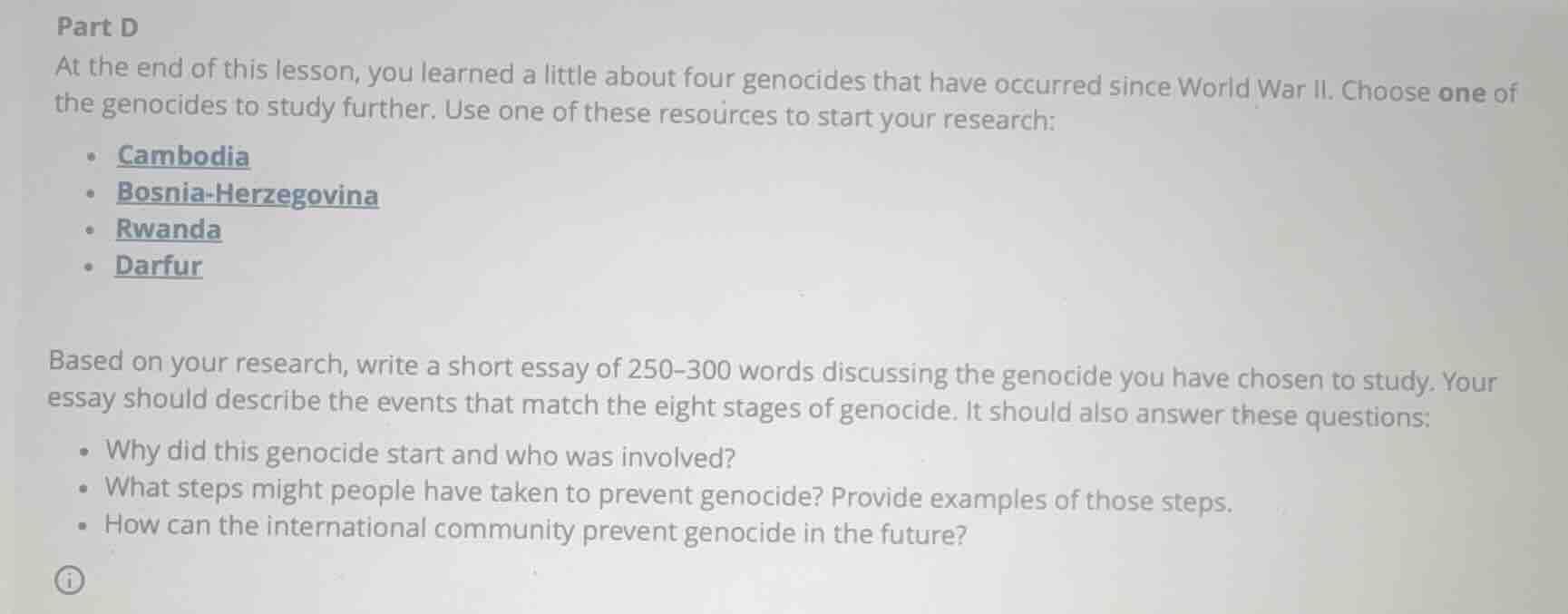
at the end of this lesson, you learned a little about four genocides that have occurred since world war ii. choose one of the genocides to study further. use one of these resources to start your research:
- cambodia
- bosnia-herzegovina
- rwanda
- darfur
based on your research, write a short essay of 250-300 words discussing the genocide you have chosen to study. your essay should describe the events that match the eight stages of genocide. it should also answer these questions:
- why did this genocide start and who was involved?
- what steps might people have taken to prevent genocide? provide examples of those steps.
- how can the international community prevent genocide in the future?
Select a genocide and establish historical context
Using the Reflective Writing knowledge point, we will focus on the Rwandan Genocide of 1994. This tragedy involved the systematic mass slaughter of the Tutsi minority by the Hutu-led government. It began following the assassination of Rwandan President Juvénal Habyarimana, a Hutu, which ignited long-standing ethnic tensions cultivated during Belgian colonial rule.
Map the events to the stages of genocide
Using the Self-Evaluation knowledge point, we analyze how the events align with Gregory Stanton's stages of genocide:
- Classification & Symbolization: Distinguishing Hutus and Tutsis on identity cards.
- Dehumanization: Hutu extremist media referring to Tutsis as "cockroaches" (inyenzi).
- Organization & Polarization: Training of the Interahamwe militia and silencing moderate Hutus.
- Preparation & Persecution: Stockpiling machetes and drawing up death lists.
- Extermination & Denial: The rapid slaughter of approximately 800,000 people, followed by perpetrators fleeing and blaming the victims or civil war.
Formulate prevention and international community actions
To address the prompt's questions on prevention:
- Individual/Local Prevention: Early warning reporting, promoting inter-ethnic dialogue, and protecting targeted neighbors.
- International Community Actions: Rapid military intervention by the UN, enforcing international law, and jamming hate-speech broadcasts.
Draft the final essay within the word limit
We will synthesize these points into a cohesive, structured essay of approximately 250–300 words that directly answers all prompt requirements.

Snap & solve any problem in the app
Get step-by-step solutions on Sovi AI
Photo-based solutions with guided steps
Explore more problems and detailed explanations
The 1994 Rwandan Genocide was a devastating conflict in which the Hutu-led government and extremist militias systematically slaughtered approximately 800,000 Tutsis and moderate Hutus in just 100 days. The violence erupted after the plane of Hutu President Juvénal Habyarimana was shot down, triggering deep-seated ethnic divisions originally exacerbated by Belgian colonial policies.
The tragedy closely followed the recognized stages of genocide. Classification and Symbolization were established early through ethnic identity cards. Dehumanization intensified as extremist radio stations branded Tutsis as "cockroaches." Organization and Polarization occurred as the military trained the Interahamwe militia and silenced moderate political voices. During the Preparation and Persecution stages, death lists were compiled and machetes distributed. This culminated in rapid Extermination, followed by systemic Denial as leaders fled and framed the massacres as a bilateral civil war.
To prevent such atrocities, local actors and citizens could have taken early steps. These include establishing underground networks to hide targeted individuals, documenting human rights abuses to alert external observers, and actively boycotting hate media.
In the future, the international community must act decisively to prevent genocide. First, the United Nations must establish robust, rapid-response peacekeeping forces with mandates that explicitly authorize the protection of civilians. Second, international bodies should jam hate-speech broadcasts and sanction regimes showing early warning signs of mass violence. Finally, holding perpetrators accountable through tribunals like the International Criminal Court reinforces global legal norms, ensuring that justice acts as a powerful deterrent against future atrocities.