QUESTION IMAGE
Question
part b
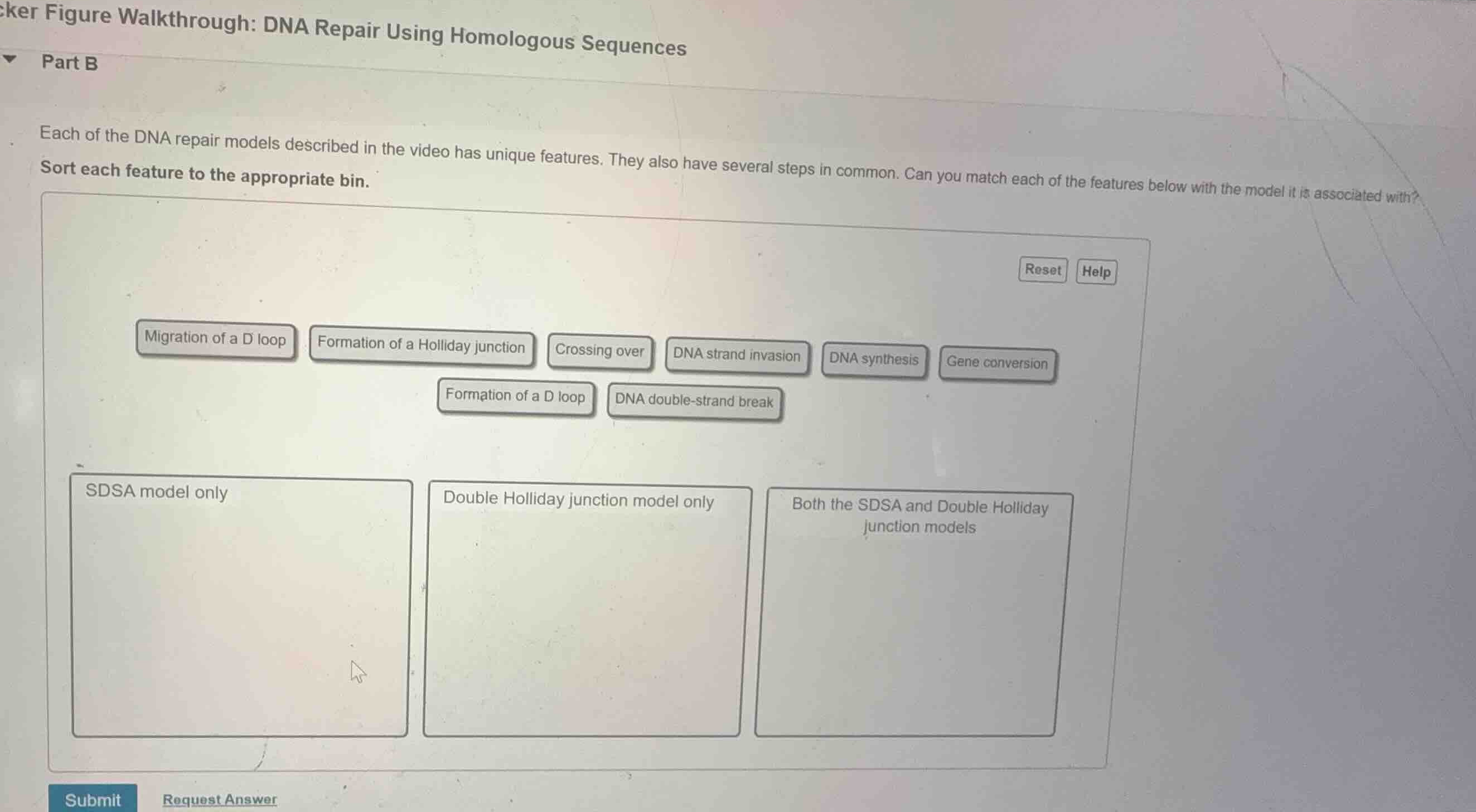
each of the dna repair models described in the video has unique features. they also have several steps in common. can you match each of the features below with the model it is associated with?
sort each feature to the appropriate bin.
features to sort:
- migration of a d loop
- formation of a holliday junction
- crossing over
- dna strand invasion
- dna synthesis
- gene conversion
- formation of a d loop
- dna double-strand break
bins:
- sdsa model only
- double holliday junction model only
- both the sdsa and double holliday junction models
Compare SDSA and Double Holliday Junction initiation
Using the D-loop Formation knowledge point, both Synthesis-Dependent Strand Annealing (SDSA) and the Double Holliday Junction (dHJ) pathway are mechanisms of homologous recombination used to repair double-strand breaks (DSBs). Both pathways initiate with a DNA double-strand break, followed by 5'-to-3' resection to generate 3' single-stranded overhangs. These overhangs perform DNA strand invasion into a homologous template, resulting in the Formation of a D loop and subsequent DNA synthesis to extend the invading strand.
Distinguish SDSA-specific features
In the SDSA pathway, after DNA synthesis occurs within the bubble, the newly synthesized strand is displaced from the template strand. The D-loop does not mature into stable Holliday junctions; instead, it migrates as synthesis proceeds. Therefore, the Migration of a D loop is a characteristic feature of SDSA. The displaced strand then anneals back to the other resected end of the broken chromosome, preventing any crossing over.
Distinguish Double Holliday Junction-specific features
In the dHJ pathway, the displaced strand of the D-loop anneals to the other end of the double-strand break, and second-strand capture occurs. This leads to the Formation of a Holliday junction (specifically, two of them). The resolution of these double Holliday junctions can occur in different planes, which can result in Crossing over (reciprocal recombination between homologous chromosomes).
Classify shared outcomes
Using the Gene Conversion knowledge point, both pathways involve localized DNA synthesis using a homologous template. If the template sequence differs slightly from the damaged sequence, this localized synthesis and subsequent mismatch repair can result in Gene conversion (the non-reciprocal transfer of genetic information) in both models.
Summarize bin assignments
- SDSA model only: Migration of a D loop
- Double Holliday junction model only: Formation of a Holliday junction, Crossing over
- Both the SDSA and Double Holliday junction models: DNA double-strand break, DNA strand invasion, Formation of a D loop, DNA synthesis, Gene conversion

Snap & solve any problem in the app
Get step-by-step solutions on Sovi AI
Photo-based solutions with guided steps
Explore more problems and detailed explanations
- SDSA model only:
- Migration of a D loop
- Double Holliday junction model only:
- Formation of a Holliday junction
- Crossing over
- Both the SDSA and Double Holliday junction models:
- DNA double-strand break
- DNA strand invasion
- Formation of a D loop
- DNA synthesis
- Gene conversion