Sovi.AI - AI Math Tutor

Scan to solve math questions

QUESTION IMAGE

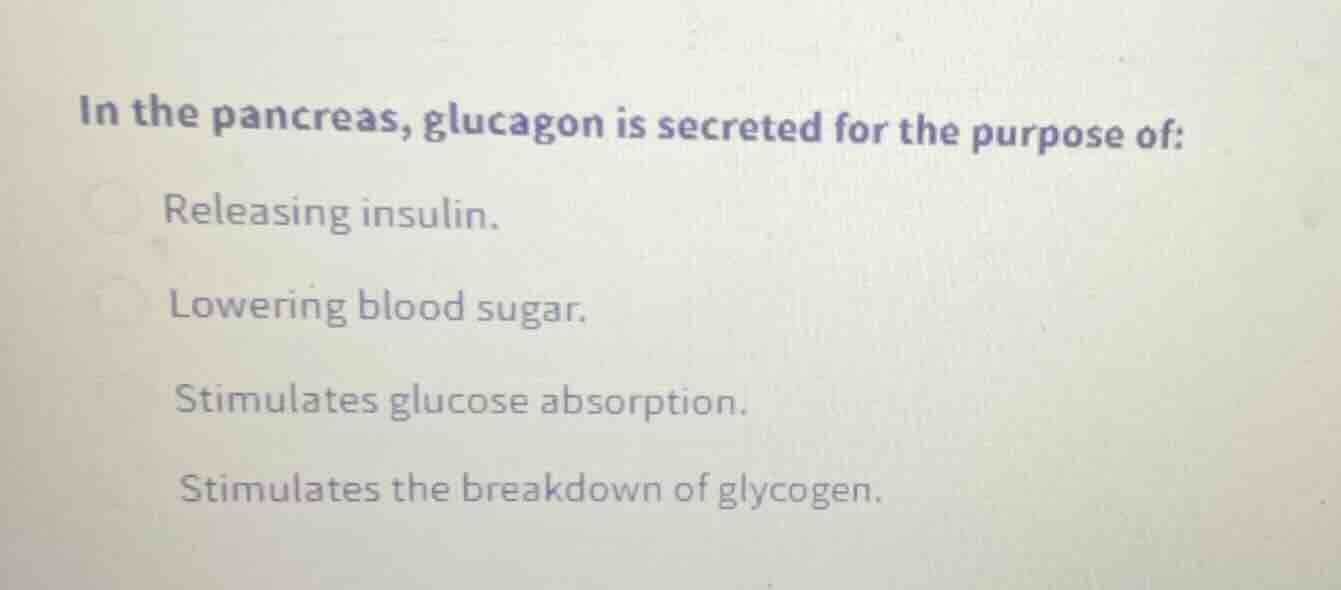
in the pancreas, glucagon is secreted for the purpose of: releasing ins…

Question

in the pancreas, glucagon is secreted for the purpose of:

releasing insulin.

lowering blood sugar.

stimulates glucose absorption.

stimulates the breakdown of glycogen.

Explanation:

Response

<pre_analysis>
{
"quality": "clear",
"question_count": 1,
"skills_matched": [
"direct_cot",
"multiple_choice_formatter",
"explain_then_answer",
"tutor",
"mastery_adaptive_brevity"
],
"needs_drawing": false,
"concepts_used": [
"Glucagon Secretion",
"Glucose Homeostasis"
],
"new_concepts": [],
"current_concepts": [
"Glucagon Secretion",
"Glucose Homeostasis",
"Glycogenolysis"
]
}
</pre_analysis>

<reasoning>

Identify the physiological role of glucagon

Using the Glucagon Secretion and Glucose Homeostasis knowledge points

  • Glucagon is a peptide hormone secreted by the alpha cells of the pancreatic islets.
  • Its primary physiological role is to increase blood glucose levels when they fall too low (hypoglycemia).
  • It achieves this by stimulating glycogenolysis (the breakdown of stored glycogen into glucose) and gluconeogenesis in the liver.

Evaluate the given options

  • Releasing insulin: Insulin is secreted by beta cells in response to high blood glucose, acting antagonistically to glucagon.
  • Lowering blood sugar: This is the function of insulin, not glucagon.
  • Stimulates glucose absorption: Insulin promotes glucose uptake into tissues; glucagon promotes glucose release into the blood.
  • Stimulates the breakdown of glycogen: This matches glycogenolysis, the direct mechanism by which glucagon raises blood glucose.

</reasoning>

<answer>
<mcq-option>Releasing insulin.</mcq-option>
<mcq-option>Lowering blood sugar.</mcq-option>
<mcq-option>Stimulates glucose absorption.</mcq-option>
<mcq-correct>Stimulates the breakdown of glycogen.</mcq-correct>
</answer>

<post_analysis>
{
"subject": "Natural Science",
"question_type": "Multiple Choice",
"knowledge_point": [
"Natural Science",
"Biology",
"Endocrine System"
]
}
</post_analysis>

Answer:

<pre_analysis>
{
"quality": "clear",
"question_count": 1,
"skills_matched": [
"direct_cot",
"multiple_choice_formatter",
"explain_then_answer",
"tutor",
"mastery_adaptive_brevity"
],
"needs_drawing": false,
"concepts_used": [
"Glucagon Secretion",
"Glucose Homeostasis"
],
"new_concepts": [],
"current_concepts": [
"Glucagon Secretion",
"Glucose Homeostasis",
"Glycogenolysis"
]
}
</pre_analysis>

<reasoning>

Identify the physiological role of glucagon

Using the Glucagon Secretion and Glucose Homeostasis knowledge points

  • Glucagon is a peptide hormone secreted by the alpha cells of the pancreatic islets.
  • Its primary physiological role is to increase blood glucose levels when they fall too low (hypoglycemia).
  • It achieves this by stimulating glycogenolysis (the breakdown of stored glycogen into glucose) and gluconeogenesis in the liver.

Evaluate the given options

  • Releasing insulin: Insulin is secreted by beta cells in response to high blood glucose, acting antagonistically to glucagon.
  • Lowering blood sugar: This is the function of insulin, not glucagon.
  • Stimulates glucose absorption: Insulin promotes glucose uptake into tissues; glucagon promotes glucose release into the blood.
  • Stimulates the breakdown of glycogen: This matches glycogenolysis, the direct mechanism by which glucagon raises blood glucose.

</reasoning>

<answer>
<mcq-option>Releasing insulin.</mcq-option>
<mcq-option>Lowering blood sugar.</mcq-option>
<mcq-option>Stimulates glucose absorption.</mcq-option>
<mcq-correct>Stimulates the breakdown of glycogen.</mcq-correct>
</answer>

<post_analysis>
{
"subject": "Natural Science",
"question_type": "Multiple Choice",
"knowledge_point": [
"Natural Science",
"Biology",
"Endocrine System"
]
}
</post_analysis>