QUESTION IMAGE
Question
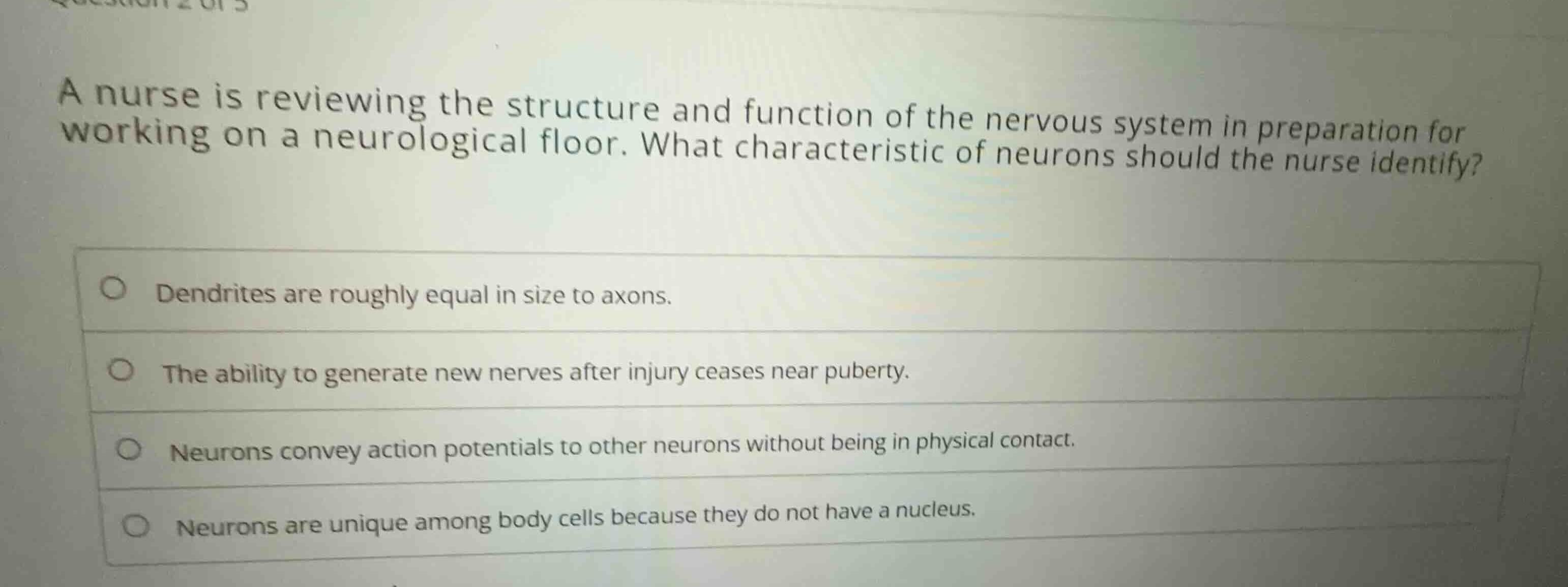
a nurse is reviewing the structure and function of the nervous system in preparation for working on a neurological floor. what characteristic of neurons should the nurse identify?
dendrites are roughly equal in size to axons.
the ability to generate new nerves after injury ceases near puberty.
neurons convey action potentials to other neurons without being in physical contact.
neurons are unique among body cells because they do not have a nucleus.
<pre_analysis>
{
"quality": "clear",
"question_count": 1,
"skills_matched": [
"direct_cot",
"multiple_choice_formatter",
"explain_then_answer",
"tutor"
],
"needs_drawing": false,
"concepts_used": [
"Neuron Function",
"Nervous System Structure"
],
"new_concepts": [],
"current_concepts": [
"Neuron Function",
"Nervous System Structure"
]
}
</pre_analysis>
<reasoning>
Analyze neuron structure and size
Neurons typically have multiple short, branching dendrites that receive signals and a single, much longer axon that transmits signals. Thus, dendrites and axons are not roughly equal in size.
Evaluate regeneration capabilities
The nervous system has limited regenerative capacity, but the ability to repair or sprout new connections does not abruptly cease near puberty. Some neurogenesis and synaptic plasticity continue throughout adulthood.
Examine synaptic transmission
Neurons communicate with each other across a small gap called the synaptic cleft. They convey signals (via action potentials triggering neurotransmitter release) to other neurons without being in direct physical contact. This aligns with Neuron Function and Nervous System Structure.
Assess cellular components
Neurons are eukaryotic cells and contain a nucleus within their cell body (soma). They are not unique for lacking a nucleus; mature red blood cells are an example of human cells that lack a nucleus.
</reasoning>
<answer>
<mcq-option>Dendrites are roughly equal in size to axons.</mcq-option>
<mcq-option>The ability to generate new nerves after injury ceases near puberty.</mcq-option>
<mcq-correct>Neurons convey action potentials to other neurons without being in physical contact.</mcq-correct>
<mcq-option>Neurons are unique among body cells because they do not have a nucleus.</mcq-option>
</answer>
<post_analysis>
{
"subject": "Natural Science",
"question_type": "Multiple Choice",
"knowledge_point": [
"Natural Science",
"Biology",
"Neurobiology"
]
}
</post_analysis>
Snap & solve any problem in the app
Get step-by-step solutions on Sovi AI
Photo-based solutions with guided steps
Explore more problems and detailed explanations
<pre_analysis>
{
"quality": "clear",
"question_count": 1,
"skills_matched": [
"direct_cot",
"multiple_choice_formatter",
"explain_then_answer",
"tutor"
],
"needs_drawing": false,
"concepts_used": [
"Neuron Function",
"Nervous System Structure"
],
"new_concepts": [],
"current_concepts": [
"Neuron Function",
"Nervous System Structure"
]
}
</pre_analysis>
<reasoning>
Analyze neuron structure and size
Neurons typically have multiple short, branching dendrites that receive signals and a single, much longer axon that transmits signals. Thus, dendrites and axons are not roughly equal in size.
Evaluate regeneration capabilities
The nervous system has limited regenerative capacity, but the ability to repair or sprout new connections does not abruptly cease near puberty. Some neurogenesis and synaptic plasticity continue throughout adulthood.
Examine synaptic transmission
Neurons communicate with each other across a small gap called the synaptic cleft. They convey signals (via action potentials triggering neurotransmitter release) to other neurons without being in direct physical contact. This aligns with Neuron Function and Nervous System Structure.
Assess cellular components
Neurons are eukaryotic cells and contain a nucleus within their cell body (soma). They are not unique for lacking a nucleus; mature red blood cells are an example of human cells that lack a nucleus.
</reasoning>
<answer>
<mcq-option>Dendrites are roughly equal in size to axons.</mcq-option>
<mcq-option>The ability to generate new nerves after injury ceases near puberty.</mcq-option>
<mcq-correct>Neurons convey action potentials to other neurons without being in physical contact.</mcq-correct>
<mcq-option>Neurons are unique among body cells because they do not have a nucleus.</mcq-option>
</answer>
<post_analysis>
{
"subject": "Natural Science",
"question_type": "Multiple Choice",
"knowledge_point": [
"Natural Science",
"Biology",
"Neurobiology"
]
}
</post_analysis>