Sovi.AI - AI Math Tutor

Scan to solve math questions

QUESTION IMAGE

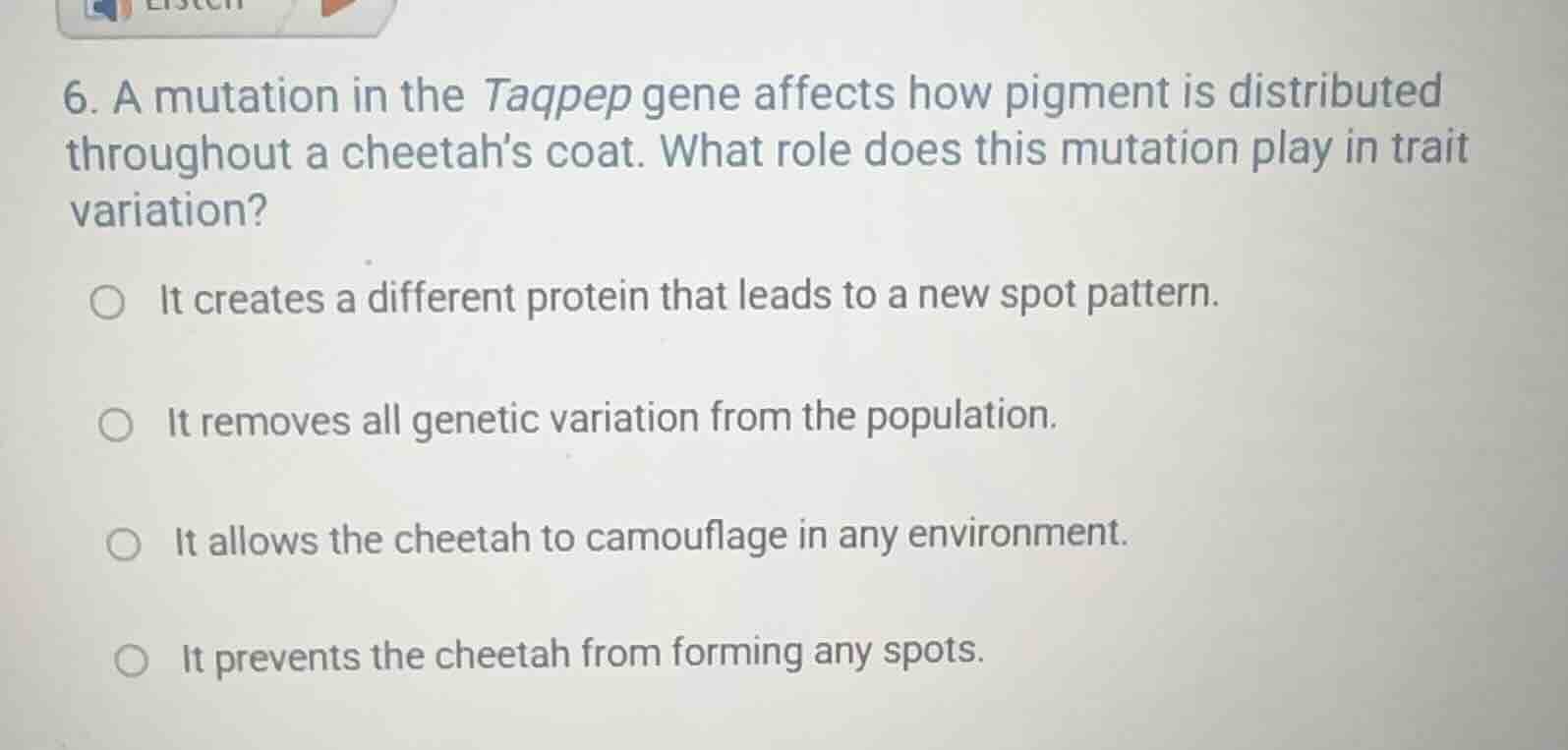
6. a mutation in the taqpep gene affects how pigment is distributed thr…

Question

  1. a mutation in the taqpep gene affects how pigment is distributed throughout a cheetahs coat. what role does this mutation play in trait variation?

it creates a different protein that leads to a new spot pattern.
it removes all genetic variation from the population.
it allows the cheetah to camouflage in any environment.
it prevents the cheetah from forming any spots.

Explanation:

Response

<pre_analysis>
{
"quality": "clear",
"question_count": 1,
"skills_matched": [
"direct_cot",
"multiple_choice_formatter",
"explain_then_answer",
"quick"
],
"needs_drawing": false,
"concepts_used": [
"Genetic Mutations",
"Mutation Effects",
"Genetic Variation"
],
"new_concepts": [],
"current_concepts": [
"Genetic Mutations",
"Mutation Effects",
"Genetic Variation"
]
}
</pre_analysis>

<reasoning>

Analyze the effect of gene mutations on proteins

A mutation in a gene alters its DNA sequence, which can lead to the production of a modified protein with a different structure or function.

Connect protein changes to phenotypic traits

The altered protein affects cellular processes, in this case, how pigment is distributed, resulting in a visible variation in the cheetah's coat pattern (phenotype).

Evaluate the given multiple-choice options

  • Option 1 correctly describes this biological pathway: a mutation creates a different protein, leading to a new spot pattern.
  • Option 2 is incorrect because mutations introduce, rather than remove, genetic variation.
  • Option 3 is incorrect as a single coat pattern mutation does not grant universal camouflage.
  • Option 4 is incorrect because the mutation alters pigment distribution (such as blotches instead of spots) rather than preventing all spot formation.

</reasoning>

<answer>
<mcq-correct>It creates a different protein that leads to a new spot pattern.</mcq-correct>
<mcq-option>It removes all genetic variation from the population.</mcq-option>
<mcq-option>It allows the cheetah to camouflage in any environment.</mcq-option>
<mcq-option>It prevents the cheetah from forming any spots.</mcq-option>
</answer>

<post_analysis>
{
"subject": "Natural Science",
"question_type": "Multiple Choice",
"knowledge_point": [
"Natural Science",
"Biology",
"Genetic Mutations"
]
}
</post_analysis>

Answer:

<pre_analysis>
{
"quality": "clear",
"question_count": 1,
"skills_matched": [
"direct_cot",
"multiple_choice_formatter",
"explain_then_answer",
"quick"
],
"needs_drawing": false,
"concepts_used": [
"Genetic Mutations",
"Mutation Effects",
"Genetic Variation"
],
"new_concepts": [],
"current_concepts": [
"Genetic Mutations",
"Mutation Effects",
"Genetic Variation"
]
}
</pre_analysis>

<reasoning>

Analyze the effect of gene mutations on proteins

A mutation in a gene alters its DNA sequence, which can lead to the production of a modified protein with a different structure or function.

Connect protein changes to phenotypic traits

The altered protein affects cellular processes, in this case, how pigment is distributed, resulting in a visible variation in the cheetah's coat pattern (phenotype).

Evaluate the given multiple-choice options

  • Option 1 correctly describes this biological pathway: a mutation creates a different protein, leading to a new spot pattern.
  • Option 2 is incorrect because mutations introduce, rather than remove, genetic variation.
  • Option 3 is incorrect as a single coat pattern mutation does not grant universal camouflage.
  • Option 4 is incorrect because the mutation alters pigment distribution (such as blotches instead of spots) rather than preventing all spot formation.

</reasoning>

<answer>
<mcq-correct>It creates a different protein that leads to a new spot pattern.</mcq-correct>
<mcq-option>It removes all genetic variation from the population.</mcq-option>
<mcq-option>It allows the cheetah to camouflage in any environment.</mcq-option>
<mcq-option>It prevents the cheetah from forming any spots.</mcq-option>
</answer>

<post_analysis>
{
"subject": "Natural Science",
"question_type": "Multiple Choice",
"knowledge_point": [
"Natural Science",
"Biology",
"Genetic Mutations"
]
}
</post_analysis>